The yinglaoye timetable: the first-month procession days, village by village
In Chaoshan the yinglaoye falls in the first and second months, and the days are roughly fixed. Here they are split into four village tables by city — Chaozhou, Shantou, Jieyang and Puning — 645 entries in all, the lunar days copied from the sources and the Gregorian converted for 2026 only.
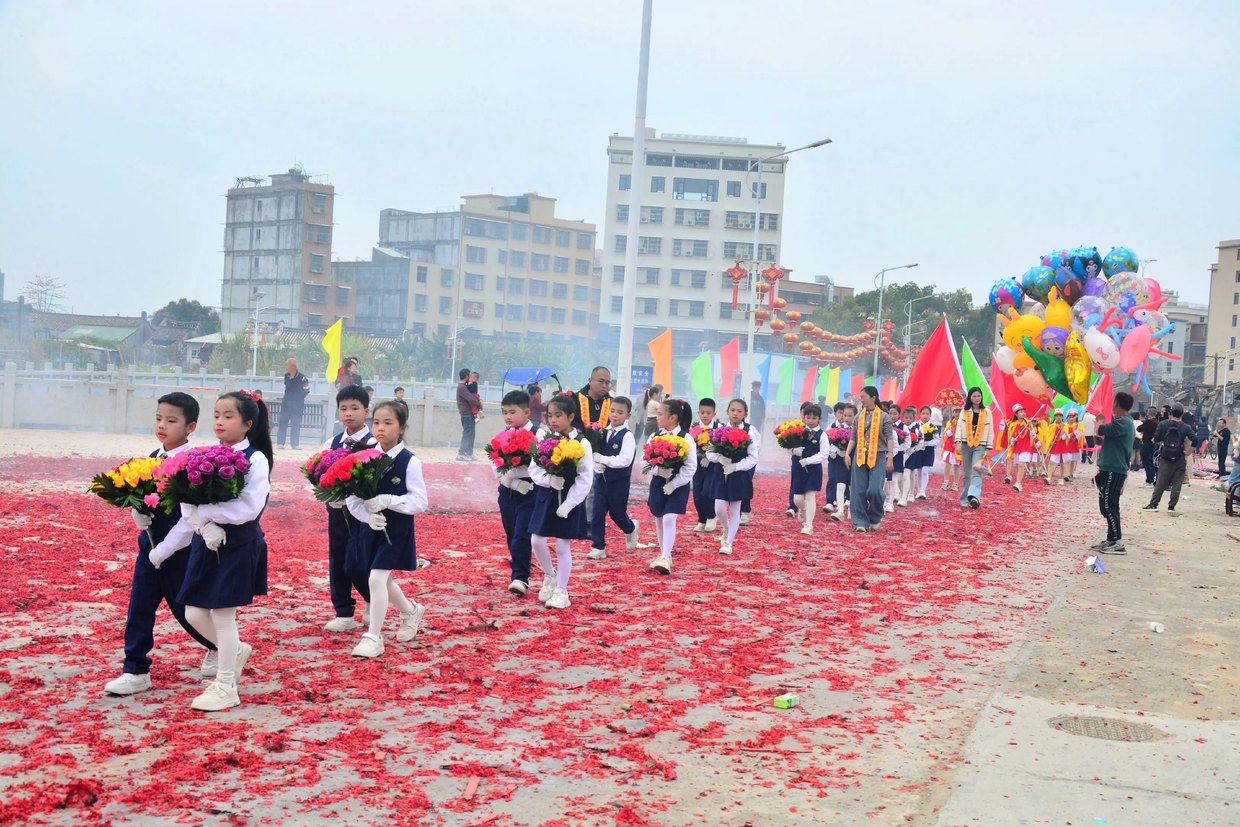
1. Why four tables
The yinglaoye gathers in the first and second months, with days mostly fixed, which is what makes a table possible. But the three cities arrange it differently, and forcing it into one table makes it unreadable.
Chaozhou calls it laoze, and a dozen villages keep it on the same day, so to read the table you first look at which day of the month it is. Chenghai in Shantou works the same way — on the seventeenth of the first month, the five villages of Yinsha in Xinan, Qianmei in Longdu, Xucuo in Lianxia and Guanshan in Chenghua all fall together; but Chaoyang, Chaonan and Haojiang are one village a day. Jieyang is one village a day, and the fifth to the tenth of the first month are absurdly dense, dozens of villages a day. Puning is the densest of all: across twenty-five towns and subdistricts there is scarcely an empty day in the first month, and on the fifteenth Liusha subdistrict alone has a dozen villages.
So the tables are split by city, each in the arrangement that suits it: Chaozhou by day, Shantou and Jieyang by town, and Puning merging villages of the same town and day into one cell.
2. The four tables
645 entries between them, all at village or temple level. Click a city to go into its table.
| City | What it covers | Entries | Character |
|---|---|---|---|
| Chaozhou | Xiangqiao, Chao’an, Raoping | 198 places | by day. Called laoze here; a dozen villages keep it at once |
| Shantou | Chenghai, Chaoyang, Chaonan, Haojiang, Jinping, Longhu, Nan’ao | 103 places | Chenghai is the thickest; plenty of villages keep it twice |
| Jieyang | Rongcheng, Jiedong, Jiexi, Huilai | 157 places | one village a day; densest from the fifth to the tenth |
| Puning | twenty-five towns and subdistricts | 187 places | same town and day merged into one cell. The most fire piles |
3. The skeleton of the first month
For when you would rather not leaf through the tables: this picks the one or two places each day most worth the trip. The days and the Gregorian are 2026 (bingwu).
| Day | 2026 Gregorian | That day |
|---|---|---|
| 1st of the 1st month | 17 February 2026, Tuesday | Guanyi in Dongli, Chenghai (Zhanglin old port), Guandai in Longhu, Houzhai on Nan’ao; Huicheng and Donglong in Huilai; the dragon dance opens at Qiaolin township, Pandong, Jiedong |
| 2nd of the 1st month | 18 February 2026, Wednesday | the fire-pile jump at Liandong, Linpan, Jiedong; the yingge parade at Minghua stadium, Puning |
| 4th of the 1st month | 20 February 2026, Friday | the Shuangzhong tour round the Wenguang pagoda in Chaoyang, seven in the morning to seven at night, dozens of yingge teams |
| 5th of the 1st month | 21 February 2026, Saturday | Yangmei in Jiedong sets out, with the small session at Qiaonan; Fenggang in Rongcheng; a dozen villages of Nanxi in Puning on the same day |
| 6th of the 1st month | 22 February 2026, Sunday | the Yangmei torch festival in Jiedong (at night); Fenggang, Haimen and Dakeng in Gurao, Chaoyang; the firecracker bombardment of the god at Jiantianwei, Pingshang, Jiexi Yangmei torch festival |
| 7th of the 1st month | 23 February 2026, Monday | the fire-pile jump at Xinlin, Dongyang, Rongcheng; Dongyan in Chaonan; the densest day at Nanxi in Puning |
| 8th of the 1st month | 24 February 2026, Tuesday | the great pig contest at Yuepu, Jinping; the Chen ancestral hall at Guiyu and Yuyi in Guanbu, Chaoyang the Yuepu pig contest |
| 10th of the 1st month | 26 February 2026, Thursday | the Qiaonan firework dragon in Jiedong (the great session); the Jie Gong tour at Hongyang, Puning the Qiaolin firework dragon |
| 11th of the 1st month | 27 February 2026, Friday | Qining in Rongcheng sets out and crosses the coloured bridge; the god carried at the Gurao bus station, Chaoyang |
| 13th of the 1st month | 1 March 2026, Sunday | Zhaocuoliao in Liusha and the fire-pile jump at Silingtou, Liaoyuan, Puning |
| 14th of the 1st month | 2 March 2026, Monday | the lantern congratulations open at Dachanglong, Junbu, Puning the Dachanglong lantern congratulations |
| 15th of the 1st month | 3 March 2026, Tuesday | Liusha, Xiajiashan and Daba in Puning all along the line; Dachanglong in Junbu carries on until dawn; the soaked Earth god at Shalitan, Jiexi |
| 16th of the 1st month | 4 March 2026, Wednesday | pigs and sheep set out at Shuolian, Jiedong; the fire-mound jump at Xidong, Zhanlong, Puning; the sugarcane lanes at Xikou, Linxi, Chaozhou the Xidong fire-mound jump |
| 17th of the 1st month | 5 March 2026, Thursday | the great pig contest at Guanshan, Chenghai; the yinglaoye at Hepu, Haojiang; Linquan in Fuyang and Fengyang second village in Guxiang, Chaozhou the Guanshan pig contest |
| 18th of the 1st month | 6 March 2026, Friday | the great session at Houzhai on Nan’ao, all thirteen townships of the island; Fuzhao in Quxi, Jiedong |
| 19th of the 1st month | 7 March 2026, Saturday | the lantern procession at Nansha, Xinan, Chenghai the Nansha lantern procession |
| 20th of the 1st month | 8 March 2026, Sunday | the lantern procession and fire-pile jump at Qining, Rongcheng |
| 21st of the 1st month | 9 March 2026, Monday | Yanzao in Chenghai starts dragging the god: Gangtou and Shangcuo on the twenty-first, Zhongshe and Shangshe over the twenty-first and twenty-second dragging the god at Yanzao |
| 22nd of the 1st month | 10 March 2026, Tuesday | the DJ yinglaoye at Zhongxia, Yunlu, Jiedong; a stretch of Jinshi town, Chaozhou |
| 23rd of the 1st month | 11 March 2026, Wednesday | the City God goes out at the Jieyang City God temple the Jieyang City God temple fair |
| 24th of the 1st month | 12 March 2026, Thursday | the Chaozhou Azure Dragon temple fair, the Anji holy king on tour the Chaozhou Azure Dragon temple fair |
| 25th of the 1st month | 13 March 2026, Friday | fruit frames set out at Shipai, Paotai, Jiedong |
| 29th of the 1st month | 17 March 2026, Tuesday | Beilian, Hemei and Xinxing street at Zhanglin, Dongli, Chenghai |
| 1st of the 2nd month | 19 March 2026, Thursday | the incense boat at Longcheng, Lianhua, Chenghai, on the first and second |
| 2nd of the 2nd month | 20 March 2026, Friday | the three Liu villages of Jiangdong, Chaozhou (Jingmei, Longkou, Pengdong); Yuanqian in Caitang, Chaozhou |
| 10th of the 2nd month | 28 March 2026, Saturday | the Shuangzhong festival at Chaoyang the Chaoyang Shuangzhong festival |
| 13th of the 2nd month | 31 March 2026, Tuesday | the birthday of the Guangli holy king at Shenquan, Huilai |
| 16th of the 2nd month | 3 April 2026, Friday | the procession at Ximen, Chenghai; Yujing and Shenpan in Fengtang, Chaozhou |
| 23rd of the 3rd month | 9 May 2026, Saturday | Mazu’s birthday at the Tianhou temples of Shenquan and Jinghai, Huilai; Huxin in Shanghua, Chenghai |
4. How to read the dates
Every line in the tables carries its source, because the sources are of different years.
For the Chaozhou table, the village names and their towns come from an old table of 2014 that traced each village to its town; what is settled by custom changes slowly, and eleven years on the villages are there and the towns are there, while the days may have shifted by a few. For the Shantou table the body is the 2014 table, but the time bands and the sessions added in 2026 come from a timetable issued before the 2026 Spring Festival; where the two collide they are set side by side, without smoothing the sources over. The Jieyang and Puning tables are both 2026, the newest, and also the ones most needing checking on the ground — in the same table the fire-pile jump at Qining is written as the night of the twentieth in one post and the twenty-first in another, a day apart.
One class of days cannot be worked out from a table: the fire rite at Huicheng in Huilai comes once in ten years; the dengshou pig contest at Outing has its day set by throwing the blocks in the village; the yinglaoye at Guangnan, Liaoyuan, is held for one day only and the day has to be divined; the turning of the god at Yaocuowei, Qilin, comes once in two years; the three mountain kings at Guolong, Liaoyuan, are kept only in dragon years; the water lord at Daba once in three years. These are written “not set” in the tables or noted in the remarks, and are worth asking about before setting out.
Another class runs over several days: Qining from the eleventh to the twentieth, the ten wards of Shuolian from the sixth to the fifteenth, Tatou Wu in Jiexi from the ninth to the sixteenth, and the lantern congratulations at Dachanglong in Junbu from the night of the fifteenth until dawn. For these the table gives the start and end; the order in between differs from village to village.
5. What comes next
The year-end round is another matter: see xieshen. For how to watch a procession, where to stand and when to leave, see reading a procession. For stringing the three cities into one route, see routes. For the detail of a single session, see its entry in the Chaoshan procession calendar.
Sources and notes
The sources of the four tables are listed at the end of each page; the common part is here. The village names and their towns come mainly from the “Overview of the festival days of every place in Chaoshan” published by the account “Chaozhou old city” in February 2014, the only item in this material that traces villages to the three levels of city, district and town; the 2026 days come mainly from the Jieyang-wide table compiled by “Jieyang starry sky net”, the Shantou time bands of “April’s observation diary”, and the Puning first-month summary relayed by “Meeting Puning” (originally compiled by the Lingdong wangshitang studio).
The Gregorian is converted for 2026 only, by the Hong Kong Observatory’s table of concordance. 2026 is a bingwu year with no intercalary month: the first of the first month falls on 17 February, the thirtieth on 18 March, and the second month has only twenty-nine days. Other years must be worked out separately; this table cannot be pushed forward.
The Chaoshan yinglaoye is not a fixed schedule. The same village keeping it on the seventh this year and the sixth next is ordinary; in the same town the village at the east end may hold the thanksgiving in the eleventh month while the one at the west end holds the procession in the first. A table tells you roughly which days; which day exactly is still a matter of the red notice at the village gate.
Home › Customs › The procession calendar › The yinglaoye timetable
Last revised: 4 November 2026