People and events
What this section holds
People are recorded under four heads: examination rank, office held, deeds, and what survives on the ground. Events under four heads: date, place, parties, consequences. Judgements do not go into the body text; they sit in a separate section of later assessments, each with the assessor and the source named.
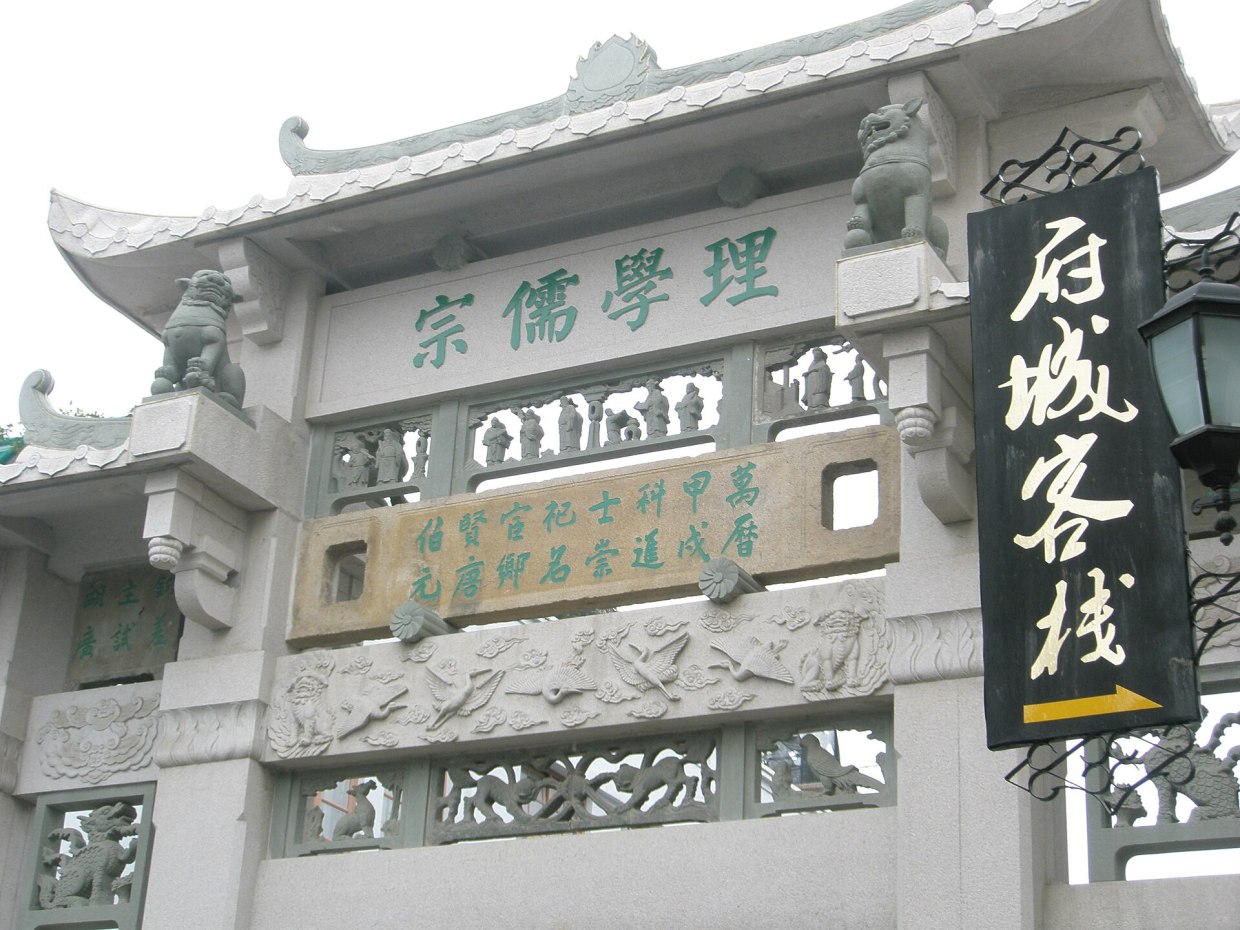
One hard rule: legend and historical record are kept in separate columns. The couplet stories about Lin Daqin and the “child prodigy” tag on Zheng Dajin are legend — they may be recorded, but must be labelled as legend, with the area where they circulate. Examination years, offices and dates of death are record, and must be checkable in the Ming History, the Draft History of the Qing, or a gazetteer.
How to read the section
Four things have to be recorded for a person, and two traps avoided.
The four things
- Examination rank: which sitting, and what place. The firmest item of all — the pass lists survive.
- Office: what was held, at what grade. The official biography and the gazetteer’s table of officials check one another.
- Deeds: what the person did. Needs memorials to the throne, a biography, or a gazetteer behind it.
- Survivals: arches, residence, tomb. Physical evidence outlasts text.
The two traps
First, taking legend for record. Lin Daqin’s couplet contests and Zheng Dajin’s “child prodigy” reputation are very widely told, but they are later narration with no contemporary record. They can be written, in a paragraph marked as legend.
Second, taking a later grouping for a verdict. “The three outstanding men of Chaoshan” and “the three Dongs” are later joint honours, absent from the documents of the time. When cited, they must be described as a later framing, not a contemporary assessment.
One thing worth noticing
The three men’s native places happen to fall in three different counties: Lin Daqin in Haiyang, Weng Wanda in Jieyang, Chen Beike in Chaoyang. The “three outstanding men” is in fact a later balancing act across three counties of one prefecture — a more useful observation than praising each in turn.
The three outstanding men
Lin Daqin, Weng Wanda and Chen Beike took the courtesy names Dongpu, Dongya and Dongshi, hence “the three Dongs”.
- Lin Daqin (1511–1545), courtesy name Jingfu, style Dongpu, from Dongpu du in Haiyang (today Jinshi town, Chao’an district, Chaozhou). He took first place in the 1532 palace examination and was appointed to the Hanlin Academy as compiler. He is the only civil examination top graduate the Chaoshan region itself produced.
- Weng Wanda (1498–1552), courtesy name Renfu, style Dongya, from Jieyang (today the Tuopu area of Jinping district, Shantou). A 1526 graduate, he rose to Minister of War and Governor of Xuan-Da. While commanding the northern frontier he built more than eight hundred li of wall and over three hundred beacon towers between Datong and Xuanfu. The Jiajing emperor called him “the first minister south of the ranges”.
- Chen Beike (Chen Guang, 1478–1534), courtesy name Shijie, style Dongshi, from Guiyu in Chaoyang. A 1511 graduate, he rose to vice-minister of the Court of Judicial Review.
A minister of the Qing
- Zheng Dajin (1709–1782), courtesy name Yujie, styles Qianji and Tuigu, from Meigang du in Jieyang (today Yujiao town, Jiedong). A 1736 graduate, he rose to Governor-General of Zhili and was appointed Junior Tutor to the Heir Apparent; on his death he received the posthumous name Qinke and a tomb inscription written by the Qianlong emperor himself.
On the candidate list
Zheng Xin (Chenghai; the Thonburi dynasty in Siam), Ding Richang (Fengshun; the self-strengthening programme), Weng Zhaoyuan (Huilai; resistance to Japan), Cai Qiao (Jieyang; physiology), Yang Shihun (Puning; revolutionary). Their native places fall across the seven counties and the within-prefecture comparison counties; each must be checked against a county gazetteer or an authoritative biography before being written up.
Sources and what remains to do
Dates, examination ranks and offices are put together from the inscriptions on the arches of Paifang Street and from local historical material. A formal entry is published only after checking against the official biographies in the Ming History and the Draft History of the Qing, and against the prefectural and county gazetteers. Where an arch inscription and the official record disagree, the official record prevails and the difference is noted.
Four entries so far
Lin Daqin, Weng Wanda, Chen Beike, Zheng Dajin.
Last revised: 3 November 2026