Birth rites in Chaoshan
The first rites a Chaoshan child passes run from the third day after birth to the first birthday: announcing the birth, the third day, the twelfth day, the full month, the first taste of meat and the grasping ceremony — six rites inside one year, more densely packed than any set of rites that comes after.
1. Announcing the birth, and the third day
When the child is born, the son-in-law goes to his wife’s family with the news. For a boy, a red paper slip giving the year, month, day and hour of birth goes with pomegranate flowers, xiancao herb and sweet cakes — this is reporting an added male. For a girl it is done plainly, by word of mouth, and called reporting an added mouth.
On the third day the child is bathed in water boiled with mugwort leaf, pomelo leaf and old ginger — washing on the third day. The same day the midwife and the elders of the house are asked to wine, the third-day wine, and those who come bring gifts to the mother and congratulate her.
From birth to the twelfth day is a guarded time indoors, called qi la: the mother keeps her head bound in a cloth, wears more than usual, draws the curtain and shuts the window, and visits no one. On the third or the seventh day the wife’s family sends pork and eggs to build her up, which is called watching the confinement; once the twelfth day passes and the child is well, the confinement is over.
2. The twelfth day, and the children’s goddess
On the twelfth day the wife’s family brings chicken, eggs, pork, glutinous rice, brown sugar and black-bean wine — “filling the belly” for their daughter. If the child is a boy, sweet dumpling soup is cooked and sent round the neighbours; if a girl, soup with flat rice noodles, and the neighbours give eggs back.
On this day the censer of the children’s goddess is set up. A coarse bowl is filled with sand, incense stuck in it, and the bowl itself is her place — she is the goddess who watches over children. In some places the bowl is put under the bed, which is why she is also called the granny at the foot of the bed. From then on the child’s affairs are hers, and hers until the day of the coming-of-age rite at fifteen.
In the Hakka country around Jiexi and Puning, some families steam glutinous rice and boil ginger wine on this day and ask the neighbours in to drink to the child.
3. The full month: shaving and the first meat
The full month is marked with a feast; the grandmother’s family brings live chicken, pork and fine noodles, and adds gold and silver jewellery, a dress, a bib, a carrying sling, red shoes, a cat hat and a cradle. On this day the mother has her face threaded, and only after the full month may she leave the room.
The shaving is symbolic. A whole bunch of spring onions is held against the razor and passed over the child’s head as if shaving; afterwards the onions are planted back in the vegetable garden, in the hope that the hair will grow as thick as onions. In the villages of Puning a red egg is also sent to relatives and neighbours, called a shaving egg.
The day of the first meat differs from county to county: some keep it between the seventh and twelfth day after birth, others wait until the fourth month. Three offerings and kueh are set out for the children’s goddess, and among them must be small dried fish, chicken tongue, chicken thigh and firm bean curd. They are laid on the wooden lid of the water jar; the child is held up to burn incense and kneel, and then, at the edge of the jar, is fed a symbolic mouthful of rice to show that from now on it may eat meat.
Each offering carries a sense: the small dried fish stands for the saying “even the tiniest fish has its swim bladder”, the wish that the child grow up with nerve; the chicken tongue is pointed and stands for cleverness; the bean curd is square like an official seal, the wish that he grow up to hold one. Around Chenghai the child is carried to worship the goddess on this day, and afterwards a little fish or meat is held to its lips to lick.
4. The first birthday: the grasping, and the year feast
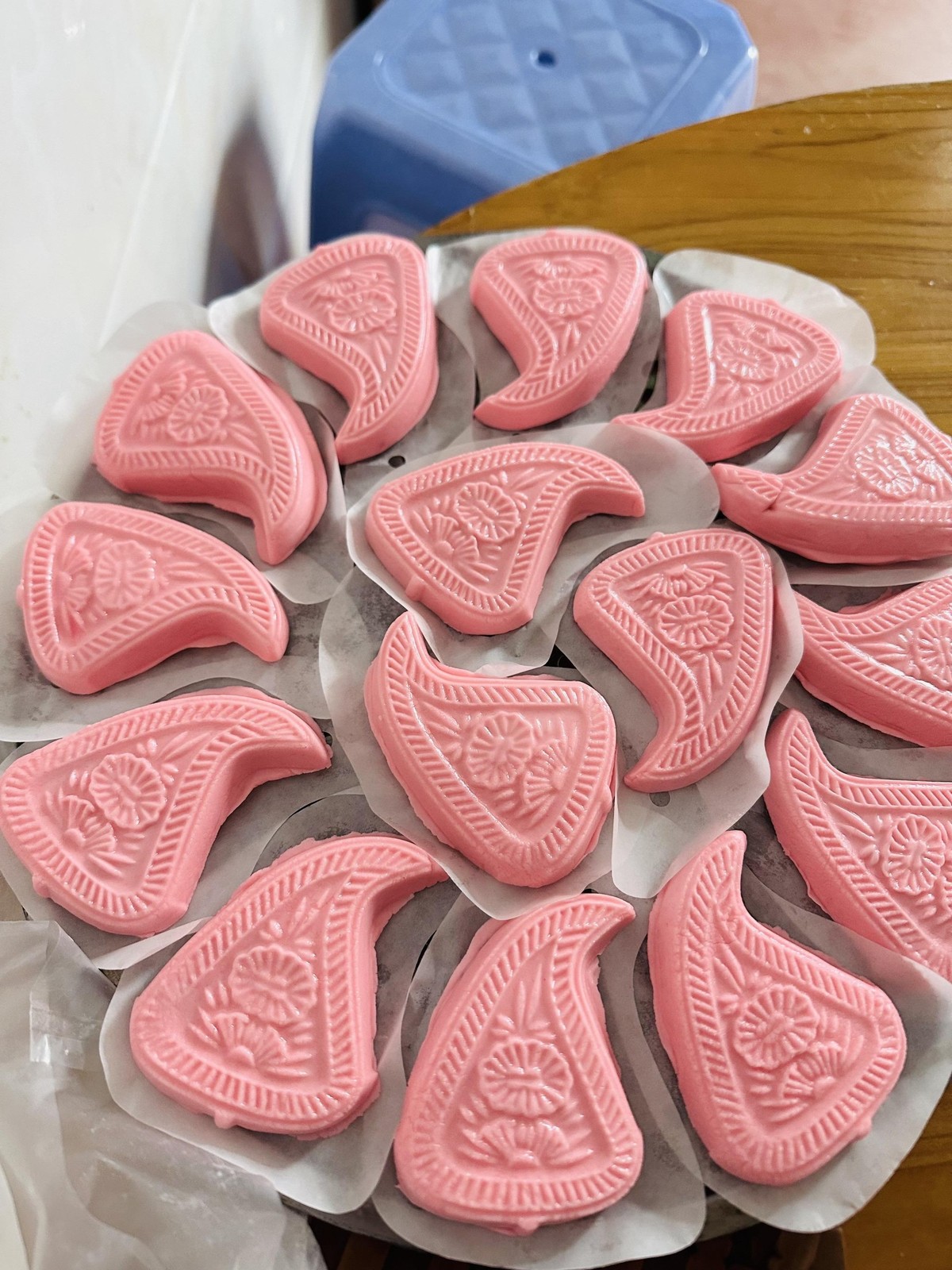
For the first birthday, offerings are set out for the gods and the ancestors and relatives are feasted. The grandmother’s family sends new clothes and new shoes, and the house makes red peach kueh to give round the neighbourhood. In some places the day is called the year wine, in others making the year, in others simply the year.
For the grasping, the table is laid out with the four treasures of the study, books, an abacus, a steelyard, a seal, needle and thread, face powder, toys, sweetmeats and coins, and it is watched which the child takes first. In the old days the four treasures were the most hoped for, and needle, thread and toys the least.
In the countryside the first birthday is sometimes moved to the Lantern Festival of the following year, to fall in with the lanterns hung in the ancestral hall and the feasting of the added-male tables. Any household that had a boy after the previous Lantern Festival hangs a lantern at its own door that year, lights red candles among the lanterns in the ancestral hall at night, and lays out a feast for guests.
The name is settled in this stretch too. It may follow the generation poem, or be chosen to supply whatever element the child’s eight characters lack; grander families ask the clan head or an elder to bestow it, while ordinary families give a rough childhood name first and a school name when the boy goes to school.
5. Differences between counties
Whether the full month or the first birthday is the greater occasion varies: in some places the full month is done large and the birthday is a single family meal; in others it is the other way round, the month kept plainly and the birthday feasted.
The number of congratulatory gifts is even for a boy and odd for a girl. For a boy, sweet glutinous rice is sent; for a girl, fish-roe balls — small rounds rolled from sweet-potato starch.
Among the Hakka of Jiexi and Puning, a boy is congratulated with a wide skirt and a girl with trousers instead. Skirt, qun, sounds like qun, “a flock”; in the old days a flock of girls was feared, so a skirt was never sent for a girl.
Questions people ask
- Why spring onions for the full-month shaving?
- The onion stands for luxuriance. The shaving is only symbolic: a whole bunch of spring onions is held against the razor and passed over the child’s head as if shaving, and afterwards planted back in the garden, in the hope that the hair grows as thick as onions.
- At how many months is the first meat given?
- It varies by county: between the seventh and twelfth day after birth in some places, not until the fourth month in others. Once it is done, the child may eat meat.
- What is laid out for the grasping?
- The four treasures of the study, books, an abacus, a steelyard, a seal, needle and thread, face powder, toys, sweetmeats and coins, and it is watched which the child takes first. In the old days the four treasures were most hoped for and needle, thread and toys least.
- Who is the children’s goddess?
- The goddess who watches over children. Her censer is a coarse bowl filled with sand, put under the bed in some places, which is why she is also called the granny at the foot of the bed; the child’s affairs are hers until the coming-of-age rite at fifteen.
A few of the words on this page: reporting an added male, qi la, the full month, shaving the head.
See also: Rites of passage (the four thresholds side by side); Chu huayuan (the coming of age at fifteen, where the goddess’s charge ends); the children’s goddess; red peach kueh; Banquet rites (where people sit at the full-month and added-male feasts); the glossary.
Sources
Folk records and local compilations on childbirth custom in Chaoshan; consulted on 29 October 2026.
Home › Rites of passage › Birth rites
Text on this site is CC BY-SA 4.0; copyright in images is reserved and commercial use requires a separate licence.
Last revised: 4 November 2026