Mazu in Chaoshan
The goddess of the sea. Along the Chaoshan coast there is a Tianhou temple at almost every landing, fishing village and emigrant hometown; the goddess is divided from the ancestral temple at Meizhou in Putian, Fujian, and the twenty-third of the third month is her chief day.
1. From woman to goddess
Mazu was born Lin Mo of Meizhou, on the twenty-third of the third month of the first year of Jianlong in the Song (960). On the ninth of the ninth month of the fourth year of Yongxi (987) she went out to a ship in trouble at the mouth of Meizhou bay and did not come back, aged twenty-eight. The villagers, remembering her, put up a temple on the island — the first Mazu temple in the world.
Over the eight hundred years after, the court went on granting titles. In the fifth year of Xuanhe (1123) Lu Yundi was sent as envoy to Goryeo and met a storm on the way; of eight ships seven went down and his alone came through, and when he reported it and asked for a plaque, Huizong granted the two characters Shunji, “smooth crossing” — the first time Mazu received an imperial plaque. In the twenty-sixth year of Shaoxing (1156) she was titled Lady Linghui, in the third year of Shaoxi (1192) raised to consort, in the eighteenth year of Zhiyuan under the Yuan (1281) to Tianfei, and in the twenty-third year of Kangxi under the Qing (1684) to Tianhou. Across the Song, Yuan, Ming and Qing, fourteen emperors honoured her thirty-six times, the title growing from two characters to sixty-four, from lady to consort to Tianfei to Tianhou — all the way to the top.
In the fifty-ninth year of Kangxi (1720) the court allowed local officials to sacrifice in spring and autumn, and Mazu entered the state register of worship; by the fifty-third year of Qianlong (1788) the spring and autumn sacrifices were formally in force. In 2006 the Mazu rite was placed on the first national list of intangible cultural heritage; in 2009 “Mazu belief and customs” was inscribed on UNESCO’s Representative List of the Intangible Cultural Heritage of Humanity.
2. The ancestral temple at Meizhou
The ancestral temple stands in the north of Meizhou island, built in the fourth year of Yongxi in the Song (987) and enlarged once in the Tiansheng years (1023–1032), with repairs under the Yuan, Ming and Qing. In 2006 it was listed in the sixth batch of nationally protected cultural relic sites.
The present buildings run along two axes, west and south, both in imitation Song style, set against the hill and facing the sea. The Chaotian Pavilion stands between the sleeping hall and the ascension tower, three storeys and octagonal; on the summit of the temple hill stands a stone statue of Mazu, 14.35 metres high and built of 365 blocks of granite, crowned with the imperial bead fringe and holding a jade ruyi, facing the sea.
The incense of every branch temple is divided from here. Three words carry the relationship between temples: fenling, dividing the spirit, is taking an image from the ancestral temple to a new one; jinxiang, presenting incense, is coming back to pay respects; gehuo, cutting the fire, is taking fire from the ancestral censer.
3. Chaoshan: nearly four hundred
Chaoshan is a coastal country — three parts farming, seven fishing — and the Tianhou temple is its commonest shrine. A man who has spent years surveying the temples of Chaoshan has estimated their number at close to four hundred, under various names: Tianhou Gong, Tianhou Miao, Ma Gong and Mazu Miao all mean the same kind of building.
- Mayu island: at the mouth of Shantou harbour, one island with two Mazu temples, one new and one old. The old Tianhou temple was first built in the Yuan, the fishermen dividing the incense from Meizhou. The island’s old name was “the hill where chickens are released”: fishermen brought live chickens to worship and let them go afterwards.
- The Old Mazu temple in Shantou: on Shengping Road, standing shoulder to shoulder with the Guandi temple, first built in the Jiaqing years, rebuilt in the fifth year of Guangxu (1879), listed as a Shantou protected site in 1988 and restored in 1991 with money given by overseas compatriots. There is a local saying: “before there was a Shantou port, there was the Old Mazu temple.”
- The Maniang temple at Xialing: built in the second year of Hongwu in the Ming (1369), the earliest Mazu temple in the city of Shantou with a date that can be checked.
- The Tianhou temple at Outing: first built in the Ming. The new Mazu temple at the old port of Zhanglin in Chenghai was built in the eighth year of Wanli (1580), tied to the shipping of that harbour.
- Chengyanggang: one village with two Tianhou temples, one on the dike of the Xianmei creek, one on the dike above the Han river.
- The city of Chaozhou: one below the east gate tower, one on Fenghuang Zhou, one at Jishui hill. The island of Nan’ao has more than ten. Chaoyang has the Houxi Mazu temple.
4. The twenty-third of the third month
The twenty-third of the third month is Mazu’s birthday. On that day the temples along the Chaoshan coast all put on something: opera, flag processions, drums and offerings. It is grandest at Zhelin harbour in Raoping, where fishing boats and merchant boats lie side by side and for several li of water you can walk across them.
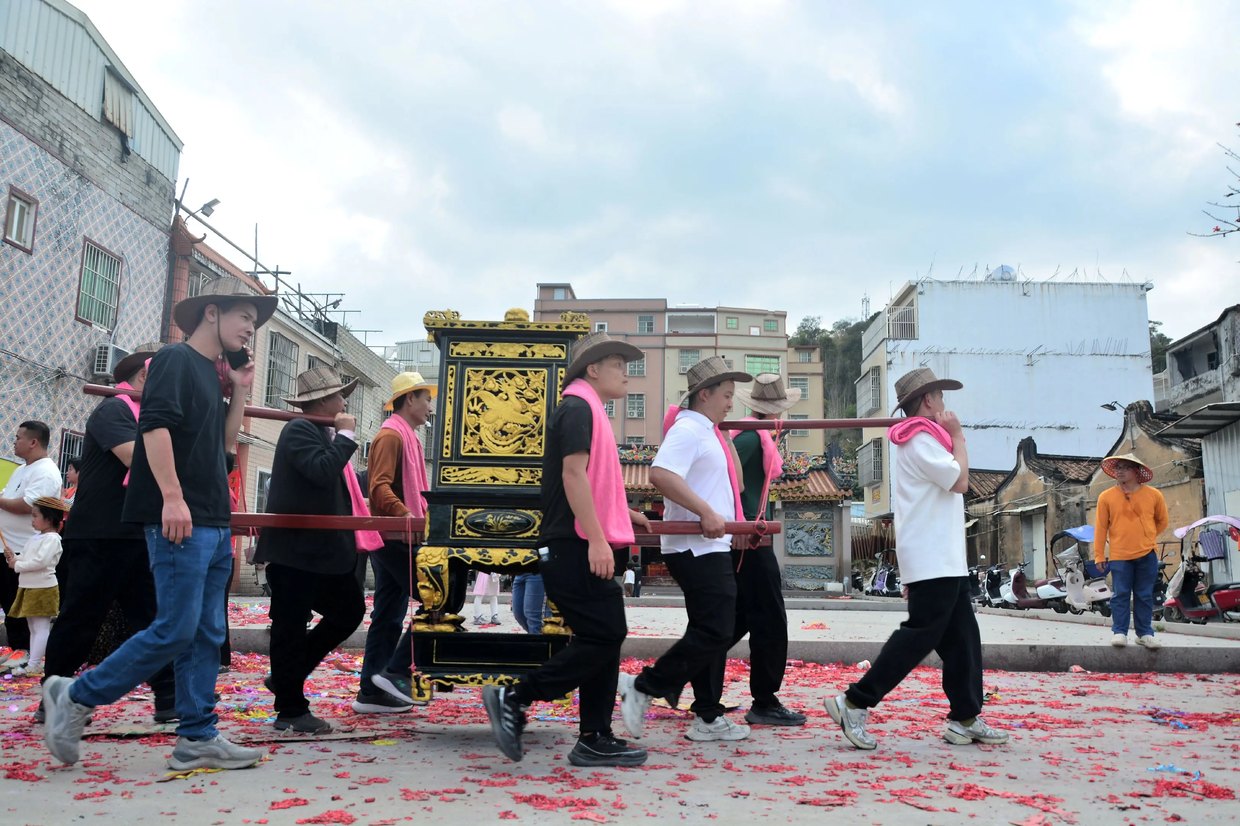
Zhanglin has a particular custom: the Lin surname there reckons Mazu as an aunt of the clan, and when a family takes a bride, the next morning the bride carries a plate of large mandarins and a basin of clean water to the temple, to wash the aunt’s face and comb her hair. The custom later spread through Chaoshan.
Those going abroad had rules of their own. After Shantou was opened, people who took ship from the bay in front of the Old Mazu temple went first to the temple to take their leave, and many carried a small packet of incense ash on them — home carried on the body. When an emigrant came back, the first thing was to return to the temple and fulfil a vow.
5. A few words easily confused
Mazu is the goddess, Mayu an island — the same sound, different characters. Tianhou Gong is the general name of the temple, Mazu the folk name; the plaque over the door reads Tianhou, the mouth says Mazu. The ancestral temple at Meizhou is the root, all the others are branch temples, and the temples of Chaoshan are the latter.
Sources
The Meizhou side (her birth and death, the temple raised in the fourth year of Yongxi, the Tiansheng enlargement, the plaque of the fifth year of Xuanhe, the ladder of titles, entry into the register in the fifty-ninth year of Kangxi, the spring and autumn sacrifices in the fifty-third of Qianlong, the 2006 national protection and first national listing, the 2009 UNESCO listing, the dimensions of the stone statue): People’s Daily app, “Mazu’s home, Meizhou island” (17 April 2025); the Putian CPPCC volumes Notes on Mazu culture and Mazu seen from everywhere: the Meizhou ancestral temple; and the China Mazu Culture Exchange Association’s feature series under the same title.
The Chaoshan side (the figure of nearly four hundred, the Yuan temple on Mayu, Xialing in 1369, Outing in the Ming, Zhanglin in 1580, Chengyanggang’s two temples in one village, the three in Chaozhou city, the ten-odd on Nan’ao, the scene at Zhelin harbour, the Zhanglin custom of washing the aunt’s face, the incense ash carried abroad): the Putian CPPCC’s The Mazu temples of Chaoshan, Shantou Culture Cloud’s “Old city memory: the Old Mazu temple”, China News Service’s “The hills, sea and culture of Chaoshan”, and the International Chaoshan Youth Federation’s “Mazu, guardian of the sea”. For the history of the two temples on Mayu, see this site’s Mayu island.
All the above pages were consulted on 29 October 2026.
See also: Mayu island (two temples on one island, and the throat of the harbour); Ying laoye (the other road, carrying the gods through the streets); The Three Mountain Kings (another line of gods in Chaoshan); Mazu (the glossary entry: how it is said, and one line of meaning); Belief and processions (the section index).
Home › Customs › Belief and processions › Mazu in Chaoshan
Text on this site is CC BY-SA 4.0; copyright in images is reserved and commercial use requires a separate licence.
Last revised: 4 November 2026