Daoyun tower
The largest true octagonal earthen tower in China, at Sanrao in Raoping. Three generations of the Huang family built for more than a hundred years and finished in 1587, the fifteenth year of Wanli.
In one line Eight sides, three rings inside one another; the look up from the middle of the light well is the whole of it.
Look for The three rings of roof from the light well · the size of the doors and windows · the lanes between one ring and the next
Why it matters
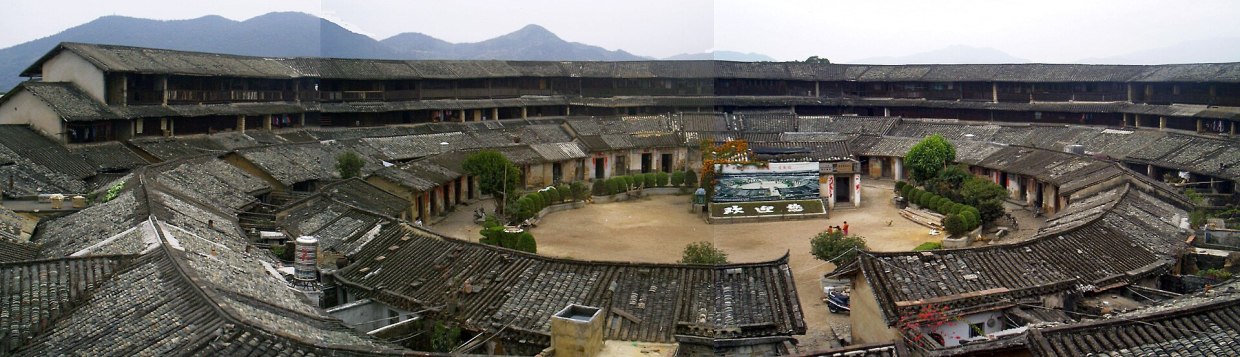
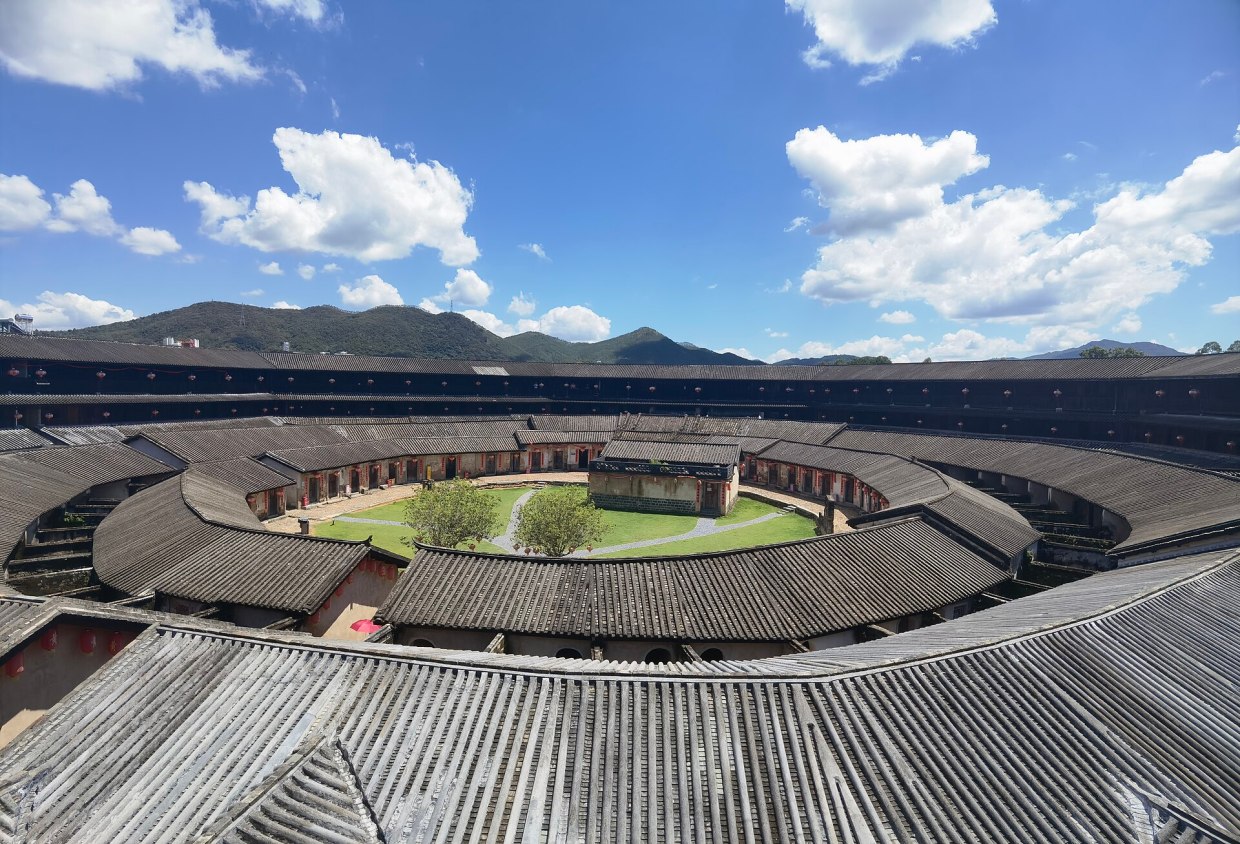
The largest surviving true octagonal earthen tower in China, built by three generations of one family over more than a century. Eight sides, three rings set inside one another, the light well at the centre; stand in the well and look up, and ring after ring of timber closes towards the sky — that one look is the whole of it. The earthen tower and the fortified village are two ways of living together: one encloses inward, the other defends outward.
History
In Nanlian village, Sanrao town, Raoping county. Begun in 1477, the thirteenth year of Chenghua, carried on by three generations of the Huang family, and completed in 1587, the fifteenth year of Wanli — more than a hundred years. Listed in the sixth batch of national key cultural relics in May 2006.
Craft
- Form: a true octagon, a fortified tower-village, three halls and three rings, laid out on the eight trigrams.
- Size: more than ten thousand square metres in all — the largest true octagonal earthen tower in China.
- Method: walls of rammed earth, doors and windows opening inward, the high outer wall doing the work of defence as well. It belongs with the round houses of western Fujian, but the octagon is rare.
What it is known for
Descriptions usually call it old, large, strange and beautiful: old in its date, large in its bulk, strange in the octagon and the trigram layout, beautiful in the layering of the three rings. It is not an empty monument — families still live inside, and washing hangs in the light well.
What to look at
- Stand at the centre of the light well and look up once: the roofs of the three rings step inward towards each other.
- Doors and windows: the outer wall is thick and the openings are small, and the sense of scale comes straight from that.
- The lanes: the passages between one ring and the next. Walk the full circle.
Visiting
It is in Raoping, the opposite direction from Nanao island, so the two do not go in one day. The building is people’s homes: ask at the door, do not push one open.
Tickets and hours Ticket: bought to go up | Hours: open by day, price and hours as posted on site | No booking needed.
Related entries
Houses and settlements, Four-point gold, The intangible heritage list.
Earth tower and fortified village: two ways of living together
Chaoshan has two traditions of settlement. On the plains it is the courtyard house — four-point gold, the tiger coming down the hill. Along the coast and in the hills it is the fortified enclosure: high walls outside, doors and windows facing inward, defence first.
Daoyun tower is of the second kind. It belongs with the round houses of western Fujian, but the form differs: most of those are round, and this one is a true octagon. Eight sides are harder to build than a circle — every joint has to line up, and over three concentric rings the error accumulates. Three generations and a hundred years is probably where that difficulty shows.
Eight sides and the eight trigrams
Three halls and three rings, laid out on the eight trigrams, more than ten thousand square metres in all: the largest true octagonal earthen tower in China. The usual description — old, large, strange, beautiful — reads as 1477 for the start, ten thousand square metres for the bulk, the octagon and the trigrams for the strangeness, and the three rings stepping inward for the beauty.
There is an order to seeing it. Walk the outside first and watch how the eight faces turn; then go into the light well and look up at how the three ridges stack into concentric octagons; then walk the passages and feel the dark and the cool that come of walls this thick and windows this small. It is not an empty monument — families still live inside.
Plates
On the same trip
- Fenghuang mountain — also in the hills to the north, but a different direction; better on another day.
- The Han Wengong shrine — a stop on the way back into the city.
- The Bijiashan kiln site — also east of the city, on the way home.
The order is yours to work out from the map and the hours; this only says what lies on the way.
In the routes: only the five-day itinerary takes it in.
Note on sources
- The dates, the octagonal form and the claim to be the largest in China: the Chaozhou Municipal Government and the China News Service, “How Chaozhou became a model in protecting and using its relics”; Southern Net, “The nine national key sites of Chaozhou”.
- The description of the form and the “old, large, strange, beautiful”: Southern Net, same piece.
Home › Travel › Chaozhou › Daoyun tower
Last revised: 5 November 2026