Home › Intangible heritage › Yingge dance › Women and children
Yingge · Women and children
The official item says “performed by men”, and that is how it stood when the item was catalogued. Women’s teams and children’s teams have since become lines of their own; their founding years, their stickwork and their standing are set down here.
1 · That sentence in the listing
In the national listing for Chaoyang yingge, “performed by men” stands in the column for performance form. The sentence records how it stood when the item was catalogued. There was already a women’s team at Ximen in Miancheng in 1952, rebuilt in June 2011; and it was not until the second of the first month in 2026 that Puning produced its first women’s yingge group.
Of the three schools, the one whose public material mentions women’s teams most often is Chaoyang. In the records for the Jiazi school, no women’s team appears. The several that have risen in Puning in the last two years are dealt with separately below.
2 · The Ximen team
The Ximen women’s yingge team of Miancheng was founded in 1952, broke off at one point, and resumed in June 2011. What it builds on is the “five strokes” — five basic combinations beaten over and over. The five are not the pattern of the whole district: the middle tempo also runs in groups of five, seven, eight and on up to thirteen strokes, and whether other teams use the five, the material does not say.
Beyond the old sets, the team has composed two of its own in recent years: “A Hundred Phoenixes Dancing Together”, a ten-stroke set for paired work, and “Circling Taiji”, for solo work. Three formations are in common use — double coin, four columns, plum blossom; only the names exist, and no diagram of the movements has been published.
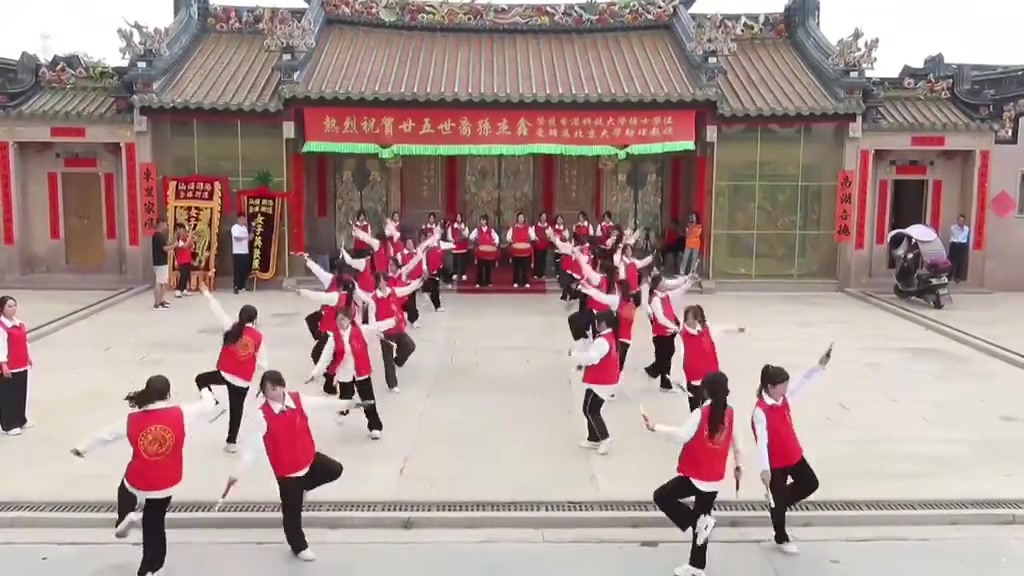
The costume is the female warrior’s dress in red and green: red for Mulan, green for Mu Guiying. The make-up runs light, with the character for fire painted at the centre of the forehead, which the team says stands for holding together. The footwork is taken from the basic step of the men’s yingge with the bearing of opera dance worked in, so that it moves lightly.
3 · The ones that rose in the last two years
The Fumei women’s yingge team is in Lihu town, Puning. Founded and put on stage at the end of 2025 by Li Junhao, a man of the village, it appeared at the Puning yingge festival on the second of the first month, 2026 — the first women’s yingge group locally. Twenty-four at the founding, now sixty-odd; it dances the fast tempo within the fast; the first stick is Zhou Yating.
The Yuxin women’s yingge team was founded in June 2026 and entered the 2026 yingge league, training every evening beforehand, working on the force of the stickwork, the evenness of the step, and how faithfully the faces and costume are reproduced; the drummer is Yao Huanjin. The team name carries no place name, and the township is not recorded.
The Qiaozhu Jiudi women’s yingge team reappeared in August 2025 “after many years”, and was among the six teams at the show before the Pearl Goddess temple on 5 October; the team also calls itself Mulan. It raised the drum on 7 October 2026, under a title giving the year as bingwu.
An earlier batch: the Guiyu Huamei women’s yingge team plays three days running, the twenty-sixth to the twenty-eighth of the second lunar month, and on 2 May 2025 sailed to Meizhou Island on the ferry Tianfei No. 3; the flag bearer of the Xinan women’s yingge team is a woman; the Chaoyang vocational women’s yingge team came out at the Chaoyang yingge carnival in the spring of 2026.
4 · How many are on the list
In the table on Teams, six team names carry “women’s”; counting Nanshan’s women’s group, seven. Who dances lists eleven by the records: Guiyu Huamei, Houxi, Taguan Ximen, Xinan, Qiaozhu Jiudi, Fumei women’s, Nanshan (women’s group), Chaoyang vocational, Guiyu Beilin, Xianpeng, Yuxin. Seven of them have entered the table; Houxi, Taguan Ximen, Guiyu Beilin and Xianpeng appear only in the records.
Two belong to the same village as a men’s team. Taguan is the men’s team of Ximen, and Ximen has a women’s team as well, one village with two gates; a title of August 2025 says “men and women mixed”, and the team also sets up a head coach.
5 · Youths and children’s teams
The “children’s teams” in the records take several forms. The “straw-hat children’s yingge” of the Zhuoyue nursery at Helong, Tongyu, has Guan Sheng as its first stick and nursery-age children in the file (2026-03-05). The Liantan youth yingge team of Puning has a child painted as Shi Qian, by the name of Jiang Haorui (2025-04-19); at another Mazu procession in the same township, the part of Shi Qian was likewise danced by a child (2026-05-09). A small boy from Xinchu, Guiyu, came out at the Chaoyang yingge carnival in 2026 (2026-02-21).
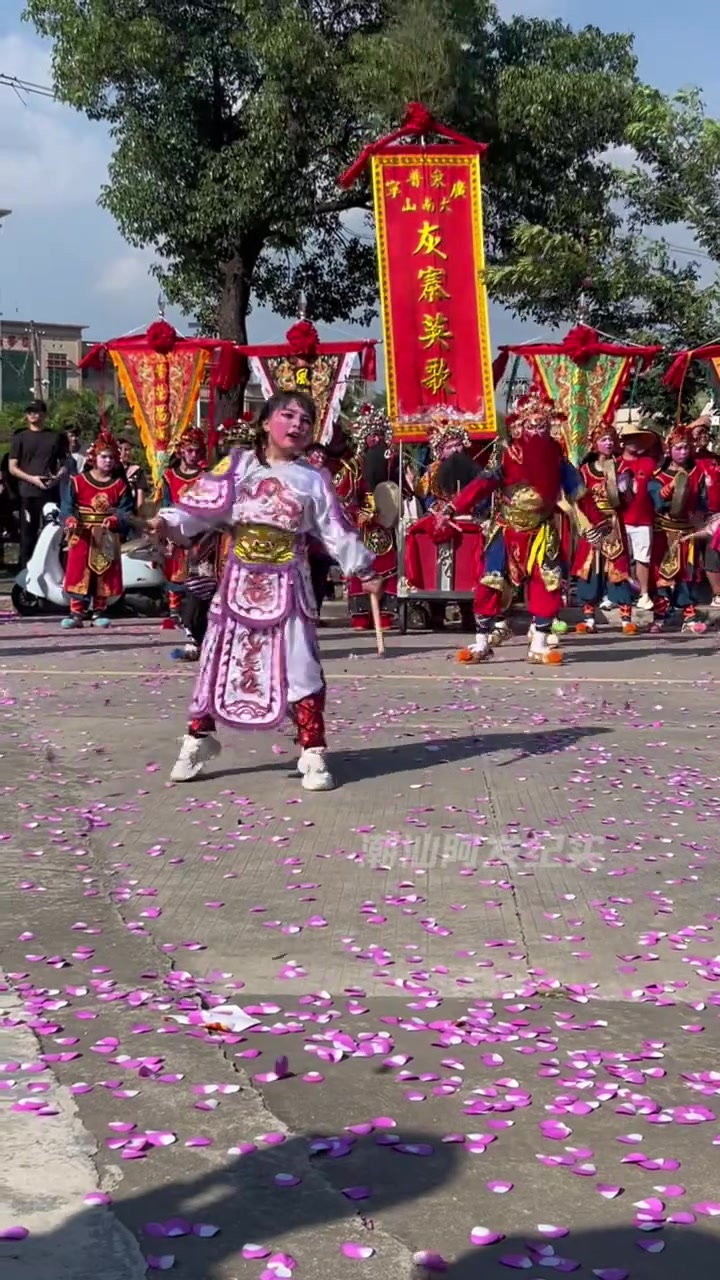
The one recorded again and again is Zhuang Enqi: on record from March 2025, put down as six years old in August 2025, and in February 2026 “in training for the Hong Kong performance at the New Year”.
The plainest statement of how age sits with role comes from the Nanshan yingge team of Puning — “Chen Jinshan, fifteen”, in the team (2025-09-30).
6 · Standing
“Women’s team” and “children’s team” are phrases from the records, not categories in any register. No document has ever sorted yingge teams by sex; what a team calls itself depends on how it writes it and how the reports write it.
Only a few differences can actually be used. Shoes: the women wear embroidered shoes throughout, the men wore straw sandals in the early years and now mostly hemp. Dress: the yingge costume has no water sleeves, so that the movement stays brisk; the women’s armour carries dozens of coloured streamers from waist to foot, the men’s only to above the knee.
What cloth, colour and embroidery each team uses is still not recorded team by team. The local standard describes the form, not which cloth a given team used in a given year. Of the sets the women’s teams have composed themselves, apart from the two at Ximen, the names of the rest have not been published.
← Previous page: Who dancesBack to the featureNext page: Teams →
| Source | Type |
|---|---|
| Intangible cultural heritage: Chaoyang yingge (DB 4405/T 315—2025)Shantou local standard, Shantou Administration for Market RegulationIssued 2025-02-24, in force 02-25 | Local standard |
| Yingge (Chaoyang yingge)China Intangible Cultural Heritage Network / Digital Museum of China ICHNo publication date on the item page; announced in the first batch, 2006 | Listing page |
| The Ximen women’s yingge team of Chaoyang districtShantou Polytechnic, “Yingge dance” feature2025-03-06 | College feature |
| The women’s yingge team and its “Chinese war dance”Guangming Online2024-02-22 | Report |
| The women’s yingge team and its “Chinese war dance”Zhanjiang Evening News2024-03-03 | Report |
| Reply to proposal no. 20250334 of the fourteenth Shantou CPPCC sessionOffice of the Chaoyang district government, Shantou2025-05-14 (https certificate faulty; this link goes over http) | Government disclosure |
| Once in a lifetime, you have to see yingge dance in ChaoshanChina News Service2024-02-28 | Report |
| Behind yingge dance’s breakoutFarmers’ Daily (reprinted by China Economic Net)2023-06-06 | Report |
Read next
Who dances — roles and get-up, the women’s teams and the children’s teams, all on that page.
Teams — the full table of twenty-five teams, with founding dates and status on the day.
How it is danced — stickwork, step and formation, and how they are brought together.
Questions — “can women dance it” is answered there too.
Last revised: 4 November 2026