Home › Intangible heritage › Yingge dance › How it is danced
Yingge · How it is danced
Six things taken apart: mace technique, footwork, masks, formations, front and rear sections, costume.
Header texture: photo by Auongkinghe, CC BY-SA 4.0
Yingge fuses dance, southern boxing routines and opera acting — that is the wording of the official project page overview; the Chaoyang project page has another passage, “combining drama, dance and martial arts”, and the two stand side by side, both recorded here as written. Below, the six are taken apart: mace technique, footwork, masks, formations, front and rear sections, costume. Wherever a statement belongs to one branch only, the paragraph says so outright and does not pass it off as province-wide.
The mace
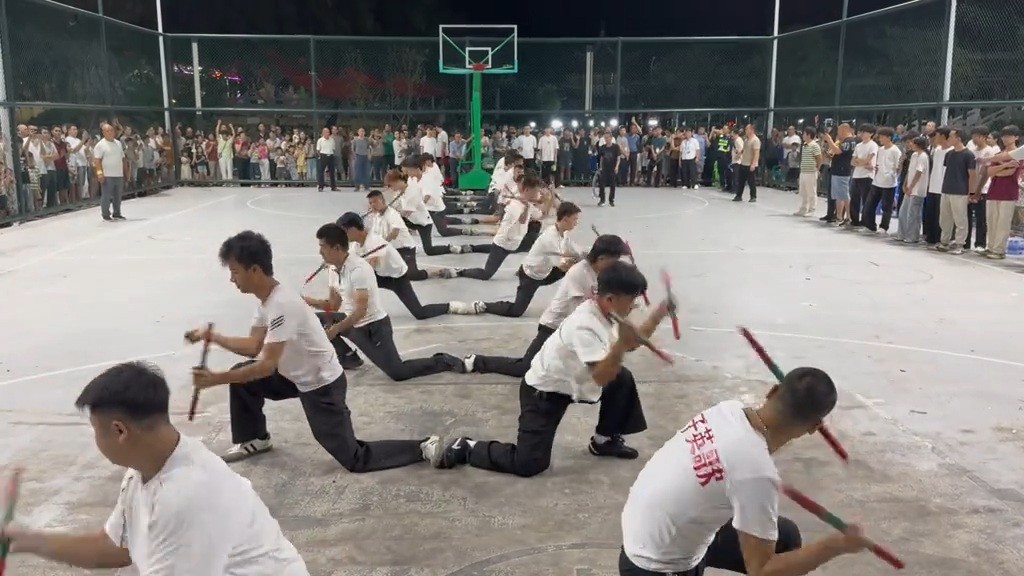
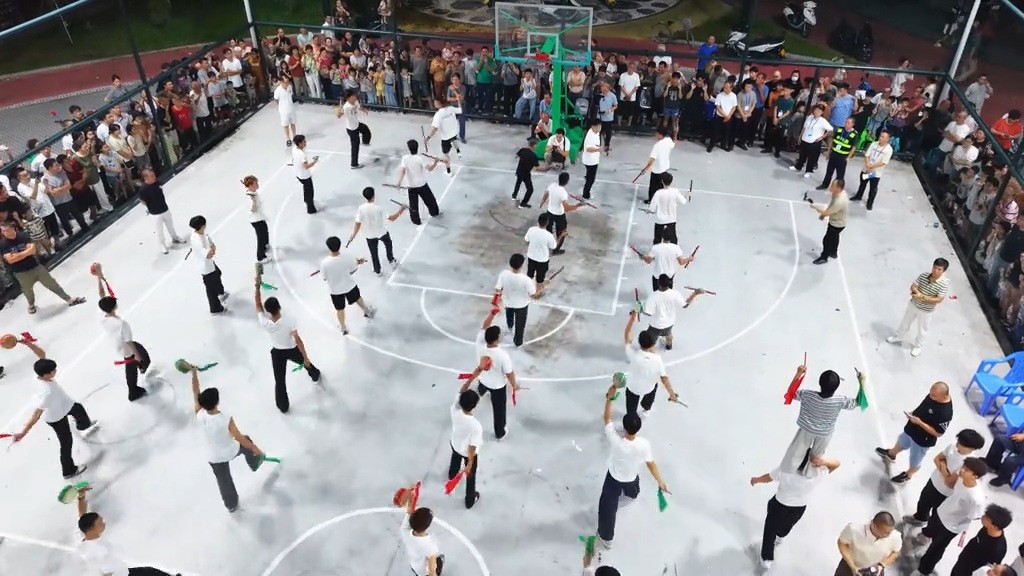
Each dancer has two round wooden maces, one in each hand, struck up, down and to either side to the drums and gongs, head and body swaying naturally. Mace length differs by team: the project page records “10 cm in diameter, 20 cm long”, while the Chaoyang district standard gives “generally 40 cm to 61 cm”; the two differ by a factor of two, and the discrepancy is the first note at the end. Set names on the Puning branch include Spinning the Mace, Mace Flower, Washing the Street, New Year Greeting, Planting the Field, Mace on the Back, Through the Hip and Mace Hug with Hooked Foot (after the Puning project entry).
The Chaoyang branch divides by rhythmic pattern: the slow branch builds a set of three or four beats, and there is also a “drunken mace” in which the dancer looks like a drunkard; the fast branch divides into paired-combat sets, the Nanshan civil school and the Nanshan martial school (after the Chaoyang project entry).
Chaoyang district has a local standard, Intangible Cultural Heritage: Chaoyang Yingge, numbered DB 4405/T 315—2025. It was issued by the Shantou Market Supervision Administration on 24 February 2025 and took effect the next day; proposed and administered by the municipal culture, radio, television, tourism and sports bureau, it was drafted by, among others, the Mianbei Houxi, Wenguang Taoyuan, Caowei township, Chengnan Zhongjing and Ximen women’s Yingge teams, and by the Shantou Polytechnic.
It runs to 40 pages: chapter 5 basic technique, chapter 6 seven basic formations each with a floor plan, chapter 7 the three rhythmic patterns, Appendix A a chart of the costume and masks of the 108 heroes (drawings by the Houxi team), Appendix B costume. Most of the names in the paragraphs below come from this standard. Its beat cycles are concrete: the slow branch has a three-beat drum cycle and sets of three or four mace beats; the middle branch a five-beat cycle with sets of five or seven, or of eight, ten, eleven or thirteen;
the fast branch a seven-beat cycle. Mace technique splits into two classes and nine forms —Spinning the Mace and the striking mace. The spinning mace divides into inward and outward: inward, gripping the mace at its middle with the butt forward and turning the wrist from the butt so that the butt traces a vertical circle against the inner side of the forearm; outward is the reverse, head forward, circling against the outer side. Nine striking forms — the vertical strike, the two maces meeting above and below before the chest, the rising mace head striking the descending one;
the diagonal strike, a diagonal from the right hip past the front left of the head down to the left hip, the right mace striking the left at the start and the path then retraced symmetrically; the double toss strike, swinging out forward from beside the hip, striking before the chest, carrying the motion into a mace flower and raising it, then returning along the same path to strike again; the slicing strike, the two forearms parallel and facing each other, the upper mace slicing down at the lower and pushing it away;
the cross slide, the two maces crossed at the waist and struck together, one hand sliding forward while the other stays at the waist; the dart mace, the two heads crossed and held at the waist, one hand thrusting level forward while the other draws back; the downward thrust, the mace head driven down to strike the ground; the mace on the back, both hands behind the back, the two maces struck up and down; the under-hip mace, the two struck together below the hip, one before the other.
These names are set by the standard and are called differently elsewhere. The Puning branch’s names are Spinning the Mace, Mace Flower, Washing the Street, New Year Greeting, Planting the Field, Mace on the Back, Through the Hip and Mace Hug with Hooked Foot, which do not line up with the nine forms above — “mace on the back” exists on both sides, the rest need not be the same movement. When two names match, do not take them for one form.
Footwork
Take the horse-riding squat stance and spring sideways with the leg lifted. The Chaoyang entry describes the three temperaments more closely: the slow branch “slowness with momentum, momentum with spirit”, grave and expansive; the middle branch “poise with dash”; the fast branch has a tight drumbeat and formations that open and close with much change. These three are the Chaoyang branch’s division and elsewhere need not be cut this way.
The standard gives three basic steps: the lifting-tapping step, one foot stamping the ground and rising onto the toes while the other knee comes up about 90°, repeated left and right; the bow step, a long stride of four or five foot-lengths, the knee bent until the thigh is near horizontal, knee and toes pointing the same way; the horse stance, feet two or three foot-lengths apart, half-squatting with the thighs slightly above horizontal. Chen Laifa, interviewed in 2024, put the horse stance and the presence together: “Yingge contains southern boxing routines; only with the horse stance planted firm does it have presence when you jump.”
Masks
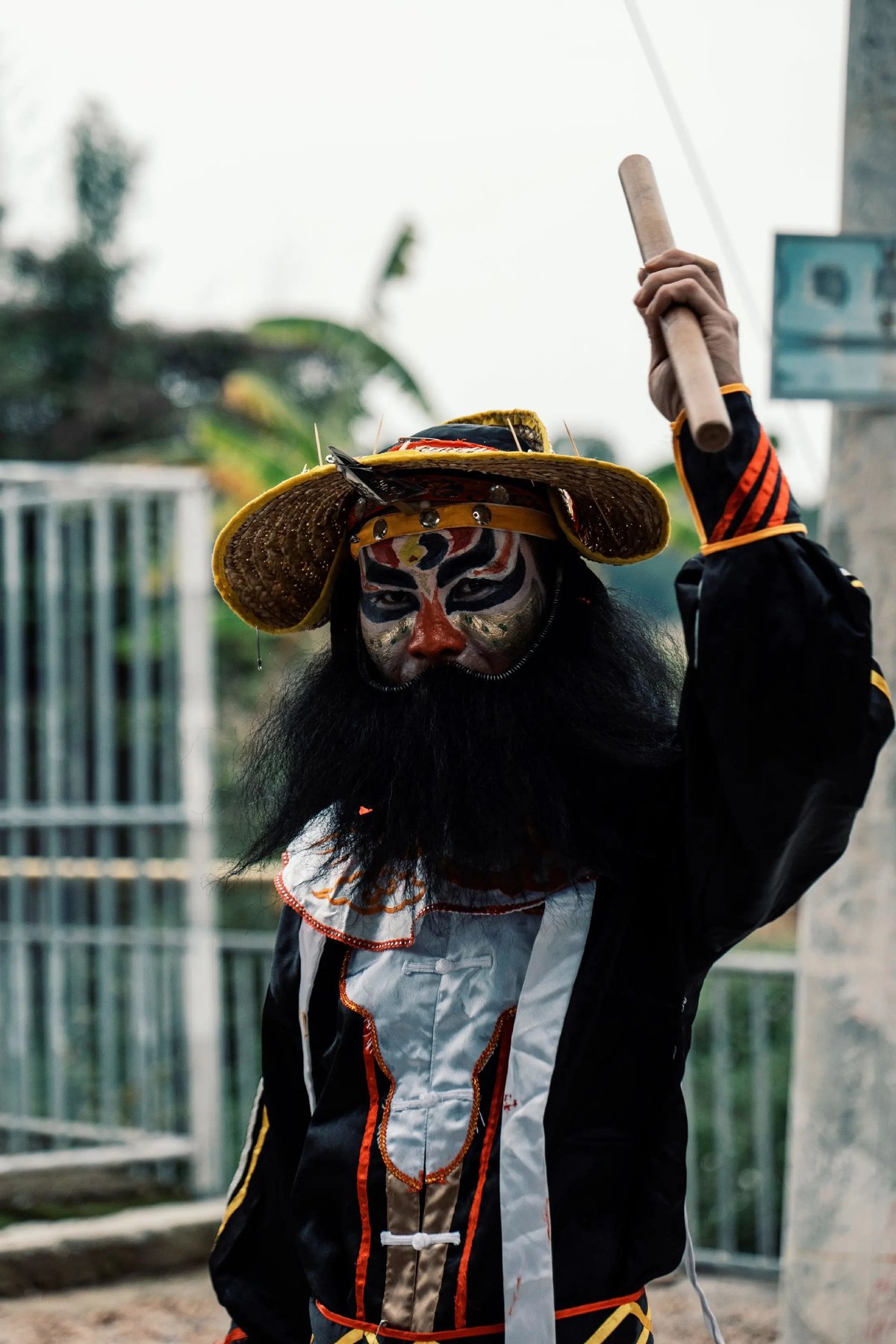
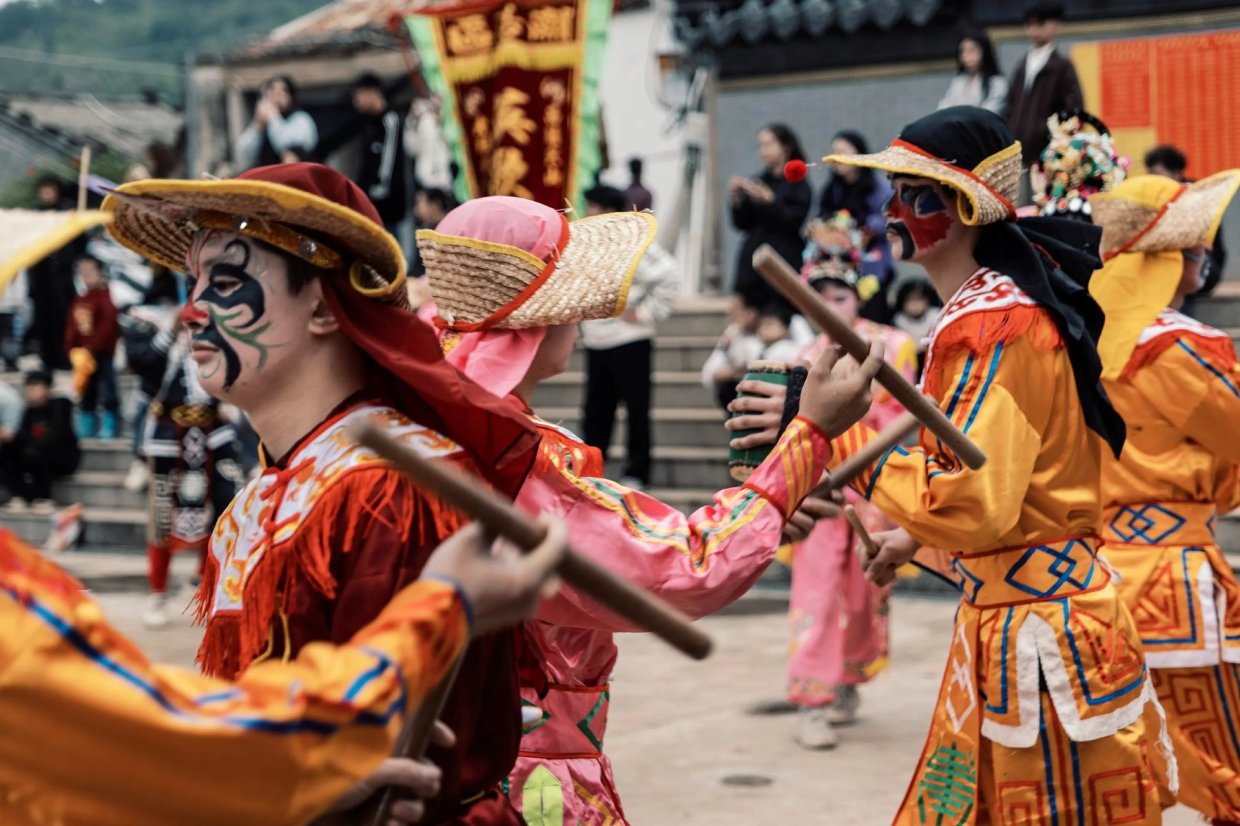
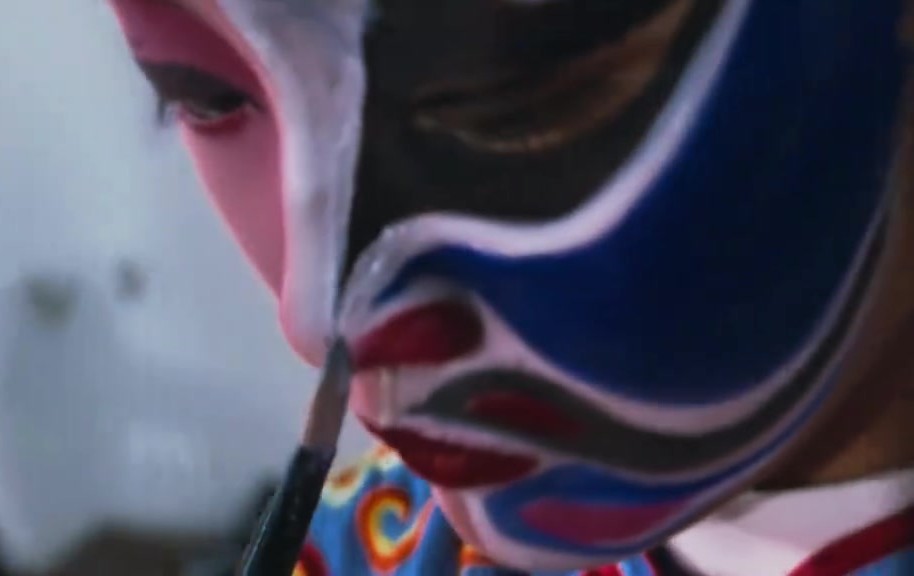
Painted after the Liangshan outlaws. Four common types cover most of it: red face with long beard, painted face with flame pattern, blue-green with taiji pattern, white face with black lines. There is no nationally uniform scheme; the same role changes ground colour and pattern from team to team.
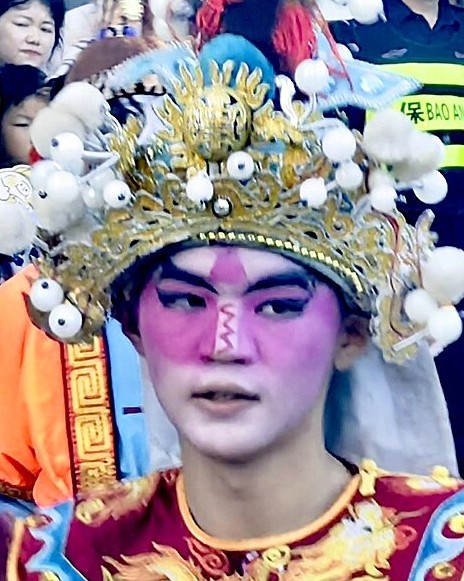
Front section and rear section
A team is split into two sections, the front section (前棚) and the rear section (后棚): the front section is drum and gong music and the Yingge body itself, and the rear section is the small operas of their own kind and the signature turns. The front section is the trunk; the rear section depends on what the team can do.
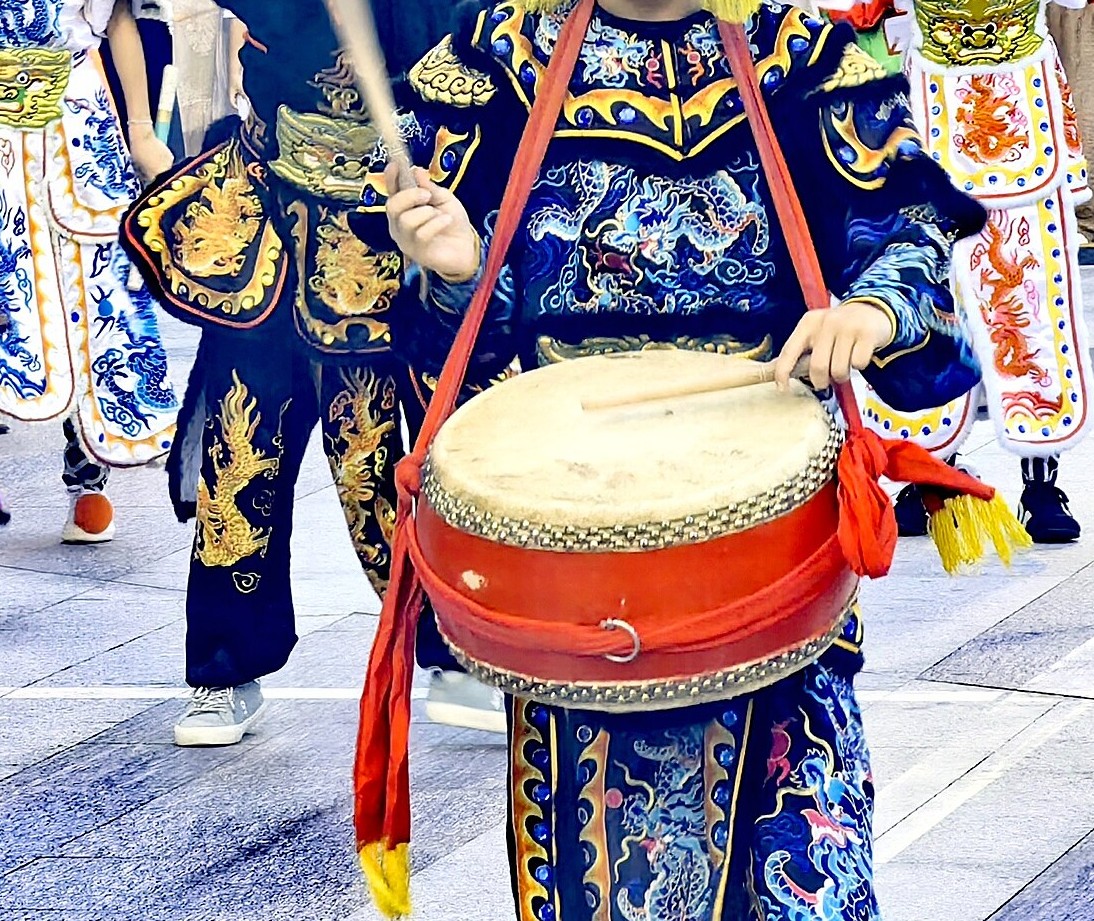
Jiazi’s rear section has left titles: Damo Crossing Guanyin, Father and Daughter Meet, Two Bamboo Maces, Two Oars, plus comic pieces such as Stealing the Piglet, The Fool Visits the Hall, Husband Carrying Wife (after the Jiazi project entry). What other places perform in the rear section has not yet been gathered.
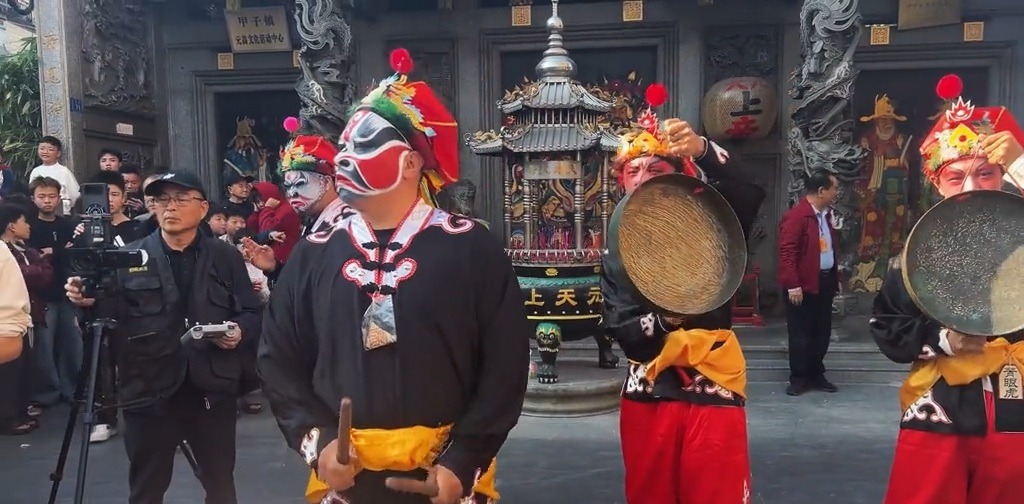
formations
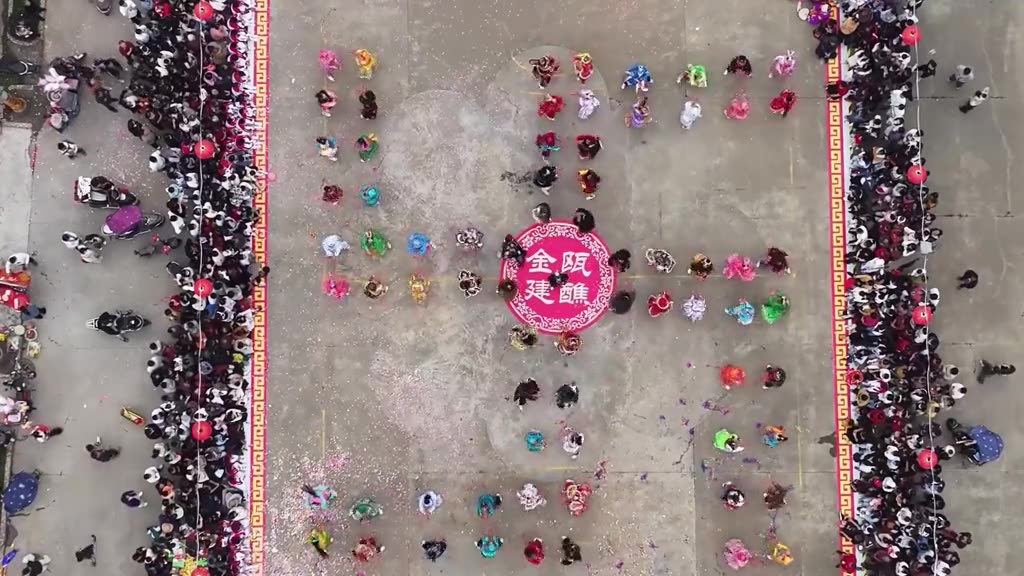
The Puning branch records four: “Two Dragons Out to Sea”, “Tiger Descending the Mountain”, “Wheat Ear”, “Snail Spiral”; the appearance is led by the “head mace” and the “second mace”, with Shi Qian, the flea on the drum, going ahead carrying a cloth snake and the rest arranged in the guise of Liangshan outlaws. The formation follows the occasion: a great circle in the village clearing, a long column at the street mouth, two columns pushing forward on the temple forecourt (four measured sessions; see also Schools: Puning, Chaoyang, Jiazi). There is also a clip of two teams on one ground, again a ball court: each team rings itself, the centre left empty, everyone facing in.
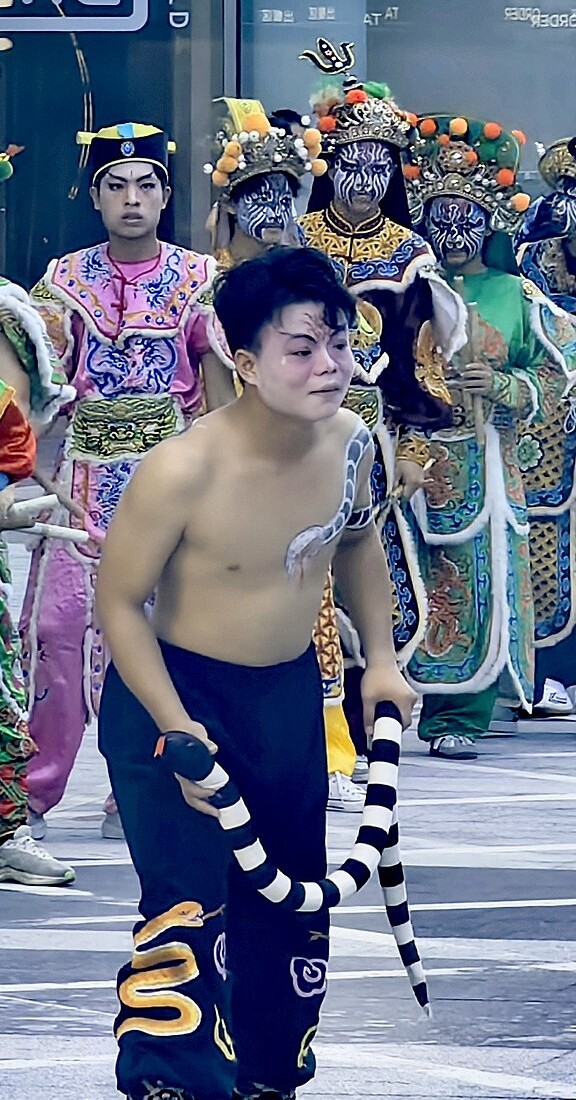
The Chaoyang district standard fixes seven basic formations, each with its floor plan written out.Twin columns: two parallel columns flowing forward in symmetry, the commonest in procession.Square formation: two columns to a group, two groups side by side making a square.Two dragons to sea: two or four symmetric columns moving the same way, splitting from the middle of the team and gradually separating into single or double columns to left and right.Snail formation: everyone joined into one column, spiralling inward or outward from the very front into a circle.
Wheat-ear formation: two columns; the fuller one joins head to tail into a great flowing circle, the thinner one weaving through it in small circles the opposite way.Peace Across the Four Seas: four columns of equal numbers, each joined head to tail into a flowing circle, the four circles set symmetrically about a cross.Eight-Trigram Formation: two columns joined head to tail into an inner and an outer ring, the band standing in an S inside the inner ring with one man on either side, the whole making the eight-trigram figure.
These three names — “Two Dragons Out to Sea”, “Wheat Ear”, “Snail” — are also used on the Puning branch (see the paragraph above), and their floor plans are recorded as the standard writes them. Beyond the standard each team has its own names: the Houxi team reports Tiangang formation, Sky Full of Stars, Double Coins, Stars Around the Moon, Beating the Middle Street and Two Dragons Spitting Auspice; the Lingsha Gong team reports Big Figure 8, Small Figure 8, Twin Arrows Piercing the Clouds and Sky Full of Stars. The same name does not mean the same floor plan, and the two are not merged.
Names that can be tied to particular teams, as things stand:Houxi team is Miancheng middle branch; each dancer carries two 58 cm wooden maces; the formations it has reported are Tiangang formation, Sky Full of Stars, Double Coins, Stars Around the Moon, Beating the Middle Street and Two Dragons Spitting Auspice. Another report gives nine names — Two Dragons Out to Sea, Six Harmonies and the Cosmos, Tiangang Paying Homage, Four Seas Rejoicing, Eight Directions Answering, Twin Rings Counter-running, Eight-Trigram Formation, Sky Full of Stars, Stars Around the Moon.
Its leader Lin Fangwu says the most traditional method in the team is the “seven-star hammer”, and that the appearance always takes “Two Dragons Out to Sea”. Both pieces are from 2023 and concern the same team with different lists; the two are set side by side, not merged on anyone’s behalf.Lingsha Gong team was originally civil-school middle branch, its sets the Seven-Beat Set and the Eight-Beat Set, its formations Two Dragons Out to Sea, Big Figure 8, Small Figure 8 and Double Coins;
after the 1997 Chaoyang Yingge arts festival it switched to the Nanshan civil-school fast branch, changing its sets to nine including Horse Battle and Breaking the Pass and adding Twin Arrows Piercing the Clouds and Sky Full of Stars.Nanshan divides into a civil and a martial school: in the civil school the later-column dancers hold a small drum in one hand and a stick in the other, and “crossing the river” occurs in the course of it; the martial school has no crossing, and instead inserts a “striking passage” of twenty-odd to thirty-odd beats into the formation changes.
On big occasions the names are counted differently. At the 2024 National Day beach show in Chaoyang, 10 teams performed the spinning mace, the single mace and the double mace, with single, double, three-sided and four-sided strikes, and ran through more than twenty formations including “Two Dragons Out to Sea”, “Wheat Ear” and “Double Coins”; in the “Two Dragons Out to Sea” section the 10 teams split into two routes and paraded along the shore. The women’s teams compose their own sets too: besides the old routines the Ximen Women’s Yingge Team has composed the ten-beat set “Two Phoenixes Greeting Spring” and the twelve-beat set “Hundred Phoenixes in Flight”.
Costume
The Puning branch records “warrior garb, tight short jackets”; mask, costume and props together identify the man.
The forms have names. The standard divides costume into two by mask: opera-face masks go with opera dress, close to the short-jacketed martial role of opera, colour prized for brilliance; ghost-face masks go with black clothes and trousers, or white, close to the folk figures of the Black and White Impermanence. Four kinds of headgear:the helmet is worn by military roles, with pom-poms on top, a cape behind, some with pheasant tails; the one Guan Sheng wears is called “Jianying”, the one Shi Jin wears “Yinglaobao”;the gauze cap is worn by non-military roles and includes the arhat cap, the hexagonal cap and the foreign cap;the straw hat is in fact cloth, and some have no crown, being called the “straw-hat ring” or the “soldier’s cap”;
there is also the head cloth used together with the caps. Clothes come in three kinds:the hero’s coat, large collar and front opening, embroidered braid along the hem, a waist sash, cuffs and trouser legs tied tight;the flaunt coat, worn by Shi Qian, with rows of knotted buttons from collar to hem, in embroidered and plain versions;the armour, worn by military roles, a tiger’s head embroidered on the front and called the “armour belly”; the women’s armour carries dozens of coloured streamers from waist to foot.
Footwear: men wore straw sandals early on and now mostly the coir sandal, that is the arhat shoe; women always wear embroidered shoes. Yingge costume has no water sleeves, so that the movement stays brisk.
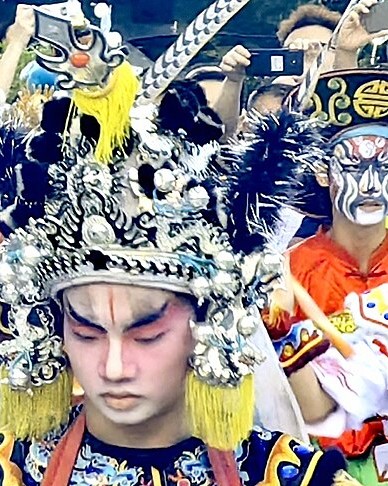
Tied to a particular team, as things stand, one:the Ximen Women’s Yingge Team dress in the red-and-green uniform of the sword-and-horse female role, the red playing Hua Mulan and the green Mu Guiying; the make-up is fresh, a “fire” character painted on the forehead, which the team says takes in both unity and “women not giving way to men”. The team’s movement borrows the basic footwork of the men’s Yingge and folds in the steps and poses of opera dance, so it moves lightly.
Fabric, colour and embroidery by team still have no team-by-team record. This layer the standard cannot supply either — it writes forms, not which cloth a team used in which year, what dye, what pattern.
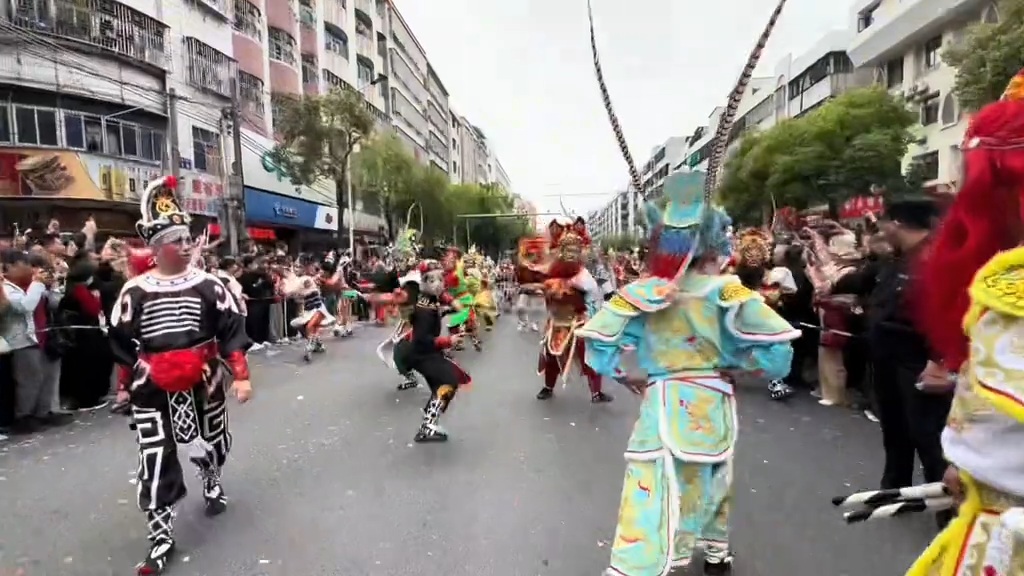
Team size depends on manpower and money: 24, 36, 72 and so on; another reading fills the establishment of the 108 Liangshan heroes yet fields 107 — Lu Junyi is the man being rescued and does not enter the ranks, hence one fewer. This reading appears in teams’ own accounts and in reporting; the official project page never writes 107, and it cannot be taken to mean that every team fields that establishment (see “107 and 108 are two measures”).
← Previous: What it isBack to the featureNext: Schools →
| Sources | Type |
|---|---|
| Houxi Yingge goes viral: traditional dance researchers from Shantou, Chaozhou and Jieyang feel its pull togetherNanfang Plus2023-04-10 | report |
| Chaoyang district holds a beach show of Yingge danceNanfang Plus2024-10-05 | report |
| The women’s Yingge team’s “Chinese war dance” — sharp!Guangming Online2024-02-22 | report |
| The women’s Yingge team’s “Chinese war dance”, sharp!Zhanjiang Evening News2024-03-03 | report |
| Intangible cultural heritage: Chaoyang Yingge (DB 4405/T 315—2025)Shantou local standard, Shantou Administration for Market RegulationIssued 2025-02-24, effective 02-25 | Local standard |
| [Chaoyang heritage] A national intangible cultural heritage item: Chaoyang YinggeNanfang Plus2023-02-06 | report |
| Behind Yingge dance’s breakoutFarmers’ Daily (reprinted by China Economic Net)2023-06-06 | report |
| Yingge (Puning Yingge)China Intangible Cultural Heritage Network / Digital Museum of China ICHNo publication date on the item page; announced in the first batch, 2006 | National list entry |
| Yingge (Chaoyang Yingge)Ibid.No publication date on the item page; announced in the first batch, 2006 | National list entry |
| Yingge (Jiazi Yingge)Ibid.No publication date on the item page; third batch, 2011 (extension item) | National list entry |
| Publication of the revised protection units for national ICH representative itemsDepartment of Intangible Cultural Heritage, Ministry of Culture and Tourism2019-12-05 | Ministry release |
| Puning Yingge DanceOffice of the Foreign Affairs Commission of the CPC Guangdong Provincial Committee (Foreign Affairs Office of the Guangdong Provincial People’s Government)2026-07-24(https certificate error; this link runs on http) | Government website introduction |
| Reply to Proposal No. 20250334 of the Fourth Session of the 14th Shantou CPPCCOffice of the Chaoyang District People’s Government, Shantou2025-05-14(https certificate error; this link runs on http) | Government information disclosure |
| Ximen Women’s Yingge Team, ChaoyangShantou Polytechnic, “Yingge dance” feature2025-03-06 | College feature |
| “Once in a lifetime, you must see Yingge dance in Chaoshan!”China News Service2024-02-28 | report |
Access date: all eight items above were opened one by one on 23 October 2026 and were reachable that day. Two further team counts sit outside the table for want of a stable direct link: the Chaoyang team count in Southern.com, November 2024, and the Puning team count on the Puning municipal government site, January 2024; both are named in the text. The figures they record can be checked against two government documents already in the table (the Chaoyang district government reply of May 2025 and the provincial foreign affairs office’s July 2026 note on a visit), so the two notes stand side by side, without arguing from the unlinked items alone.
Two further pieces were read but not cited and so are not listed: the National Ethnic Affairs Commission’s “Dance drama Yingge: where the sticks rise, one family” (2026-08) and the Guangdong Department of Housing and Urban-Rural Development’s “Light and shadow on the hometown of emigrants”.
Statements and sources
The source table above is arranged by where each source is used, and cross-volume ones are listed as well. This passage works the other way: it picks the six sentences most worth checking back and points each to its basis one by one. It is not the whole page — not that the other sentences have no basis, but that these five are the ones most easily read as general rules. The bracket after each heading is Evidence status: recorded directly on the official project page / local standard / teams’ own accounts and reporting / on-site record on this site / inference from images on this site — the five are never mixed; where a statement involves two or more sources they are listed in order.
One · The size of the mace Official project page / local standard / on-site record on this site
Where in the text: the first sentence of “The mace”
Basis:Puning Yingge, Chaoyang Yingge Both project page overviews carry the same sentence, “each person holds two round short wooden sticks (10 cm in diameter, 20 cm long)”; the Chaoyang page says elsewhere that the slow branch “uses longer maces than the other branches” and the fast branch “uses shorter Yingge maces” — so one document gives two lengths. The Chaoyang district local standard Intangible Cultural Heritage: Chaoyang Yingge, DB 4405/T 315—2025, records in Table 2 that “the length of the Yingge mace differs by type of Yingge and is generally 40 cm to 61 cm”, and that the body of the mace is mostly black or red, with patterns allowed on the heads and shaft. One pair in use at the Mianbei Houxi team measured 58 cm by this editor.
scope: 10 × 20 is the overview’s record for the “short stick” line and is not a measurement by each team; 40–61 cm is the range the standard gives across types; 58 cm is one pair in one team. Three figures answer three questions and are not merged. Note too that “10 cm in diameter” does not match the object — a hand cannot close on that thickness, and with a 20 cm length it does not make a ratio of two; the text is copied as written and the point stands as doubtful, pending verification.
Two · The headcount: 108 and 107 Official project page / teams’ own accounts and reporting
Where in the text: the closing paragraph of “Costume”, “Team size …”
Basis: 108 comes from the Puning project page two places — the overview’s “at least 12 people, at most 108”, and the Puning passage’s “at least 24 or 36 people, at most 72, up to 108 at the maximum”. 107 appears nowhere on the Puning, Chaoyang or Jiazi pages; it comes from teams’ own accounts and reporting.
scope: 107 cannot be raised to official wording, nor generalised into a uniform establishment. What the official text gives is a ceiling, answering “how long can one team be”; 107 answers “how many the role establishment calls for”. On meeting either figure, first ask which question it answers.
Three · Chaoyang’s three rhythmic patterns Recorded directly on the official project page (Chaoyang)
Where in the text: the closing sentence of “The mace”, and “Footwork”
Basis:the Chaoyang Yingge project page The text has three passages, slow, middle and fast, each giving beat count, drum pattern and where it is current (Wenguang, Mianbei and Chengnan).
scope: Chaoyang only. A different beat count (five to thirteen) does not mean a different rhythmic pattern.
Four · The rear section’s titles Recorded directly on the official project page (Jiazi)
Where in the text: the second paragraph of “Front section and rear section”
Basis:the Jiazi Yingge project page The text lists the small operas Damo Crossing Guanyin, Father and Daughter Meet, Two Bamboo Maces, Two Oars, and comic turns such as Stealing the Piglet, The Fool Visits the Hall, Husband Carrying Wife.
scope: Jiazi only. The Puning and Chaoyang pages write only “the rear section is small operas of their own kind and signature turns” without naming them —this is a gap in the record, not an absence of performance. What the rear section performs elsewhere is still to be filled in.
Five · The formation follows the occasion On-site record on this site
Where in the text: the closing sentence of “Formations”
Basis: this sentence is not the project page’s; it comes from the four on-site records in Schools compared — public footage between March 2025 and October 2026 — and only its description of the ground shape is borrowed. The fifth record is counted separately: one clip of two teams on one ground, a ball court, each team in its own ring; it is an additional example only and does not alter the sentence above.
scope: the scope of observation is exactly these five clips and five occasions. Enough to say the ground shapes differ; not enough to prove a stable formation split between Puning and Chaoyang, nor to judge whether the difference is growing or shrinking, and certainly not a census of teams.
Six · The names of formations and costume Local standard
Where in the text: the second and third paragraphs of “Formations”, and of “Costume”
Basis:DB 4405/T 315—2025, Intangible Cultural Heritage: Chaoyang Yingge (issued by the Shantou Market Supervision Administration on 2025-02-24, in force from 02-25): chapter 5 basic technique, chapter 6 basic formations (seven, each with a floor plan), Appendix B costume. The standard was proposed and administered by the Shantou Culture, Radio, Television, Tourism and Sports Bureau, and the drafting bodies include the Mianbei Houxi, Wenguang Taoyuan, Caowei township, Chengnan Zhongjing and Ximen women’s Yingge teams and the Shantou Polytechnic.
scope: the standard covers only the Chaoyang branch, and its introduction states plainly that “the drafting of this document covers only the main content of the front-section performance of Yingge and does not include the performance content of the middle and rear sections”. Formation names and floor plans at Puning and Jiazi are counted separately. The standard gives names and floor plans, not a census of teams — what a given team actually walks still has to be seen on site.
Inference from images on this site One item is not among the five above and is set out separately here: the four mask types and the roles they go with are inferred from images. The official project pages write only “masks are painted after the Liangshan heroes” and have no such four-way split —“the source has masks in it” and “the source has this four-way split” are two different things. Which of the four a given team used in a given year still needs separate checking;
Last revised: 25 October 2026