The yingge face-paint table
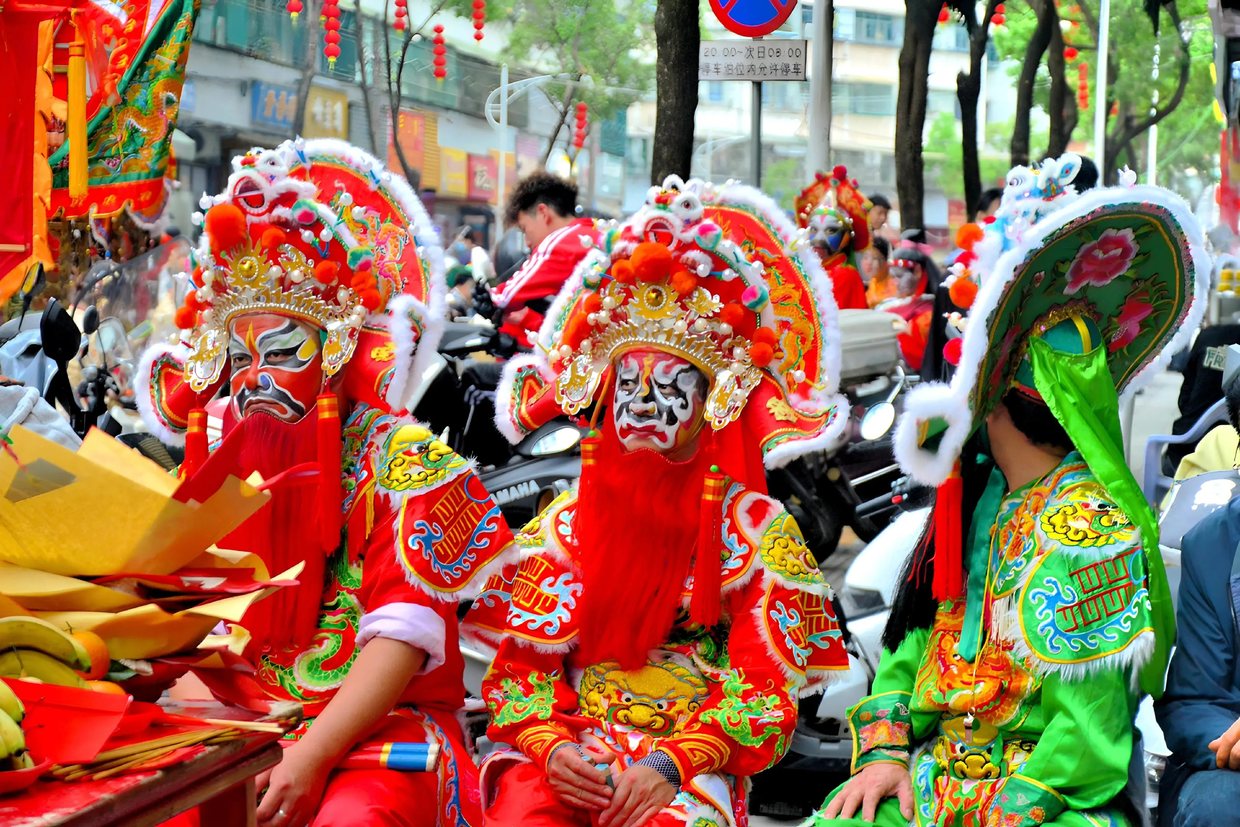
Yingge paints its faces after the Liangshan heroes, but there is no national scheme saying which role paints what, or in what colour. Keep two things apart: first the rules the standard does fix (the Chaoyang district local standard DB 4405/T 315—2025), then what the records show each recognisable role painted as. Roles with a recorded face go in the table; those that exist only as a name, with no face on record, follow after it.
1. First the rules: how a team paints its faces
The rules come from a local standard: Intangible cultural heritage: Chaoyang yingge, number DB 4405/T 315—2025, a recommended local standard, currently in force. The Shantou Administration for Market Regulation approved and issued it on 24 February 2025, in force from the 25th; the administering body is the Shantou culture, radio, television, tourism and sports bureau, and the filing number is 121564-2025. Seven chapters, plus Appendix A for the plates and Appendix B for costume. Its scope, in its own words, is “the transmission and practice of traditional Chaoyang yingge” — so it governs the Chaoyang school only. The introduction adds that “this document covers only the main content of the front-section performance, not the middle and rear sections”, so it describes only the faces of the front section. Fourteen bodies drafted it: besides the city and district culture centres and Shantou Polytechnic, several teams — Houxi of Mianbei, Taoyuan of Wenguang, Gushuai Youth, Caowei township, Lingdong, Chengnan Zhongjing, Ximen women’s, and Haimen Cihai.
| Item | What the standard says |
|---|---|
| Two kinds of scheme | The opera scheme borrows theatre make-up and mostly paints Water Margin characters; the ghost scheme is chiefly black and white, and the hideous and terrifying are to be avoided |
| Base colours | Red, black, white |
| Secondary colours | Blue, green, yellow |
| Auxiliary colour | Ochre red or light brown |
| Two ways of painting | Gou, outlining: a brush loaded with pigment drawn straight on the face. Rou, rubbing: colour taken on the hand and rubbed over the face, then the key lines picked out with a brush |
| Order of work | Brows first, then the eye sockets, the nostrils, the corners of the mouth and the cheeks, and the face lines last |
| Roles and colours | The first stick is red-faced with a red beard, most often painted as Qin Ming or Guan Sheng; the second stick is black-faced with a black beard, most often Li Kui |
| How many roles to a team | As a rule only the first few in the file carry a fixed role; the rest of the team are mostly of no fixed identity |
| The plates | Appendix A holds the figures and face paint of the 108 heroes, plates supplied by the Houxi yingge team of Mianbei; every hero has a star name and a nickname, and not a word is written on brushwork |
What the standard gives is categories and an order — no colour numbers, no brushwork. The pigments each team actually uses, and how heavy the hand is, all differ; two faces painted “to the standard” will still not look the same.
And it does not settle the two steps before make-up, or the order the colours go on. Before painting, the face is wiped clean and the hair bound back tight with a two-inch band of black cloth, called “binding the head” in the trade and “the head cloth” in the local speech, so as to flatten the muscles of the forehead; the colours then go on black first, white next, the rest after. What the standard orders is which feature is painted before which, not which colour is laid before which. (Source: Shantou Culture Cloud, “Yingge dance”, consulted 31 October 2026.)
2. Of the three schools, only one has a written face scheme
School here means the branch of yingge: Chaoyang, Puning and Jiazi each form one, and neither the stickwork nor the face paint carries across. Set the three side by side and the written scheme falls to Chaoyang alone — Chaoyang has a local standard whose Appendix A takes the 108 heroes one by one, figures and faces; the other two stop at the one-line summary on their listing pages.
| School | Basis for the face paint | How far it is recorded |
|---|---|---|
| Chaoyang | DB 4405/T 315—2025, Appendix A, the figures and face paint of the 108, plates supplied by the Houxi yingge team of Mianbei; the body adds the two kinds of scheme (opera and ghost), the base, secondary and auxiliary colours, the outlining and rubbing methods, and the order of work | Every hero has a star name and a nickname, but the plates carry no brushwork. Colour and beard are written out for the first and second sticks only; the rest are in the plates alone. |
| Puning | The official listing page goes no further than “face paint drawn after the Liangshan heroes”; it also names eight set patterns such as the spinning stick and the washing of the street, which belong to stickwork, not to face paint | No per-hero record of face paint. Chen Laifa’s two changes to the established forms (Lin Chong with a panther’s mouth and beard, Ruan Xiaoqi with a frog’s face) are one man’s account, not a table. |
| Jiazi | The listing page records the names of the rear-section pieces and the front-section line-up; the front-section faces are not recorded | Names and line-up only. |
3. Roles, side by side
The table runs by position: first stick, second stick at the front, the rest in the order they appear in the records. Only the first two hold their role and colour steadily; it loosens further back, and the standard says as much itself.
| Role | School | Base colour | Beard | Basis |
|---|---|---|---|---|
| First stick | Chaoyang | Red | Red | The standard, word for word: “first stick, red face and red beard, most often painted as Qin Ming or Guan Sheng” |
| Second stick | Chaoyang | Black | Black | The standard, word for word: “second stick, black face and black beard, most often Li Kui” |
| Qin Ming | Chaoyang | Red (with the first stick) | Red (with the first stick) | The standard does not give him a face of his own; it records only that the first stick is most often painted as him or as Guan Sheng |
| Guan Sheng | Chaoyang | Red (with the first stick) | Red (with the first stick) | At the Helong nursery team’s session of 2026-03-05 the first stick was danced by Wu Tongbin; the standard likewise gives him no face of his own |
| Li Kui | Chaoyang | Black (with the second stick) | Black (with the second stick) | In the early years a dancer was known by a waist tablet with the name written straight on it, and Li Kui’s name was on one |
| Lin Chong | Puning | — | Panther’s mouth and panther’s beard | Chen Laifa’s change to the established form after he took over as coach, from his own account |
| Ruan Xiaoqi | Puning | — | The whole face pushed towards a frog | Same account; taken from his skill in the water |
A few other roles the teams recognise, with no face ever written down. Lu Zhishen and Song Jiang were likewise known in the early years by waist tablets with the name written on them; Song Jiang, at the Lugang township team’s session of 2026-03-09, is called “the black charcoal” and stands at the first-stick place in the file. Shi Qian goes in front with a cloth snake to lead the way, recorded as “the flying snake”, and comes out paired front and back with Gongsun Sheng carrying the command flag. Wu Song appears in a video from the Jin’ou township team, where the record has his stick broken in the dancing. Some teams set a third stick, Lu Zhishen, and a fourth, Wu Song, after the first two — whether they do, and how many they set, is not uniform. The twin princes were the roles at Caowei on 2026-01-04, and Mulan the guise borrowed by the Qiaozhu Jiudi women’s team on 2025-11-07.
The rest of the team cannot really be said to match a scheme at all. The standard says it itself: only the first few in a file have fixed roles, the rest are mostly of no fixed identity, and the red and black follow the first two, painted the same way.
4. Four looks you can pick out of the footage
The footage on this site comes down to four: red face, long beard; painted face with flame patterns; blue-green with a taiji pattern; white face, black lines. These four are a summary of the footage on this site, not an official classification — the official listing page says only “face paint drawn after the Liangshan heroes” and has no such four. Which cells fall to which team in which year needs checking separately; that point is flagged on How it is danced as well.
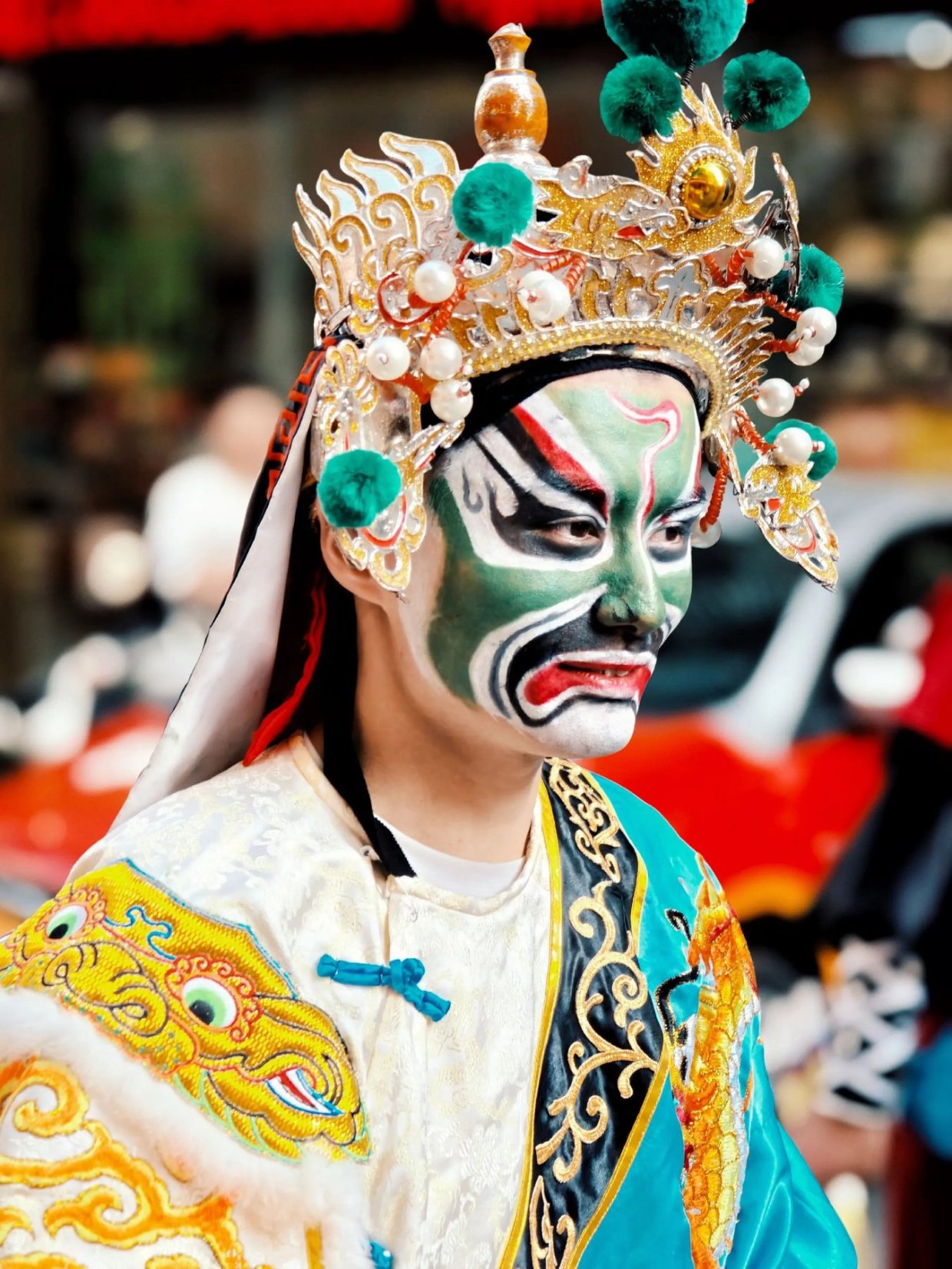
This one does not fall into any of the four: the ground is green. The four cannot hold it, which shows they describe no more than the sessions actually seen.
5. What the standard covers, and what it does not
Chaoyang only. Its scope reads “the transmission and practice of traditional Chaoyang yingge”. Puning and Jiazi each form a set of their own, and neither base colour nor pattern follows this table — the Lin Chong and Ruan Xiaoqi entries come from an oral account and are not in the standard.
No brushwork. What the standard gives is categories and an order, no colour numbers. The pigments each team uses and the weight of the hand all differ, and two faces painted for the same role will still not look alike. How many strokes go along the edge, how many lines are laid on the cheek, only comes down in words with a clear photograph of the face plus the team’s own account.
No sorting by session. The standard sorts by role, and a man wears the same face whichever day he dances. So “role to colour” is steady in this table; “which faces were used on which day” has to be checked session by session.
The 108 are in the plates, not in the text. Appendix A holds the figures and face paint of the 108, each with a star name and a nickname, and not one word on brushwork. To see a given hero’s face you have to turn to that stack of plates in the standard itself. The 108 lines are transcribed as a table on the 108 heroes.
6. Sources
| Source | Where it is | Type |
|---|---|---|
| National standards information platform — the registration page for this standard | Registration pageStandard number, issue and effective dates, administering body and filing number are taken from here; checked 25 October 2026, re-checked 26 October, still consistent | Standard registration |
| Intangible cultural heritage: Chaoyang yingge (DB 4405/T 315—2025) | Full text, PDF40 pages; chapter 5 basic technique, chapter 6 the seven basic formations, Appendix A the figures and face paint of the 108, Appendix B costume | Local standard |
| Yingge (Chaoyang yingge) | Listing pageChina Intangible Cultural Heritage Network / Digital Museum of China ICH; first batch, 2006 | Listing page |
| Yingge (Puning yingge) | Listing pageAs above; first batch, 2006 | Listing page |
| Yingge (Jiazi yingge) | Listing pageAs above; third batch, 2011 (extended item) | Listing page |
| Behind yingge dance’s breakout | Farmers’ Daily, 2023-06-06; both of Chen Laifa’s oral accounts — the changes to the established forms, and mixing colours with candle wax in the early years — come from this piece | Report |
| Chen Laifa, inheritor of Puning yingge: innovation must not spoil the thing | China News Service, 2024-02-18; the panther’s mouth and beard for Lin Chong and the frog’s face for Ruan Xiaoqi come from this piece | Report |
| The session-by-session video record on this site | Who dancesEntries from November 2025 to April 2026, the date carried on the line with the role | Record on this site |
Everything above was re-checked on 26 October 2026. The original links to the standard’s PDF and the three listing pages come from How it is danced and Who dances, where each was opened and checked line by line on 23 October 2026. The dates and team names on the video records under each role are transcribed from Who dances as they stand, unaltered.
Home › Intangible heritage › Yingge dance › The face-paint table
Last revised: 4 November 2026