The tile-kiln burning
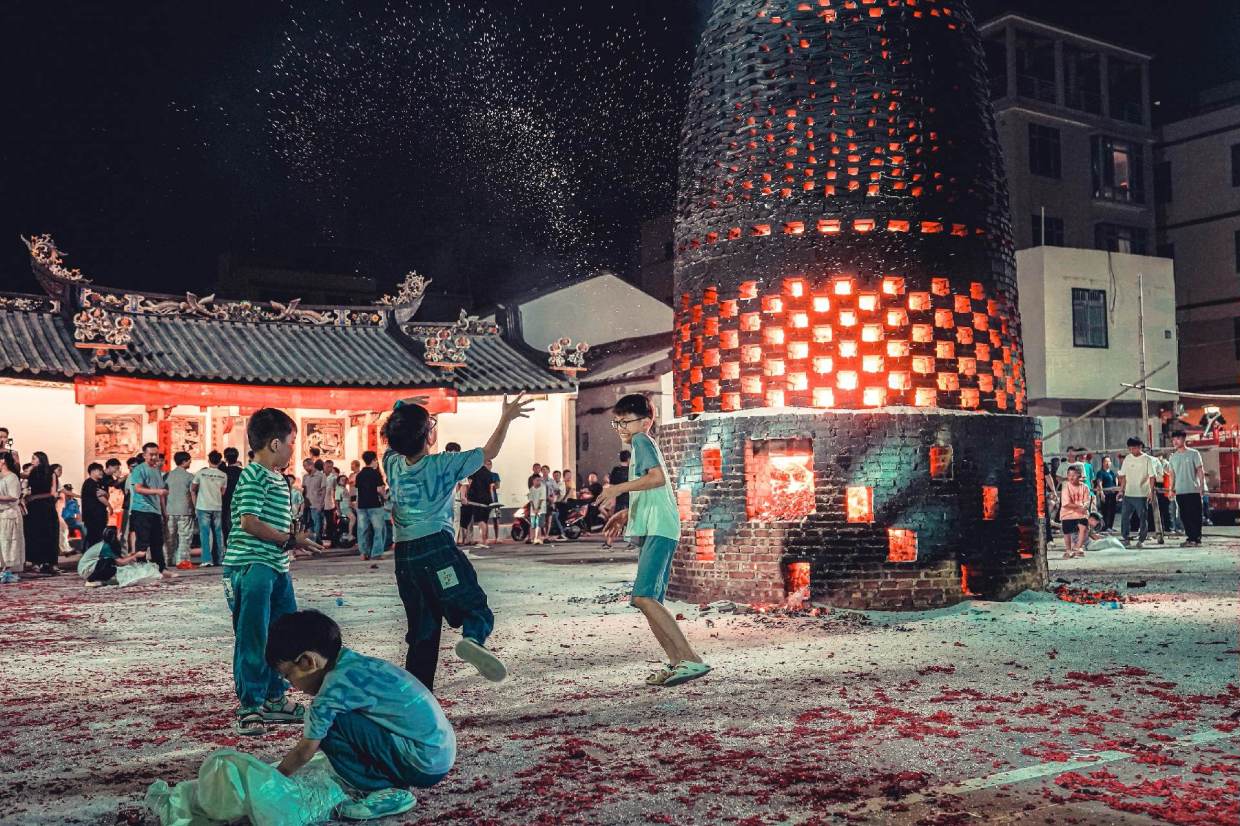
On Mid-Autumn night the village builds a tower of tiles, fills it with firewood and burns it until the whole stack glows, then throws in handfuls of salt. In the Chaoshan dialect “tile” and “ant” are the same sound: the fire is burning the ants, and it is also for the red glow of a good year.
1. The gazetteer’s “children burn towers for amusement”
At Mid-Autumn the moon is enjoyed and taro eaten peeled, which is called skinning the ghost. Children burn towers for amusement.
From the customs chapter of the Qianlong Chaozhou fuzhi. Punctuation added here.
“Skinning the ghost” is peeling the taro. The line sits on the same row as the tower burning, which tells us that in the prefectural city under the Qing, moon-watching, eating taro and burning the tower came as one run of three things.
The gazetteer says only “children burn towers” — a game for children. Today the tower at the village gate can stand nearly ten metres, with bricks and tiles pooled by the whole village, so the scale is nothing like it was; but the way it is built, the lighting and the watching it turn red are all the same set.
2. How the tower is built
In the old days it was children’s work. A few days before Mid-Autumn they gathered broken tiles, loose stones and dry branches, and on the afternoon of the festival stacked them on the threshing floor or the open ground before the lineage hall. The more broken tiles, the higher the tower.
Now it is mostly red brick. The bricks are laid in the shape of the character pin — one above, two below — course pressed on course, wide at the base and narrowing upward. Gaps are left in the body, never sealed tight, so the fire can come through; two openings at the foot, one to feed wood and one to draw out ash; and an open mouth at the top, where the flames lick up.
Dayuan village in Fengxin subdistrict, Xiangqiao, still uses brick and tile, more than ten thousand pieces to a tower. Before building, the whole village clears the ground, and bricks, tiles, firewood and straw are each household’s contribution. The burning here has come down from the middle of the Ming, more than four hundred years, and is the longest-running and most regularly held instance in the Chaozhou area.
At Xinxixi in Chendian town, Chaoyang, Shantou, the tower goes up on the big open ground beside the Zhang lineage hall. When it burns, the fire is mirrored in the pond in front of the hall — a second kiln in the water.
3. The burning: lighting, salt, red through
When the moon reaches its height, the village women make their offerings to the moon and burn paper ingots, and the elders light the kiln at its door. Straw first to catch, then split wood; the fire climbs the gaps between the bricks.
Once the body glows, people take coarse sea salt by the handful and throw it in. The grains hit the heat and burst with a crackle, scattering sparks as if a string of small firecrackers had gone off at once. The salt is there to feed the fire and to be looked at — white salt flowers turning over in the flames into a sky full of stars.
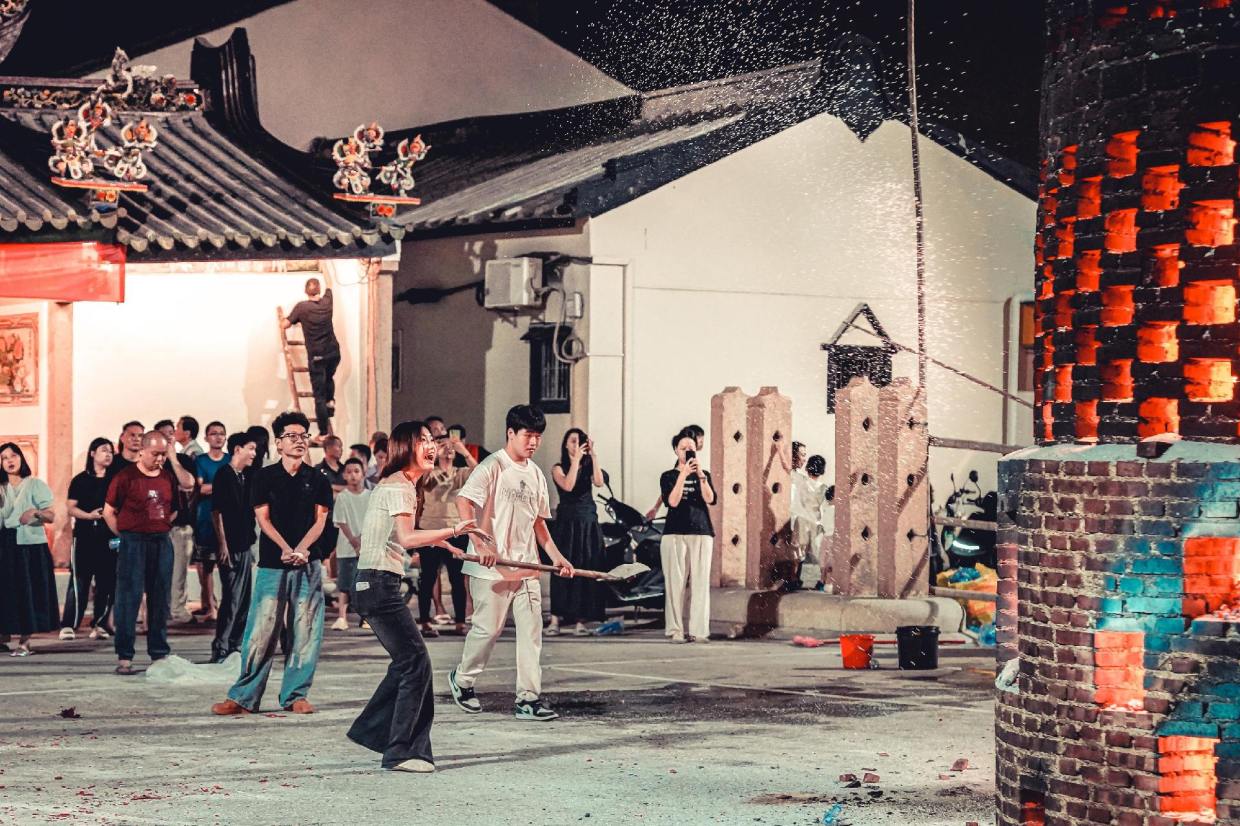
On it burns until the body is red and translucent and the fire inside can be seen from outside. Children run round the tower, adults bring stools and sit nearby with tea and cakes, staying until the fire falls of its own accord and leaves a heap of white ash.
Two companion practices belonged to the old night: fires of piled straw and wood lit at several points in the village, called smoke piles, and firecrackers and sky lanterns before and after. The first is now rare, and most villages no longer send up lanterns either.
4. Why burn it: one homophone, one legend
People here say “burn the ant kiln” rather than “burn the tile kiln”. In Chaozhou speech “tile” and “ant” sound the same, so one kiln of fire burns off every household’s ants and there are fewer the next year. That is the most down-to-earth layer of meaning.
Another layer is legend: that at the end of the Yuan, fires on Mid-Autumn night were the signal for an uprising, village lighting village, and afterwards became custom. The story is heard across Chaoshan, southern Fujian and southern Jiangxi, told differently in each place, and is best taken as a legend.
What villagers say most today is red glow and peace — the more thoroughly the tower burns, the smoother the coming year. So the saying goes; and the fire is real enough.
5. Which villages still burn
In 2026 “Chaozhou tile-kiln burning” entered the tenth batch of the city’s intangible heritage list. The list records one item for the whole city, but the holding is still by village: Dayuan is the most densely run of them, and villages in Chao’an and Fengxi each have their own tower, at different scales. The full sequence has three parts — building the kiln, burning the tower, throwing the salt.
Dayuan holds a torch relay before Mid-Autumn. The procession sets out from the kiln with torches, receives the fire at the Xiangtou ancient temple, walks once round the village and comes back to light the kiln. Lighting is followed by the salt, then gongs and drums, lion dance and the twenty-four seasonal drums.
The countryside of Jieyang and Shantou has it too, under different names, at different scales and on different days. Some villages burn one tower before the lineage hall; some keep it going for several nights.
Moon worship, peeled taro and the lard-pastry mooncake have a page of their own: Mid-Autumn in Chaoshan.
6. Before you go
The fire is big; stand well back. Do not stand directly downwind of the tower or at the kiln door — sparks travel with the wind, and hair and clothing catch first. Hold a child’s hand and do not let them run round the tower.
The tower stands on open ground with no railing round it. There are crowds at night, so look at your feet before you move.
Villages keep different dates. Most light up on Mid-Autumn night; some build the tower a day or two early and light it only that night; some move the whole thing to the weekend before Mid-Autumn so that people working away can get back. Asking locally is the surest way.
Sources
| Source | Body | Date | What it establishes |
|---|---|---|---|
| Customs chapter of the Chaozhou fuzhi | compiled by Zhou Shuoxun | Qianlong 27 (1762) | “At Mid-Autumn the moon is enjoyed and taro eaten peeled, which is called skinning the ghost. Children burn towers for amusement.” |
| Kiln fire mirrors the moon: the tile-kiln burning at Dayuan village, Fengxin subdistrict | Xiangqiao district government, Chaozhou | 2026-09 | Dayuan dates from the middle of the Ming, over four hundred years; more than ten thousand bricks and tiles stacked in the pin shape; torch procession to the Xiangtou temple to receive the fire; coarse salt thrown with a crackle; entered the tenth municipal list in 2026 |
| Four hundred years of kiln fire: Dayuan village in Xiangqiao marks the double festival | Nanfang Plus | 2026-09 | The three stages of building, burning and salting; the whole village provisioning bricks, tiles and firewood before Mid-Autumn; the alternative name “ant kiln” |
| Xiangqiao, Chaozhou: heritage kiln fire lights the Mid-Autumn night | 21st Century Business Herald | 2026-09-26 | Entered the tenth municipal list in 2026; wide at the base and narrow at the top, pin shaped; bearers of three generations |
| Festival custom at the full moon of Mid-Autumn | Chaozhou Daily | 2024-09-17 | Tower a little over a zhang high, its girth more than a person can embrace, a door left at the foot and no finial at the top; stuffed with straw and split wood; salt thrown in; the smoke piles as a companion practice |
| Burning towers at Mid-Autumn | Jieyang News | — | Called tile-kiln burning in Chaoshan, also ant-kiln burning; red-brick tower in the pin shape with two doors below and an open mouth above; built on open ground before the lineage hall, close to ten metres high; the Zhang lineage hall at Xinxixi, Chendian, Chaoyang |
Each row above establishes only what is written in its own column.
Home › Customs › The ritual year › The tile-kiln burning
Last revised: 3 November 2026