Mid-Autumn in Chaoshan
The prefectural gazetteer keeps only two lines on Mid-Autumn: moon-watching with peeled taro, and children burning a tower. Today the table carries lard-pastry mooncakes, taro and fruit in season, and what burns in the yard is a tile kiln.
1. What the gazetteer records
At Mid-Autumn the moon is enjoyed and taro eaten peeled, which is called skinning the ghost. Children burn towers for amusement.
From the customs chapter of the Qianlong Chaozhou fuzhi. Punctuation added here.
Two sentences, three things: watching the moon, eating taro, burning a tower. The taro comes to the table steamed whole and is peeled to be eaten; the name for it is skinning the ghost. The tower is built of tiles and set alight by children. That was Mid-Autumn in the prefectural city under the Qing — these few things.
2. Worship of the Moon Lady
After dark a table is set in the courtyard or before the gatehouse, draped with a cloth embroidered with auspicious birds and beasts, and laid with fruit, cloud-slice cake and mooncakes. The men sit to one side cutting red paper, and the cut-outs are pasted onto the cakes and fruit. Red candles are lit, three sticks of incense burned, and everyone waits for the moon to reach its height.
Most of those bowing are women. Young girls ask to be “fair as Chang’e, with a face like the bright moon”; those of marriageable age ask for a good match; where a family member has gone overseas and not returned, the bow carries a message to him. A Chaoshan song runs: “Mid-Autumn night, Lady Moon. Bowing deep, reunion round. A good husband, a fine match.”
Children come to the table too. Schoolbooks, pens and paper are laid beside the offerings, asking the Moon Lady to help them do well in their studies.
When the incense burns out, the housewife kneels and bows, then throws a pair of bamboo-root blocks to the ground to see whether the Moon Lady has answered. One hollow side up and one flat is the winning block; both flat the steady block; both hollow the laughing block.
3. What goes on the table
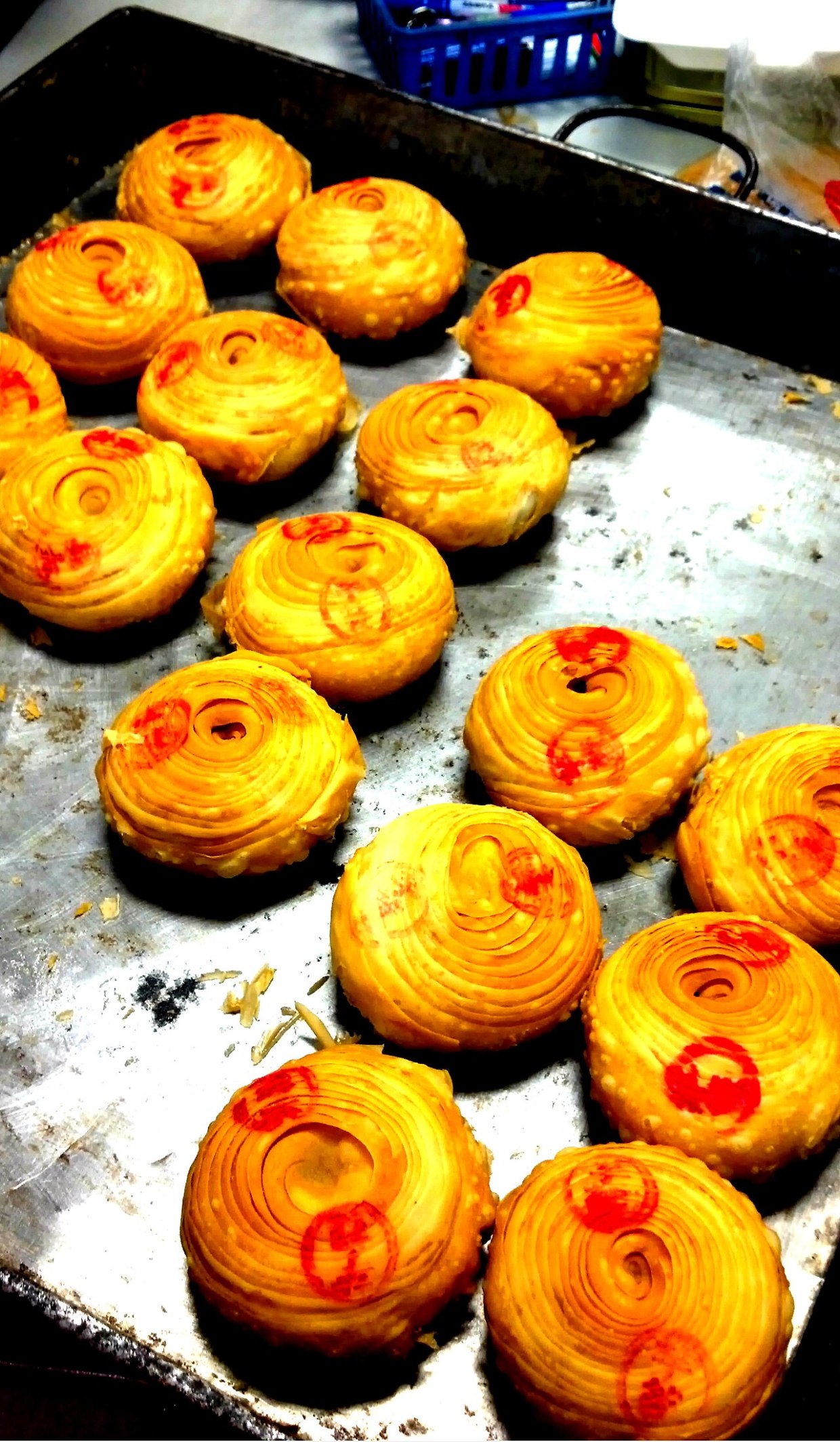
The lard-pastry mooncake is the main act. The old Chaozhou bakery way: round, a spiral on the surface, a dot of red at the centre, made both sweet and savoury. “Lao” is lard, and the flaky pastry rises on it.
Taro is obligatory, steamed whole. Peeling it is skinning the ghost; another reading has it that “taro” (yu) sounds like “the barbarian” (hu), and the sound was once used to keep one’s courage up.
The fruit is whatever is in season: pomelo, persimmon, star fruit, sugar apple, longan, green pear. Mid-Autumn falls just as this lot comes off the trees, and seven or eight kinds go on the offering table at once, which is why the festival is also called the fruit festival.
4. The tile kiln
Stacking the tower, lighting it and throwing on the salt have a page of their own: the tile-kiln burning. What children once built of broken tiles on the threshing floor can now stand nearly ten metres at the village gate, with bricks and tiles contributed by every household.
5. The date
Mid-Autumn is the fifteenth of the eighth lunar month, which falls on a different Gregorian date each year — check the calendar for the year. For the lunar-to-Gregorian correspondence, use the astronomical calendar on this site.
Sources
| Source | Body | Date | What it establishes |
|---|---|---|---|
| Customs chapter of the Chaozhou fuzhi | compiled by Zhou Shuoxun | Qianlong 27 (1762) | “At Mid-Autumn the moon is enjoyed and taro eaten peeled, which is called skinning the ghost. Children burn towers for amusement.” |
| Festival custom at the full moon of Mid-Autumn | Chaozhou Daily | 2024-09-17 | The table and prayers of the moon worship, children laying out books and pens, the three outcomes of throwing the blocks, whole steamed taro as a required offering, fruit in season, the song |
Each row above establishes only what is written in its own column.
Home › Customs › The ritual year › Mid-Autumn in Chaoshan
Last revised: 3 November 2026