Spring Festival customs
The prefectural gazetteer writes the New Year as two entries, “New Year’s Eve” and “New Year’s Day”: the day before, offerings to the ancestors, the family round the fire, firecrackers and gongs; the day after, a vegetarian offering, young and old bowing to one another, callers at every door. New Year’s Eve has a page of its own; this one covers the first day, and the driving-in of cattle that follows five days later.
1. What the gazetteer records
On New Year’s Eve the ancestors are offered to. The peach-wood charms are changed, a fire is set in the hall. The family sits round it to eat, which is called wei lu. Firecrackers, gongs and conch horns — this is called driving off evil and thieves. … On New Year’s Day the offering is vegetarian; young and old bow to one another, and callers come to the door to congratulate. Five days later cattle are brought in with exorcist dance, which is called averting calamity.
From Gujin tushu jicheng, Chaozhou prefecture section, quoting the prefectural gazetteer (customs chapter of the Qianlong Chaozhou fuzhi). Punctuation added here.
The first half of the passage belongs to New Year’s Eve — the offering to the ancestors, the change of peach-wood charms, the fire in the hall, the family sitting round it, the firecrackers and gongs. Each of the five is taken up in New Year’s Eve.
2. Three things on the first day
The first day is recorded as three things, one action each. The offering is vegetarian: the ancestors are served vegetable dishes, no meat. Young and old bow to one another: the whole household gathers in one place and bows. Callers come to the door: friends and relatives are visited and congratulated — today’s new-year calls are this third thing.
The order runs from inside the house to outside the gate: the offering is made in one’s own hall, the bowing happens among the family, and only then does anyone step out of doors.
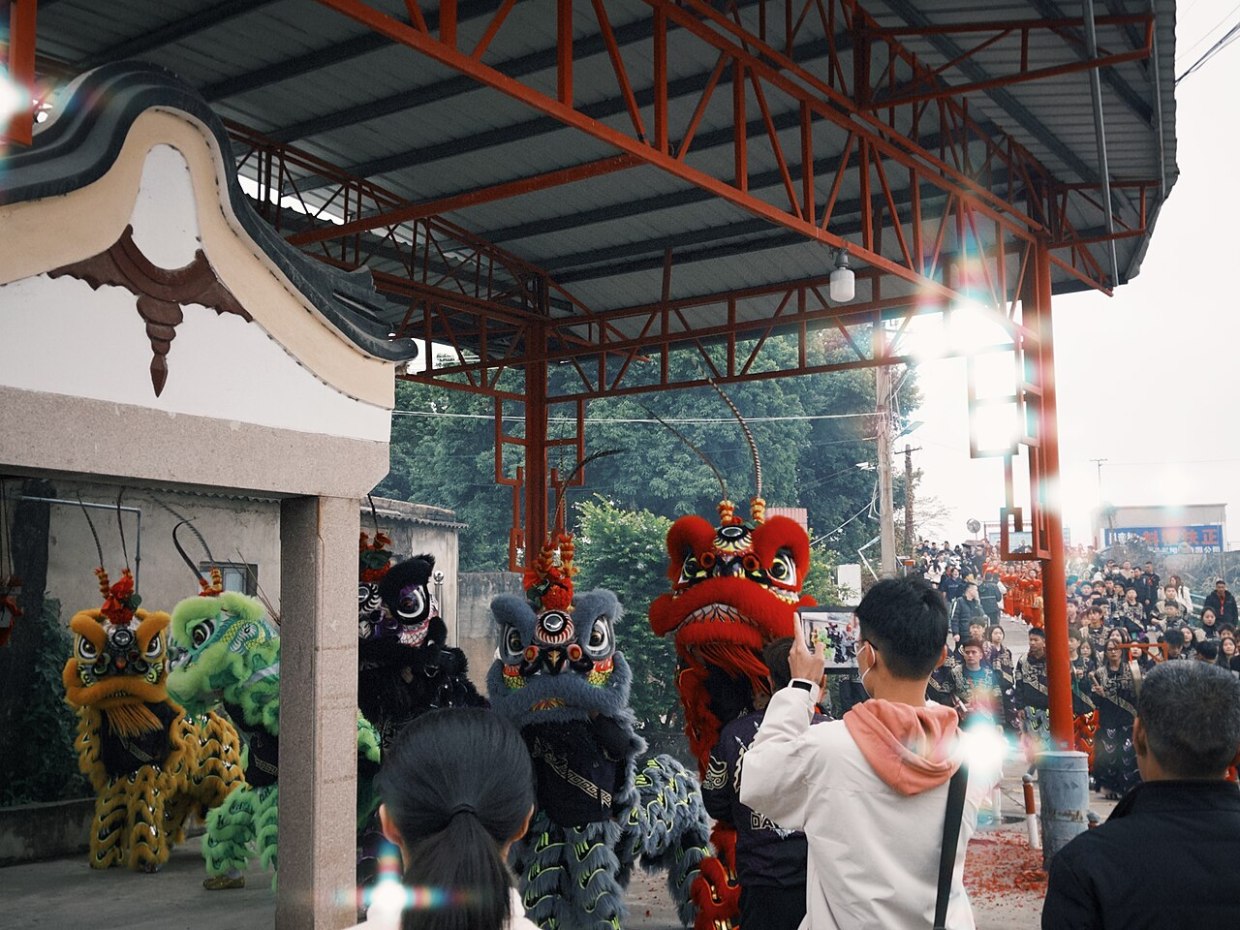
What has changed most is the “cattle brought in with exorcist dance” five days later: that rite of the days after the fifth is rarely seen now, leaving traces only in the god processions of some villages.
3. Differences between counties
The gazetteer covers the prefectural city and its neighbourhood only. The dates, offerings and rites of the constituent counties are not recorded county by county.
4. Calendar anchor
The solar terms, lunar phases and lunar dates referred to in this section can be checked on the corresponding pages at Kuang Chujia’s research site on historical astronomy and calendars. That the timing of a custom is never cut loose from the calendar is a standing rule on this site.
5. Sending spring
From the first day of the first month to the fourth, a woman’s natal family sends a gift round to a married daughter, called “sending spring”. The gift travels in a pair of spring baskets — tiered bamboo hampers with lids, three or four deep, carried as a pair on a pole by the daughter’s brothers. Big mandarins are obligatory, along with several dozen joints of sugarcane for “a step higher at every joint”. How generous the gift is depends on the family’s means, and a newly married daughter gets a fuller one. The in-laws kill chickens and geese to receive the bearers, a saying that runs “when the brother-in-law comes, catch the chicken and kill it”. What the daughter’s household receives is then handed out to relatives and neighbours by the mother-in-law, carrying a flowered basket — called “sending the food down”. These are the same baskets used for the betrothal gifts of a wedding; see the marriage customs of Chaoshan. (Reference: Chaoshan网, “The spring basket of Chaozhou custom”, cs.ymkymk.cn/fengsu/4993.html, accessed 31 October 2026.)
Sources
Gujin tushu jicheng, Chaozhou prefecture section, quoting the prefectural gazetteer; the Qianlong Chaozhou fuzhi (compiled by Zhou Shuoxun, completed in the twenty-seventh year of Qianlong), customs chapter. Accessed 18 October 2026. For the offering to the ancestors, the peach-wood charms, the fire in the hall and wei lu on New Year’s Eve, see New Year’s Eve.
The seventh of the first month is the birthday of humankind, and seven vegetables are boiled that day — see Renri and the seven-vegetable stew.
The processions from the New Year to the end of the second month have a page of their own: the procession calendar, twenty dates in lunar order with Gregorian equivalents and the status of each date.
Home › Customs › The ritual year › Spring Festival customs
Last revised: 3 November 2026