Renri and the seven-vegetable stew
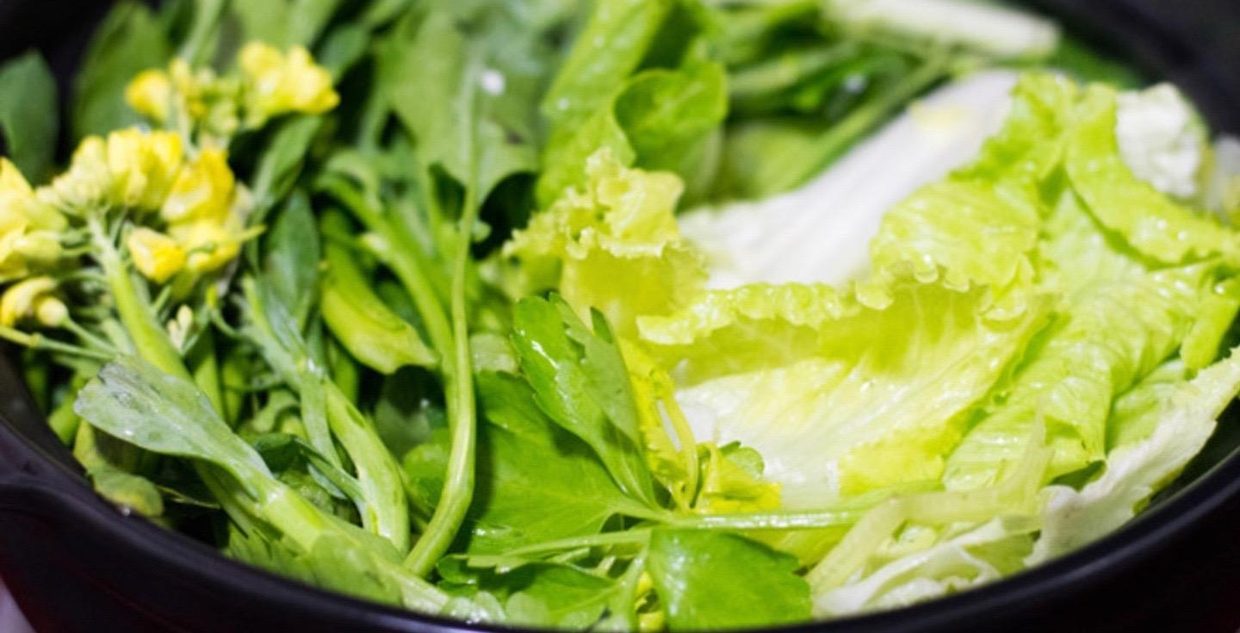
The seventh of the first month is the birthday of humankind. Chaoshan keeps it with no banquet and no offering to the gods, only a pot of greens — seven vegetables boiled together, called qi yang geng, the seven-vegetable stew, also qi yang cai or qi bao geng.
1. Why the seventh day is the birthday of humankind
In the story of the seven days of creation, the first six made the six domestic animals — a chicken on the first day, a dog on the second, a pig on the third, a sheep on the fourth, an ox on the fifth, a horse on the sixth — and only on the seventh day was humankind made. So the seventh of the first month is renri, the day of humankind.
Eating seven vegetables on it is not particular to Chaoshan. A sixth-century record of the seasons already has it that on renri “seven vegetables are made into a stew” — the pot has been on the fire for fifteen hundred years.
For the local line of descent there is another old account: on renri people made cakes of seven green vegetables and offered them in memory of the birth of humankind, and the cakes were later simplified into boiling the seven vegetables outright.
2. Which seven
There is no standard list. The seven are made up differently across Chaoshan, and within one county village differs from village and household from household. Three common combinations:
- Around Puning: da cai (mustard greens), houhe, celery, garlic, chun cai (spring mustard), Chinese chives, gai lan.
- Tuyang village, Puning, Jieyang: white radish, Chinese chives, chun cai, spring onion, celery, houhe, garlic — the houhe here is properly Swiss chard.
- Another way of making it up: celery, spring onion, garlic, chun cai, da cai, coriander, houhe — swap in Chinese chives and one more line gets said, “long and lasting”.
The list is not strict; two things are: the greens must be in season, and there must be seven of them. A few are usually kept — white radish, chun cai and Chinese chives, for the three meanings of a good omen, the return of spring, and lasting.
In recent years new items have come in: snow peas for “pockets full”, cauliflower for “wealth in bloom”, spinach (feilong cai) for “a career taking off”. Most young people can no longer say which seven were traditional; get seven colours and a good meaning and it passes.
3. It is all in the puns
The point of the seven is entirely in how the names sound in the Chaoshan dialect, one lucky line to each:
- Cai tou (white radish): a good omen (cai tou).
- Chinese chives (jiu cai): long and lasting (jiu).
- Chun cai: all things return with spring, and it sounds like “spring wealth” (chun cai).
- Spring onion (cong): clever (cong ming).
- Celery (qin cai): hard-working (qin), and it sounds like “diligent wealth”.
- Garlic (suan): good at reckoning (suan), money to be reckoned.
- Houhe: getting on with people, having one’s plans fall in with others, being helped along in what one does.
- Da cai (mustard greens): big fortune (da cai), a thriving livelihood.
Put the seven or eight together and they make one continuous sentence of good wishes: hard-working, clever, good at reckoning, lasting, spring returning, everything falling in with one’s plans. Swap one vegetable and one line changes, which is why households make up different sets and say slightly different things.
4. How it is cooked
The home method is plain: a small handful of each of the seven, washed and cut into lengths, into boiling water, two boils and off the heat, little oil and light salt, so that what you taste is the vegetables themselves. Some stir-fry the lot in a hot wok into one large plate; it is still called seven-vegetable stew.
The more particular cook uses a stock, or adds dried shrimp and dried scallop. In restaurants it comes as soup, as a stir-fry, or in a clay-pot casserole. The vegetables are always cut into lengths and cooked together, with no order of going in — all seven at once, until just done.
5. One saying
“Seven-vegetable stew, seven-vegetable stew: the grown-ups eat it and turn young again, the children eat it and their cheeks go pink, the young women eat it and look like a flower.” The saying is very widely known in Chaoshan; the three lines say the same thing — eat this pot and a person becomes younger, ruddier, better looking.
After days of meat and fish since New Year’s Eve, a pot of greens on the seventh cuts the grease and settles the stomach, and that is the most solid layer of the custom. By this day the year’s feasting is over; the Lantern Festival comes next.
Sources
Vegetables and their meanings: Puning municipal government, “‘Seven-vegetable stew’, the more you eat it the younger you get”; China News Service, “Seven vegetables on the seventh of the first month in Chaoshan, with new items added for full pockets” (9 February 2011, interviews at Tuyang village, Puning, Jieyang); Science China, “Chaoshan custom: the traditional seven-vegetable stew”.
The origin of renri and the phrase “seven vegetables made into a stew” come from Jingchu suishi ji by Zong Lin of the Liang dynasty; that Chaozhou already had the practice in the Ming is a claim cited in the China News Service piece above. All web pages accessed 29 October 2026.
The saying that goes with the dish is “seven-vegetable stew, eat it and turn young”. The old explanation: from New Year’s Eve to the seventh there is meat and fish every day, and by the seventh vegetables should pull things back — after too much meat, more greens aid digestion and open the appetite. That reading is a later note on diet and hygiene, and it travels with the saying. (Reference: Chaoshan网, “Chaoshan food sayings”, cs.ymkymk.cn/wenhua/5078.html, accessed 31 October 2026.)
There is also a glossary entry: seven-vegetable stew (pronunciation, meaning and the words most easily confused with it).
See also: Spring Festival customs (the first day and the cattle driven in on the fifth); New Year’s Eve (the last day of the twelfth month); Lantern Festival and the god processions (the fifteenth of the first month); The ritual year (the order of the year); the eight festivals of the year (glossary).
Home › Customs › The ritual year › Renri and the seven-vegetable stew
Text on this site is CC BY-SA 4.0; copyright in images is reserved and commercial use requires a separate licence.
Last revised: 3 November 2026