Jinxian Gate
The one gate tower left in the old city of Jieyang, opened in 1621, and one of the eight old views of the town under the name ‘the horn at the watchtower at dawn’.
In one line One gate tower left of five: look at the thickness and the outline, not the carving.
Look for The depth of the arched passage, the street pattern read from the tower, the octagonal roof seen from across the street.
What to see文化看點
One gate tower is all that is left. The gate was opened in 1621, re-cut by the magistrate Zeng Yingrui, and the name means ‘bringing in the worthy’: it faces the Confucian temple, a city gate turned towards where scholars go, which is not common in a town this size. The old list of eight views calls it ‘the horn at the watchtower at dawn’, and what you look at is outline and thickness rather than ornament.
History歷史
In the old city, between what were the east and north gates. Opened in the first year of Tianqi (1621; the city government page says 1622) by the magistrate Zeng Yingrui, ‘to rouse the arts and dispel ill fortune’; the gate leads through to the Confucian temple, and from that comes the name.
The city had east, west, south and north gates; this one was extra, which is why people speak of five. The stone plaque carries no signature. Local tradition has it that seven worthies of the Tang and Song buried the plaque there and seven of the Ming dug it out and built the gate — a story, but the place the gate holds in local memory is not: when the old city was rebuilt in the 1940s the wall and the four gates were all pulled down, and this one was left standing.
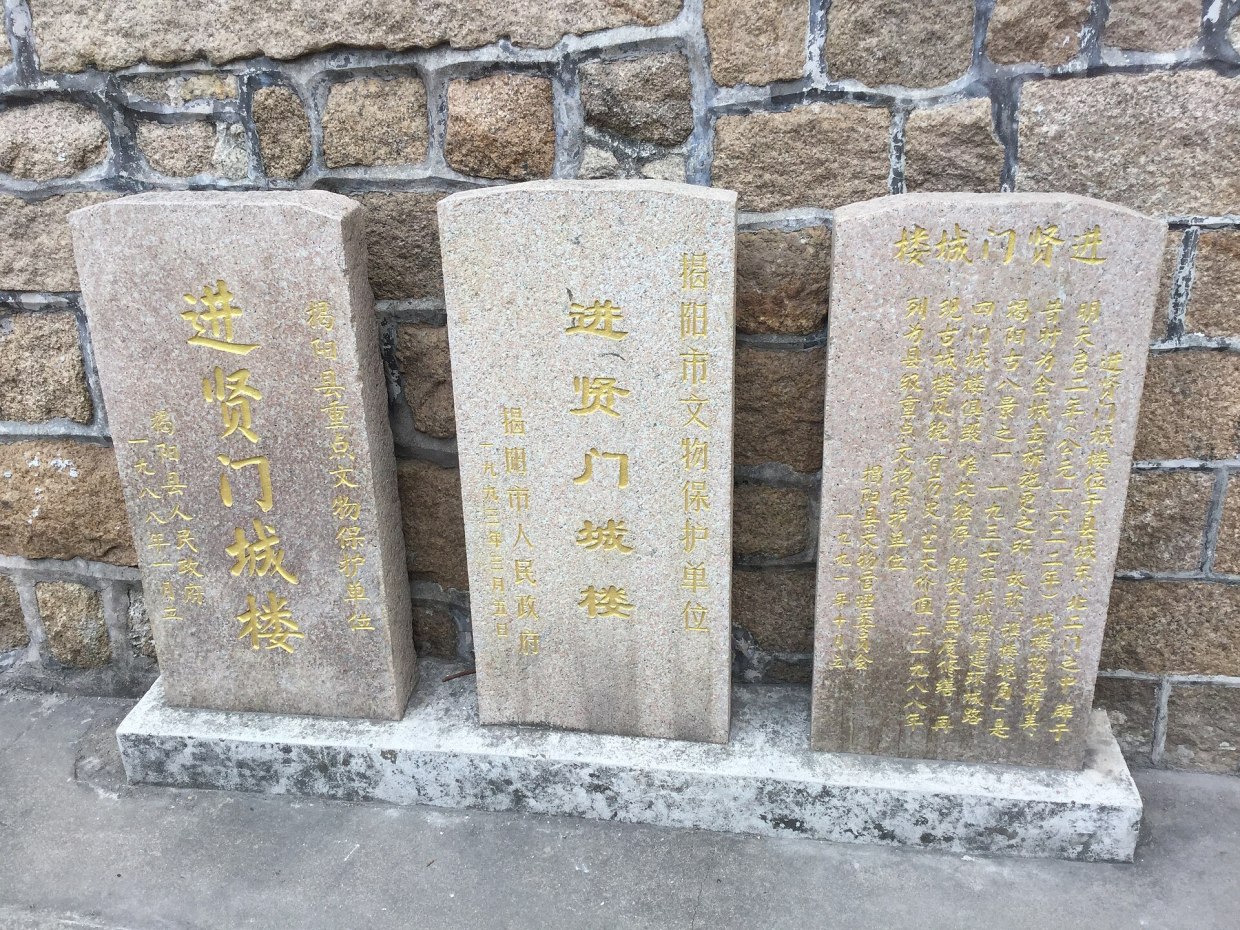
Listed in 1993 in the first batch of Jieyang protected sites, and in December 2015 in the eighth batch of Guangdong provincial ones.
Craft工藝
- Form: a brick and stone base with an arched passage below, a timber tower above — the usual way of a Ming and Qing gate tower.
- Position: not on a main gate but between two of them, which is what makes this one unusual.
The building形制
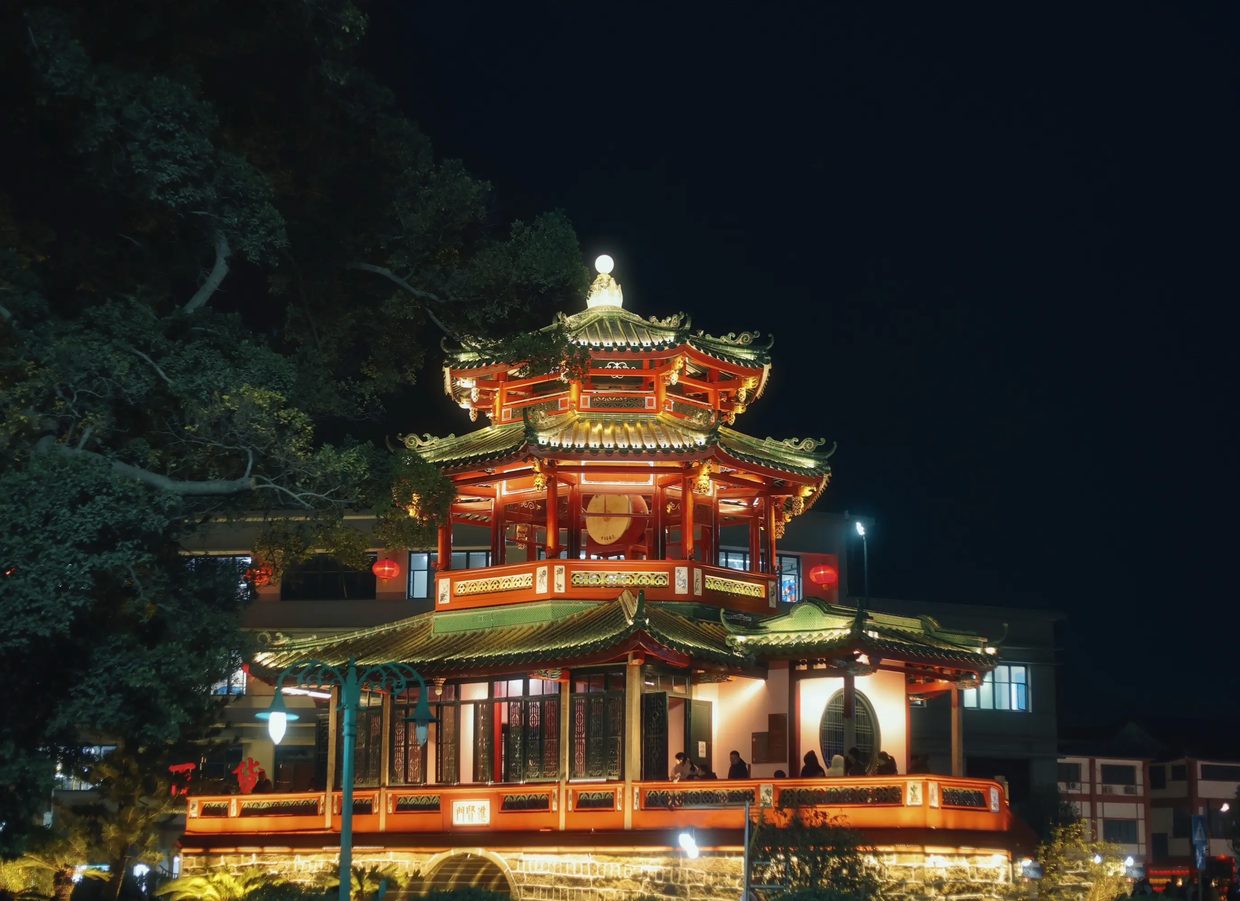
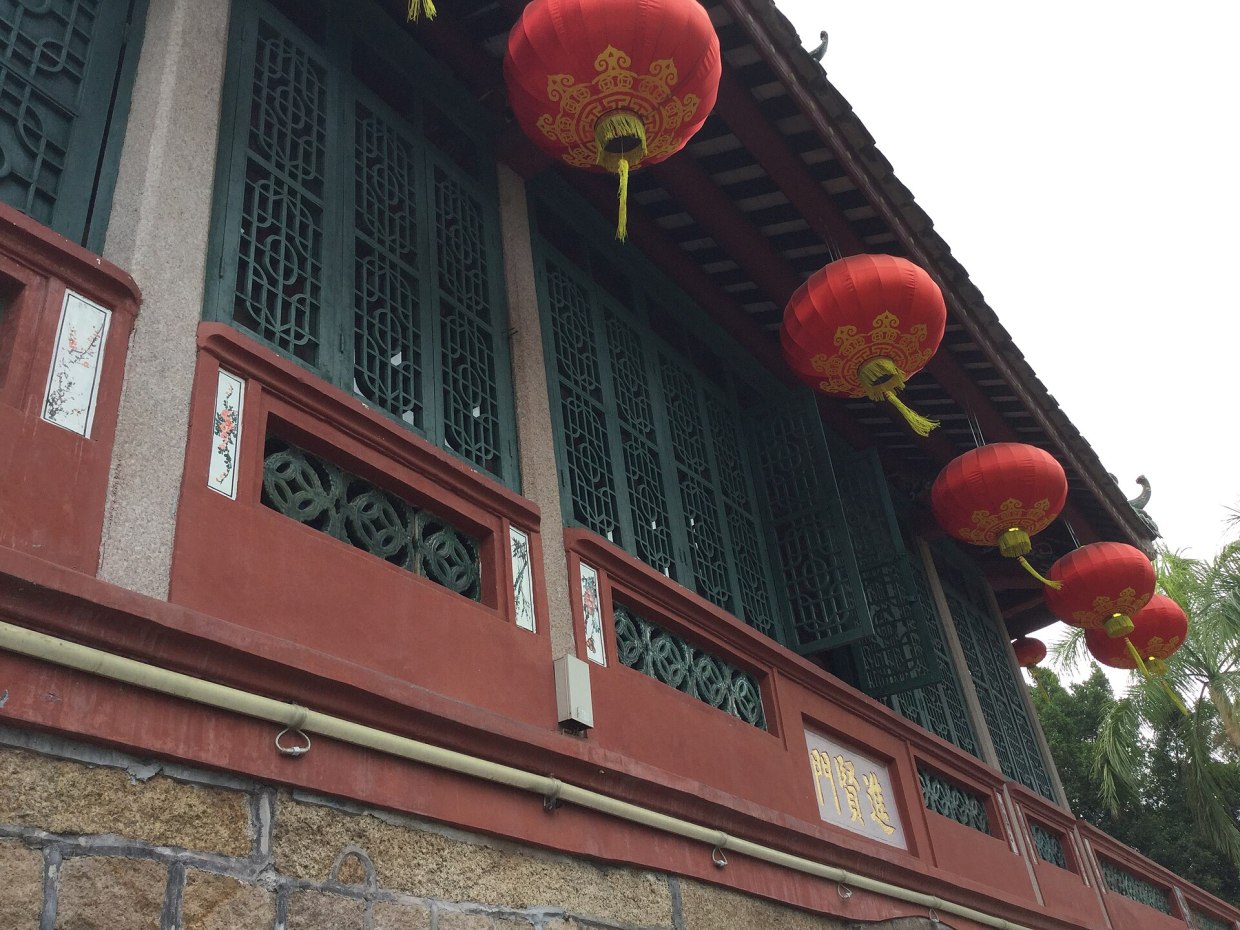
A stone gate below and a three-storey tower above, 16.77 metres to the top, of fir throughout. The first storey is three bays deep and five wide, with pierced windows on every side and a gate pavilion to north and south, the eaves turning up at the corners; above sits an octagonal pavilion under a pyramidal glazed roof. Gate, tower and pavilion run together as one building in three parts, a form rarely seen elsewhere in China. Local people call it the Red Pavilion.
The horn at dawn譙樓曉角
Through the Ming and Qing the tower was where the night watch was struck. Towards daybreak the watchman blew a horn, and the sound went across the town on the morning wind: from that comes ‘the horn at the watchtower at dawn’, one of the eight old views of Jieyang.
The eight views were revised three times: the set recorded by the magistrate Cai Shan under Hongwu includes this one; in 1632 the magistrate Chen Dingxin and Guo Zhiqi drew up a new list and replaced it; in 1687 the magistrate Zheng Lian revised Guo’s list again. This view belongs to the Hongwu set, and the old name is still the one in use.
Walking through走一趟
Officials coming to take up a post entered by this gate first, for the luck of it; so did bridegrooms, and students going up for examination, for a wise wife and a pass. The habit is still alive — in examination season you see parents walking their children round the tower.
What to look at看什麼
- The arched passage: walk through it once each way and feel the thickness.
- The tower: go up and read the direction of the streets; note the pierced windows of the first storey and the two gate pavilions.
- The octagonal pavilion: stand back on the far side of the street, where the pyramidal roof and the turned-up corners come out.
- The arcades round about: the Zhongshan arcade street is close by.
Visiting參觀提示
In the centre of Rongcheng, walkable to the Confucian temple and the City God temple. Half an hour is enough; do not come out for this alone.
Tickets and opening Free. The outside can be seen at any hour; whether the tower is open depends on the day. No booking.
Related entries對應詞條
Administrative history, the places index.
On the same trip同城順路
- The Confucian temple — same old city, walkable.
- The City God temple — walkable.
- Shuangfeng temple — same old city.
- Jinxian Gate bridge — south out of the city to the Rong river, lit purple at night; for the whole view and the reflection, go to the far bank.
Order them by map and by your own hours; this only says what is on the way to what.
Sources來源
- The date of the gate, Zeng Yingrui’s re-cutting, ‘to rouse the arts and dispel ill fortune’, the gate leading to the Confucian temple, the story of the two sets of seven worthies, and the 1940s demolition that left this gate standing: Rongcheng district government, ‘Jieyang: Jinxian Gate’ (Jieyang Daily); Jieyang city government, ‘Jinxian Gate’.
- The height of 16.77 metres, the fir structure, three bays deep and five wide, the two gate pavilions, the pyramidal glazed roof and the three parts in one building: Jieyang city government, same page; Baidu Baike, entry ‘Jinxian Lou’.
- ‘The horn at the watchtower at dawn’ and the three revisions of the eight views: Jieyang city archives, ‘The eight old views of Jieyang, revised three times’.
- The 1993 city listing and the December 2015 provincial listing: Baidu Baike as above; Rongcheng district government as above.
Home › Travel › Jieyang › Jinxian Gate
Last revised: 5 November 2026
 粤公网安备44522102000407号