Shigu: feeding the unclaimed dead in the seventh month
Shigu, also called pudu or the yulan festival, is the public rite of the seventh month that feeds the ghosts nobody makes offerings to. Each township picks its own day, one village to a day, and neighbouring villages mostly stagger — so this table is one village to a cell, unlike the first-month processions, where one day covers several villages. Fifty places are collected here, each traced to town and village, with former practice marked where it has stopped, and the rites at temples and charities listed separately.
The page does one thing: sets out the days of those fifty places, and explains why they fall as they do. The origin of the yulan festival, how the ghost shelter is built, how the scramble is run, are in a separate piece, the Chaoshan yulan festival; the four words shigu, yulan shenghui, gupeng and qianggu each have an entry in the glossary. To see which villages are keeping it on a given day, turn to the procession calendar.
The frame of the seventh month
The whole seventh month is shigu, but only three days are common to all. The rest are one village each. The word shi is pronounced like “xue” in Chaozhou speech; what the old people call “xue gu” is written with these two characters.
The old gazetteers set the arrangement out plainly. The Guangxu Haiyang xianzhi: “in the seventh month they hold the yulan fair, which is called shigu, also called pudu.” The Puning xianzhi of the sixth year of Qianlong: “the temples and monasteries all hold the yulan fair, setting out food to feed the ghosts who have no one to make offerings to them.” The Jiaqing Chenghai xianzhi records that at mid-seventh-month “the monks of each temple hold the yulan bowl assembly and chant sutras, and towards evening prepare vegetarian food and give it at the flaming mouths, and release water lanterns to light the darkness”. Rao Zongyi’s Chaozhou zhi, compiled in 1956, puts it most directly: “from the first day the village wards hold the yulan assembly and give at the flaming mouths, and on this day above all.” It starts on the first, each ward sets its own days, and the fifteenth is the densest.
Shigu and the worship of ancestors are two different things, kept apart in the seventh month. The family’s own dead have their own portion: paper money, ingots of gold and silver are put into paper “bundles”, the ancestor’s name written on the cover like filling in a form, and burned between noon and dusk — “burning the bundle”. The Qing writer Yuan Mei has it in the Xin Qi Xie: “the people of Guangdong, at mid-seventh-month, mostly seal paper money and burn it, calling it burning the bundle, each in worship of their own forebears.” What happens at the ghost shelter at the village mouth is for those with no descendants — the two are not mixed.
Some of those invited have names. The soldiers who fought the Yuan at Heping in the last years of the Southern Song, the unnamed dead of the war of resistance, the people who starved in the great famine of 1943. They have no descendants to burn paper, so the whole village invites them to this meal in the seventh month. In some villages the invocation still carries the line “we pray that the hungry multitude of Chaoshan in 1943 be released from suffering”, and the offerings include raw taro and bran cakes — the two things the starving lived on that year. The city of Chaozhou is the other way about: by old custom raw taro, raw banana and pineapple are avoided, and even the peach and pomegranate that ward off evil are not offered, for the same plain reason — what does not go down well cannot be eaten by a ghost.
| Point | What is done | 2026 Gregorian |
|---|---|---|
| 1st of the 7th month · opening the ghost gate | in the afternoon each household sets food at its door, burns incense, paper ingots and paper clothes; also called worshipping the “opening of the prison” | 13 August, Thursday |
| 15th of the 7th month · the day itself | the busiest day of shigu; most villages keep their main day on it or a few days either side | 27 August, Thursday |
| 30th of the 7th month · closing the ghost gate | worshipping the “closing of the prison”, sending the ghosts back to the underworld. In 2026 the seventh month is a short one of twenty-nine days | 10 September, Thursday |
How one public rite runs
Who runs it differs by village. Mostly a charity hall takes the lead, though a ward that keeps a god may preside — the Crown Prince, the General, the Thousand-Year Lord have all presided. The money comes by “one household undertaking it” or “several households together”: a well-off family takes a whole session, in an ordinary year a few families club together; some villages levy it by head count, or the organisers collect donations and buy everything in one go. Where a god presides there is spirit possession: the god comes down on the medium, who wears the divine robe and carries a whisk or a sword, walks and leaps, says things nobody understands, and sometimes climbs a “three-storey bed” of three square tables stacked up and gestures from the top, inviting the gods and summoning the ghosts to come and be fed.
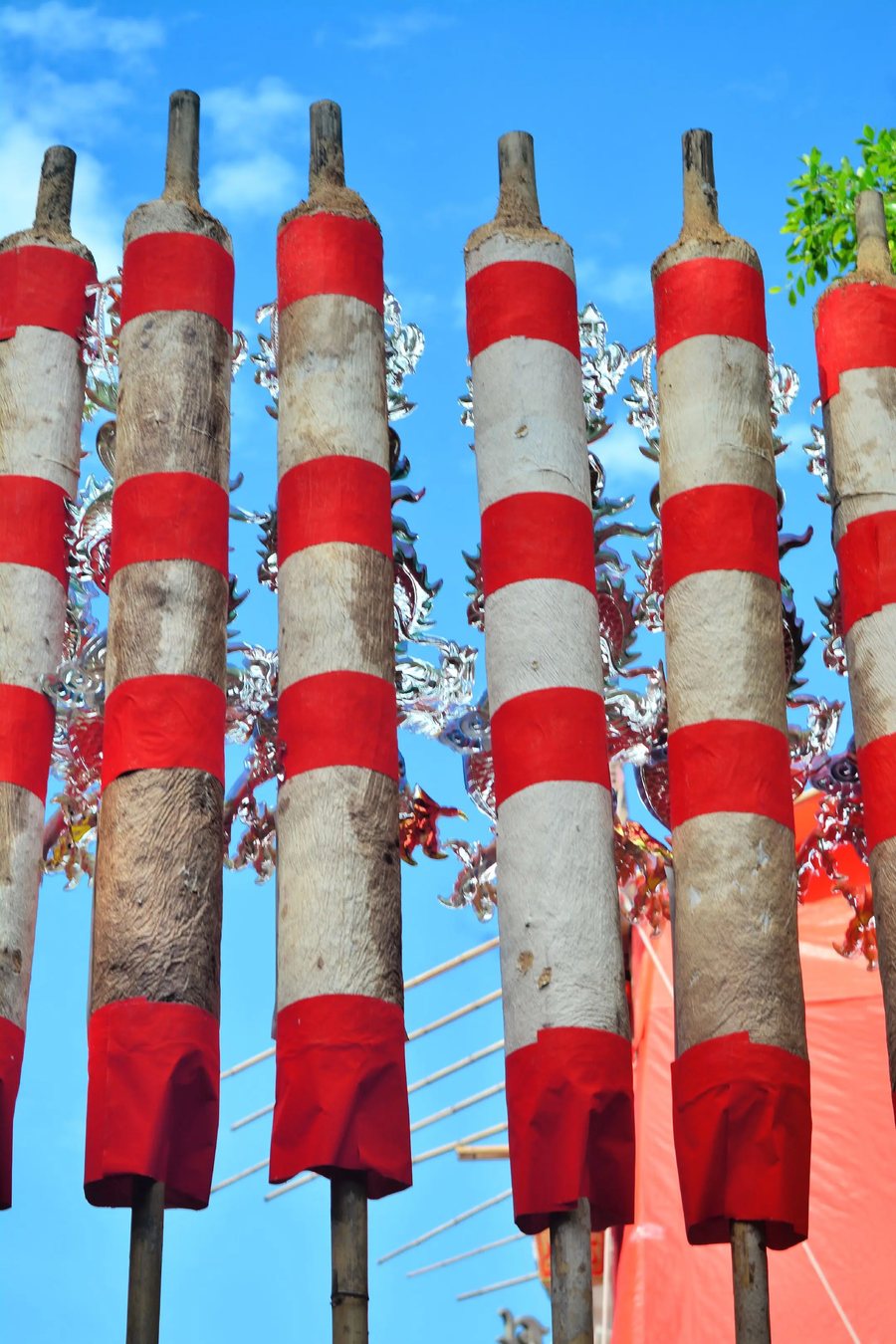
Building the ghost shelter. A frame of bamboo and timber, eight feet to a zhang high, with Ksitigarbha on top. Before it stands the king of ghosts — bamboo frame, paper skin, green face and fangs, white armour, two or three zhang tall, whose business is to keep the altar. Beside the shelter hangs the Guanyin treasure ship, filled with silver paper. The shelter at the Baode old hall in Heping can still be measured: about six metres off the ground, eighteen metres long, three metres high, four deep; before it stand a pair of “sky-lighting candles”, which are in fact tubes of bamboo packed with dry firewood — called candles, not candles. In the middle of the king of ghosts’ seat is written “the mortar of orphaned souls”, above it a horizontal plaque “cold grove lodge”, and a couplet: “guide the four kinds of birth up to the nine grades, lead the six paths out of the three evil ways.” The shelter usually goes up on the village threshing floor before the stronghold, often beside a banyan; the start is agreed by the village elders at the god’s temple.
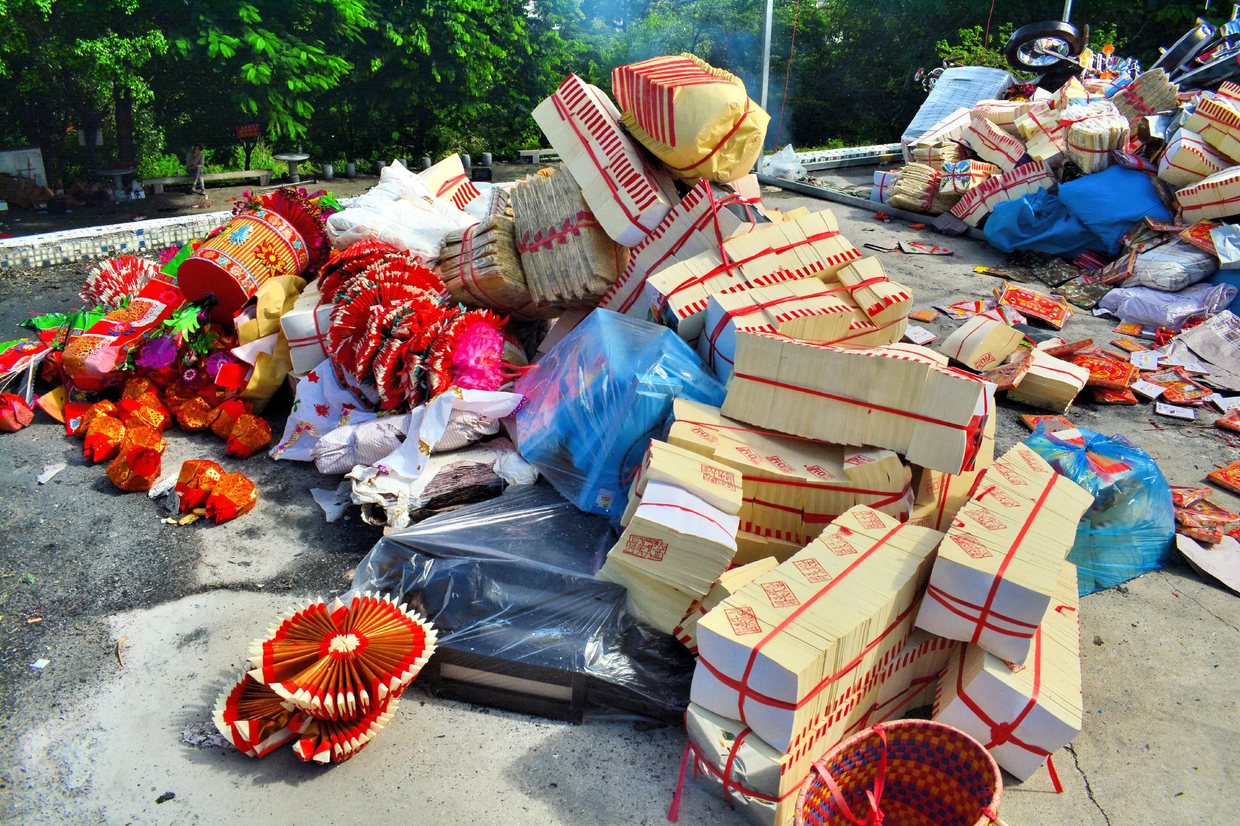
Setting out the offerings. They do not go on tables but on the ground or on low stands. The old explanation is blunt: among the war dead are men without hands or feet, and children who died young cannot reach a table. Under the shelter are separate washing rooms for men and women, with clean water, basins and towels. The tablets are in three blocks — male ghosts, female ghosts, and children of both — and after the victory in 1945 some places added a fourth, “the soldiers who fell in the war of resistance”.
Giving at the flaming mouths. The diamond master opens the altar, strikes the bell, leads the monks in chanting the yulan bowl sutra, changing mudras without pause, singing as trays of steamed buns and rice are scattered to the four directions. At the Kaiyuan temple in Chaozhou, before the great flaming-mouth rite, a boat used to go up the Han river to Sanhe dam, lighting earthenware lamps of bean oil and setting them afloat all the way down, to draw the ghosts of every quarter to the offering.
Releasing life, and opera. When the chanting ends the bells and drums sound together and the bought birds are let go. At Xinmin in Gangtou, Lugang, a Chaozhou opera troupe is engaged to build a stage as well, using yang energy to press down the yin. The finest turn of the day comes the next morning — the seventeenth — when the “bronze body” of the Yueshan holy king climbs barefoot a ladder of more than ninety steel blades.
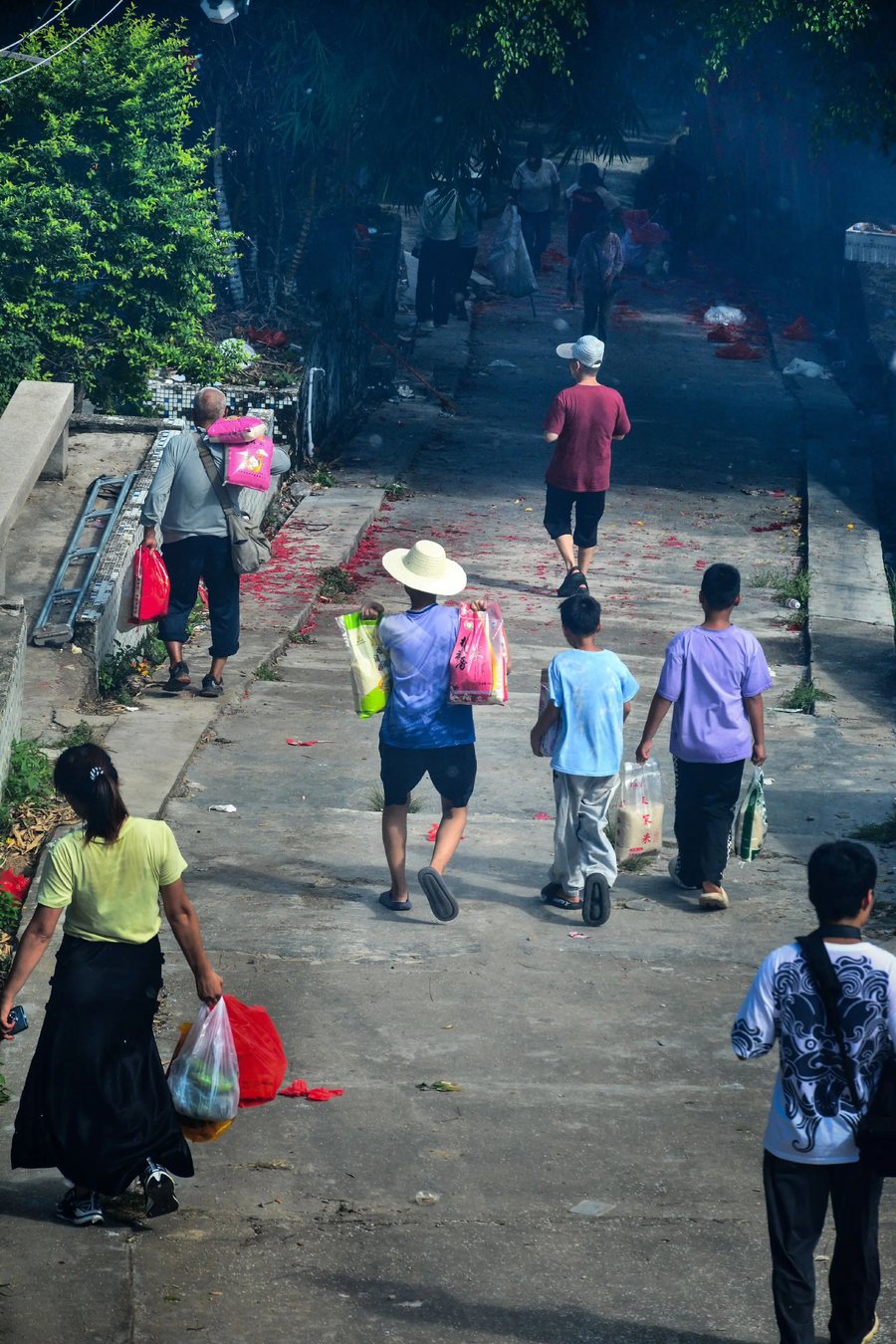
The scramble. The organisers throw the cakes and rice packets down from the shelter and the crowd below catches them in “ghost catchers” — a net bag tied to the end of a bamboo pole, opened wide. What is caught is taken home and called “eating the luck”. Tools and cloth that cannot be thrown are written on bamboo slips and dropped, and the slip is exchanged for the thing itself. Chaozhou speech has turned this into sayings: “with money, go to the opera; with nothing to eat, go to the scramble”; to grab at everything under the shelter and lose one thing catching another is “dropping the bun to grab a biscuit”; and a person without the skill is “a ghost that cannot climb the shelter”.
The close. The king of ghosts, the treasure ship and the paper clothes are burned; at nightfall water lanterns are released, lotus lamps of coloured paper pushed one by one onto the water — one drifts away, they say, and one ghost is ferried across. Paper clothes are called “mulberry clothes” locally, cut from paper in five colours, yellow red blue white and black, for men and women, old and young, with paper umbrellas and paper houses besides. The heat of the seventh month is ending, the living add clothes and the dead change season too — “in the seventh month the fire sinks, in the ninth month clothes are given out”, as the Book of Songs has it, is exactly this turn of the year.
Villages stagger so that the carriers of offerings, the chant masters and the opera troupes can all get round. Jinsha on the twenty-sixth, Huaidong and Huaize on the twenty-fifth, Huali on the twenty-third, Donglong on the twenty-eighth — through the seventh month there is a session every few days.
Six tables below: Shantou, Puning, Jieyang, Chaozhou and Hailufeng, one each, plus one for temples and charities. The lunar column is each village’s main day; the 2026 column is that round of the bingwu year, in which the closing on the twenty-ninth of the seventh fell on 10 September and is already past — the next round follows the lunar calendar and the Gregorian is worked out afresh.
In 2027 the first of the seventh month falls on 2 August, that seventh month has thirty days and the fifteenth is 16 August; in 2028 the first is 20 August and the fifteenth 3 September. The seventh lunar month floats around August in the Gregorian, ten to twenty days either way depending on whether the year has an intercalary month. Fix the day by the lunar calendar first, then look up the Gregorian.
Besides dates, the lunar column carries several states: “stopped” is a scene from the documents, not held now; “each ward sets its own”, “each temple sets its own”, “by street section” mean there was never one common day and the particular household has to be asked; “once in twelve years” means it is not annual and depends which year the turn falls; “not set” means no public date was found, not that the place has none. Where the note begins “old practice.”, it too is a scene from documents or the recollection of elders, and whether it is still held this year is worth asking before setting out.
Shantou (14 places)
The public rites in Shantou are large and the days scattered. The old city has another arrangement: nine charity halls open on the same day, the fifteenth of the seventh, and distribute goods against tickets, with no shelter built and no scramble. The most famous was at Xunsibu in Dahao, on the night of the fifteenth, when the altar for the ghosts was built three metres high and at one shot of the gun the crowd climbed it — now only the recollection of elders.
| District, town | Village | Lunar | 2026 Gregorian | Note |
|---|---|---|---|---|
| Jinping, Jinsha subdistrict | Jinsha township | 26th of the 7th month | 7 September, Monday | shelters for the chant masters and for the ghosts go up on the threshing floor before the temple of the three mountain kings; villagers come at the first watch to worship the “lord of ghosts” on the road before the temple, rice is scattered after the rite, and a puppet troupe is engaged to play the “divine merit play” before it ends |
| Jinping, old city | the charity halls of Shantou port | 15th of the 7th month | 27 August, Thursday | Old practice. nine halls — Tongqing, Tongji, Cunxin, Yanshou, Chengjing, Hejing, Ci’ai, Chengxin, Yanglian — issue tickets on the same day, goods are collected against them, and Chaozhou opera and paper-shadow plays are performed before the halls |
| Jinping, old city | Shengping road head | stopped | — | Old practice. a painted stage built high on a chosen day in the seventh month, a noted monk engaged to chant for the crossing, offerings piled into mountains of noodles, buns, rice and meat |
| Jinping, Wuqiao | Cunxin charity hall | 13th to 15th of the 7th month | 25 to 27 August, Tuesday | the Cunxin charity park. The 2025 pattern: the gate opened on the evening of the twenty-ninth of the sixth month, the crossing rite from the thirteenth to the fifteenth of the seventh, water lanterns on the evening of the twenty-seventh, the yoga flaming-mouth at noon on the thirtieth and the gate closed in the afternoon. Besides tablets for adult men and women and for children, there is one for the “28 July flood”, added after that typhoon |
| Haojiang, Dahao | Xunsibu | 15th of the 7th month | 27 August, Thursday | Old practice. on the square before the temples of the three mountain kings and of the two loyal kings, an altar about three metres high was built on the night of the fifteenth and at one shot of the gun the crowd climbed for the offerings; simplified since 1949 |
| Chenghai, Xinan | Nansha township | 15th of the 7th month | 27 August, Thursday | scramble |
| Chenghai, Lianxia | Huaidong, Huaize | 25th of the 7th month | 6 September, Sunday | run by the Tianhou palace (the Mazu temple); buns scrambled from the shelter; grain and oil given that day to the village’s needy households |
| Chenghai, Dongli | Donglong | 28th of the 7th month | 9 September, Wednesday | Old practice. the yulan assembly on the great threshing floor of the office, a dharma master invited to ascend the seat and give at the flaming mouths; the great being on the shelter, and three tablets besides: soldiers fallen in wars of every age, those crushed by vehicles on the Chengrao road, and the orphaned souls within Chenghai’s bounds |
| Chenghai, Fengxiang subdistrict | Donghu (Donghu township, Chengcheng) | 18th of the 7th month | 30 August, Sunday | the rite is held on the top of the great dyke outside the village, for the dead of other places drifted down to it. Donghu holds shigu six times in the seventh month, three more than the usual three |
| Chenghai, Guangyi subdistrict | Pumei (part of Pumei township, Chengcheng) | 18th of the 7th month | 30 August, Sunday | as above; some parts of Pumei hold it five or six times |
| Chaoyang, Heping | Heping township | 1st to 3rd of the 7th month | 13 to 15 August, Thursday | from the opening of the gate on the first, three days of rites under a shelter before the Baode old hall; besides the orphaned dead, those invited include the soldiers who fell fighting the Yuan here in the last years of the Southern Song |
| Chaoyang, Guiyu | Nanyang township | 13th to 15th of the 7th month | 25 to 27 August, Tuesday | the mountain of the lord of ghosts and the master-buddha temple, chiefly dedicated to Dafeng the patriarch. The auspicious day is chosen by the Nine Heavens Dark Girl through the medium, and it runs three days; the scramble starts at half past two on the afternoon of the fifteenth, after three shots |
| Chaoyang, Gurao | Huali | 23rd of the 7th month | 4 September, Friday | scramble |
| Chaonan, Lugang | Xinmin, Gangtou | 15th to 17th of the 7th month | 27 to 29 August, Thursday | the Huama palace. Three days from the fifteenth, with a Chaozhou opera troupe engaged to play; on the morning of the seventeenth the “bronze body” of the Yueshan holy king climbs barefoot a ladder of more than ninety steel blades |
Puning (7 places)
Puning’s shigu hangs mostly on hermitages and market towns. Two large townships at Junbu share the twelfth of the seventh, the single busiest day in the city; Meitang, Daping and Dananshan go another way — not by the day but by the year’s fortune, once in several years or once in a dozen.
| District, town | Village | Lunar | 2026 Gregorian | Note |
|---|---|---|---|---|
| Puning, Junbu | Shiqiaotou | 12th of the 7th month | 24 August, Monday | the square of the lord of ghosts, north of Tianzhong hermitage (known as the lower hermitage). The scramble has a “high” and a “low” form: the high, on a painted stage, once in three years; the low at Bailing hermitage |
| Puning, Junbu | Dachanglong | 12th of the 7th month | 24 August, Monday | the township’s temple of the lord of ghosts stands behind Nanshan and holds the “holy lord of ghosts”. From the evening of the tenth the chant masters are engaged for three nights and a day of merit, and each household sets its offerings on the great threshing floor before the temple and before the communal ancestral seats |
| Puning, Meitang | Meifeng hermitage (the thirteen townships) | 15th of the 7th month | 27 August, Thursday | Old practice. the thirteen townships worship the Goddess of Compassion together, nearly twenty opera stages filling the Meitang flat; the shelter was built high in fir, with chickens, ducks, fish and meat hung on it and whole pigs and sheep set out, and the scramble came after four in the afternoon. Now broken off |
| Puning, Daping | Daping market, the “promised rite” | stopped | — | Old practice. the committee chose three days between the first and the thirtieth of the seventh: on the first the gods of the three Daping townships were invited onto the altar, on the second monks and priests chanted, on the third offerings were thrown for the scramble and the paper clothes burned. Stopped for nearly half a century |
| Puning, Dananshan | Yuanshan, the “pure rite of the Goddess of Peace” | once in twelve years | — | once in twelve years. Men of the village over sixty, or under sixty but already with a grandson, walk in long gowns carrying lanterns to the Sankeng reservoir and scoop up clean water, called “inviting the dragon-head water” |
| Puning, Hongyang | the charity halls and voluntary societies of the old county town | 15th of the 7th month | 27 August, Thursday | the yulan assembly on the day itself, with chanting and giving of food; one of the more substantial in Puning |
| Puning, Lihu | the Goddess temple by the burnt stream at the market | not set | — | worshippers still come to give shigu here in recent years, each going on their own, with no common day |
Jieyang (4 places)
Jieyang’s shigu mostly attaches to the temples of the township, one temple one session. Mianhu is the rare “whole month in turn”: the Yongchang old temple starts, the other temples follow, and the Mazu temple outside the stronghold closes — and that closing session is called shutting the ghost gate. Huilai divides the thing in two: building a high shelter and throwing offerings is “high shigu”, while hanging only a picture of the great being and letting each household worship and collect for itself is “dark shigu”; the Guandi society at Longjiang does the high form.
The city area has another set. On the fifteenth of the seventh a master’s seat and an altar for the ghosts are built at the street corner or before the village: the master’s seat holds Ksitigarbha, with trays of peaches and rice below it; the altar carries three tablets and a soul-calling banner — “the seat of male ghosts”, “the seat of female ghosts”, “the seat of ghost children of both sexes” — and after the victory in 1945 a fourth was added in the middle, “the soldiers who fell in the war of resistance”. After noon each household sets whole pigs and sheep, chickens, ducks and geese, risen cakes and fruit on the altar. Triangular paper flags are stuck into the offerings, blue, red and green, reading “yulan assembly” and “the gate of sweet dew opens”; the rite begins with temple-hall music, the master strikes the bell, the monks chant, and then trays of peaches and rice are scattered to the four directions, three times over.
Jieyang also keeps the ancestors and the shigu apart: on the fifteenth only the ancestors are worshipped, and the shigu is set for another day — some on the eighteenth, some the twenty-third, some waiting until the thirtieth. Ask for a date in Jieyang and you have to ask which of the two.
Only four places are listed: three at Mianhu and one at Longjiang in Huilai. The rest of Jieyang’s townships mostly hold it with their own temple or ward, the day written on red paper before the temple or a notice at the village mouth, and not put out publicly.
| District, town | Village | Lunar | 2026 Gregorian | Note |
|---|---|---|---|---|
| Jiexi, Mianhu | Yongchang old temple | 15th of the 7th month | 27 August, Thursday | the great sacrifice of the fifteenth, the largest in the town |
| Jiexi, Mianhu | Mazu temple outside the stronghold | 29th of the 7th month | 10 September, Thursday | the last in the town, commonly called “shutting the ghost gate”. In a long month it is the thirtieth; in 2026 the seventh month is short |
| Jiexi, Mianhu | the other temples | each sets its own | — | held through the seventh month, each temple setting its own date, not on the same day as the Yongchang old temple |
| Huilai, Longjiang | Guandi society | 17th of the 7th month | 29 August, Saturday | a bamboo shelter about three metres high on the bank of the Longjiang river, piled with buns, instant noodles and milk; the scramble starts at half past four in the afternoon with firecrackers and lasts about twenty minutes, ending after the second string when the pictures of Mianran the great being and of Ksitigarbha are sent off |
Chaozhou (3 places)
Chaozhou has the fewest dates arranged by village — not because little is held but the reverse. “The Ghost Festival in Chaoshan custom” records it clearly: the old city of Chaozhou had thirty-eight charity halls, and through the seventh month the yulan assemblies came “almost every day”, the last of the month run by the Kaiyuan temple. Each hall first sent a bamboo gourd, the “ghost gourd”, to the shops and households in its area, and on the day each household filled it with white rice, white peach cakes, taro and green fruit and sent it back — laid out stretch by stretch, that is not one village one day but one stretch one day.
The one fixed on the fifteenth in the city is the Azure Dragon old temple on Nanchun road. That day five-coloured hanging money goes up at the lane mouth and five-coloured paper money along the street, to draw the ghosts to the offering; triangular paper flags are stuck in the offerings reading “yulan assembly”, “the gate of sweet dew opens”, “world peace”. The rite begins with the “sending of the pass”, the master chanting to report to heaven and earth and inviting the gods of the three realms into the altar; then the flag walk, several chant masters carrying flags of the five directions and weaving back and forth in the offering shelter to the gongs and drums; then the bowing to the repentance of compassion. On the great being’s platform the Universal Gate chapter is chanted, on the ghosts’ platform the Amitabha sutra; the noon offering bows in turn to the Buddha, the Lord of Heaven, the Anji holy king, the great being, and the ghosts’ platform. In the Chao’an area the shigu rite often sets out a separate seat for the three officials as well.
Eighty years ago Japan surrendered, and it was the seventh lunar month. Chaozhou held shigu in town and country, remembered the unnamed soldiers who had fallen, and added “the seat of the soldiers who fell in the war of resistance” to the altar; it has been the practice since. The peace rice and peace oil given out at the end are only twenty or thirty years old.
On the night of the festival there is one thing the whole city does: households burn incense at the roadside and stick it into cracks in the ground, or cut a piece of sweet potato and plant the incense in it — “road-foot incense”, also called “planting the field”, for a good year. The incense is given by the incense shops, which save up the imperfect sticks through the year and hand them out to customers before the festival.
Later the shelters stopped being built, and with them the scramble; now it is mostly each household giving food at its door. So what Chaozhou lacks is not liveliness but the unit “village” — the city goes by street section, the country by ward, and none of it lands on an administrative village in the public record.
Chaozhou’s king of ghosts has his own account. Elsewhere the shelter carries Mianran the great being; in old Chaozhou it was Zhong Kui — green face, fangs, blue robe, a dozen metres tall, bamboo frame and paper skin, for Zhong Kui’s power to drive off demons. The accompaniment to the chanting is its own line too: temple-hall music, even in pace, the flute plaintive, the instruments much as in Chaozhou music with a small golden bell and a dharma bell besides.
| District, town | Village | Lunar | 2026 Gregorian | Note |
|---|---|---|---|---|
| Chaozhou, Xiangqiao | Azure Dragon old temple (the Anji king’s temple) | 15th of the 7th month | 27 August, Thursday | provincial heritage. Shigu on the fifteenth. Five-coloured hanging money at the mouth of the Azure Dragon lane on Nanchun road and five-coloured paper money along the street to draw the ghosts; triangular flags in the offerings reading “yulan assembly”, “the gate of sweet dew opens”, “world peace”. The noon offering bows in turn to the Buddha, the Lord of Heaven, the Anji holy king, the great being and the ghosts’ platform, and peace rice and oil are given out after |
| Raoping, Huanggang | Huanggang town | each ward sets its own | — | the charity halls build the shelter, households set offerings at their doors and lane mouths, each ward choosing its own day. The offerings are plain: a great bowl of white rice heaped into a mountain shape, bean curd around it, a pot of spring greens boiled with pork, with incense, candles, silver paper and a stack of paper clothes |
| Chaozhou, Xiangqiao | the charity halls of the streets | by street section | — | the old city had thirty-eight halls; through the seventh month there was a yulan assembly almost every day, the last run by the Kaiyuan temple. Each hall first sent a bamboo gourd, the “ghost gourd”, to its shops and households, to be filled with white rice, white peach cakes and taro and returned |
Hailufeng (now part of Shanwei; 15 places)
Shigu in the seventh month is not confined to the three Chaoshan cities. Haifeng, Lufeng and Luhe keep the same set, only calling the king of ghosts “the holy man lord” or “the lord”, and the session itself “worshipping the lord”. Before the rite a “lantern pole” goes up before the temple — a wooden or bamboo pole several zhang high with a lantern hung at the top, lit at nightfall; the higher the pole, the more ghosts it draws. For those drowned, water lanterns are sent instead, in two forms, the lantern head and the lantern raft, with a suona leading and carrying them all the way to the riverbank or the shore. The Jiajing Haifeng xianzhi of the Ming already has the altar for the unquiet dead, “held at the hour of the monkey on the Clear and Bright festival, the full moon of the seventh month, and the first of the tenth”; the Tongzhi continuation records “on the eve of the festival the monks hold the yulan assembly, to feed the unclaimed dead”.
The tidiest arrangement is at Hudong in Lufeng. Of the town’s four residents’ committees and eighteen village committees, all but Qionglin take the days in turn from the tenth of the seventh, one group a day, down to the closing on the twenty-ninth — the densest run anywhere in Chaoshan: ten groups of villages in twenty days, neighbours never colliding.
Each group keeps two days, the second being the main rite, written locally as “the eleventh”, “the thirteenth”. Where neighbouring villages form one group they keep it on the same day, which is why eighteen townships fill only ten rows.
Some go by city gate. Jiesheng in the Shanwei city area was formerly called Zengcheng; the mid-month runs from the twelfth to the sixteenth, one day for each of the four gates, the south gate starting and the east gate closing, each ward taking turns to choose a “head of households” who collects a per-head contribution door to door. In Shanwei proper each temple keeps its own: the Great King temple at Yanting head, the Hanlin temple at Kuishan, and the commoners’ ancestral temples at Fengshan and Chiling all have a session at mid-month.
Haifeng goes another way. By county custom the festival is on the fifteenth, sometimes brought forward to the thirteenth or fourteenth; a rite is built for the ghosts and afterwards anyone may scramble for the offerings, called “snatching the ghosts”, and every three years a “ghost opera” is staged. Gongping was the grandest, and is now only memory: five wards gathered on the waste ground at Wutugoubu for a public rite, each ward with at least a hundred tables of offerings; the south ward picked eighteen “bosses”, each raising a bamboo nearly six metres long with a flag tied to the tip, and carried them from the south ward through the streets up to the top of the ground. For the other wards in the county the day does not leave the village, and no public record was found.
| District, town | Village | Lunar | 2026 Gregorian | Note |
|---|---|---|---|---|
| Lufeng, Hudong | Changxi | 10th to 11th of the 7th month | 22 to 23 August, Saturday | the first of the eighteen townships, “the eleventh” |
| Lufeng, Hudong | Quqing new village | 11th to 12th of the 7th month | 23 to 24 August, Sunday | “the twelfth” |
| Lufeng, Hudong | Quqing | 12th to 13th of the 7th month | 24 to 25 August, Monday | “the thirteenth”. The holy man lord is built fifteen metres tall and carried through the village by nearly two hundred people; in 2025 the session also built the Oriental Pearl tower and Taipei 101 out of bottles |
| Lufeng, Hudong | Shentianhu | 13th to 14th of the 7th month | 25 to 26 August, Tuesday | “the fourteenth” |
| Lufeng, Hudong | Houlin, Changhu | 14th to 15th of the 7th month | 26 to 27 August, Wednesday | “the fifteenth”. Houlin keeps it only once in three years |
| Lufeng, Hudong | Hudong town, Zhuzailan | 16th to 17th of the 7th month | 28 to 29 August, Friday | “the seventeenth” |
| Lufeng, Hudong | Hudong village | 18th to 19th of the 7th month | 30 to 31 August, Sunday | “the nineteenth” |
| Lufeng, Hudong | Houkan, Dingzhuang, Baishitou, Gewei | 19th to 20th of the 7th month | 31 August to 1 September, Monday | “the twentieth”. Dingzhuang keeps it once more on the twenty-ninth |
| Lufeng, Hudong | Huamei | 21st to 22nd of the 7th month | 2 to 3 September, Wednesday | “the twenty-second” |
| Lufeng, Hudong | Hudong town area | 29th of the 7th month | 10 September, Thursday | shutting the ghost gate, the close of the eighteen townships |
| Haifeng, Gongping | Wutugoubu (five wards) | 15th of the 7th month | 27 August, Thursday | Old practice. five wards gathered on this waste ground for a public rite, each with at least a hundred tables of offerings; the south ward picked eighteen “bosses”, each raising a bamboo nearly six metres long with a flag at the tip, and carried them from the south ward through the streets up to the top of the ground |
| Shanwei city, Jiesheng | South gate | 12th of the 7th month | 24 August, Monday | Old practice. the four gates of Zengcheng each keep a day, the south gate starting |
| Shanwei city, Jiesheng | West gate | 13th of the 7th month | 25 August, Tuesday | Old practice. |
| Shanwei city, Jiesheng | North gate | 14th of the 7th month | 26 August, Wednesday | Old practice. |
| Shanwei city, Jiesheng | East gate | 16th of the 7th month | 28 August, Friday | Old practice. the east gate closes. Before the rite each ward took turns to choose a “head of households”, who collected a per-head contribution door to door; households that could not pay gave a bag of rice or a bag of sweet potatoes instead |
Temples and charities (7 places)
There is another layer running alongside the village shigu: the yulan bowl rite at the monasteries. It is not shigu but the offering to monks — by the yulan bowl sutra, on the fifteenth of the seventh month, when the monks’ summer retreat ends, a hundred flavours of food are set in bowls and offered to monks of the ten directions, to seek release for the parents of seven lifetimes. The day is set by the Buddha, not chosen by the village.
| District, town | Place | Lunar | 2026 Gregorian | Note |
|---|---|---|---|---|
| Chaozhou, Xiangqiao | Kaiyuan temple (Kaiyuan Zhenguo chan monastery) | 15th of the 7th month | 27 August, Thursday | yulan bowl rite at nine in the morning, chanting the yulan bowl sutra and setting out the hundred flavours; in the afternoon the monks end the retreat and confess. So it was on 18 August 2024 and 6 September 2025 |
| Chaozhou, Xiangqiao | Tianhou palace | 15th to 19th of the 7th month | 27 to 31 August, Thursday | one day chosen between the fifteenth and the nineteenth, with a shigu platform built at the temple gate for the yulan bowl rite, worshipping the holy lord of ghosts |
| Chaozhou, Raoping | Hongfa temple | 13th to 15th of the 7th month | 25 to 27 August, Tuesday | per the temple’s 2025 notice: the Ksitigarbha sutra and the great offering on the thirteenth, the yoga flaming-mouth on the afternoon of the fourteenth, the hundred flavours on the morning of the fifteenth |
| Shantou, Chaoyang, Xilu | Changmeiyan Huaguo temple | 15th of the 7th month | 27 August, Thursday | yulan bowl rite with chanting of the sutra, for the release of the parents of seven lifetimes, the ancestors of the line, and those owed a debt |
| Shantou, Chaoyang, Xilu | Guxueyan | not set | — | a chanting rite in the seventh month; the date was not made public |
| Jieyang, Rongcheng | Shuangfeng temple | 15th of the 7th month | 27 August, Thursday | yulan bowl rite on the fifteenth, chanting the sutra and the spell of repaying parents’ kindness from nine in the morning; the shigu offerings are distributed by the monks and volunteers to needy households in the communities under Zhongshan subdistrict, Rongcheng |
| Jieyang, Puning, Meilin | Panlongge temple | not set | — | a yulan assembly every seventh month, with worshippers and visitors coming from everywhere; the particular day was not made public |
Five ways of arranging it
One session a day, villages staggered against each other. The commonest. Jinsha on the twenty-sixth, Huaidong and Huaize on the twenty-fifth, Huali on the twenty-third, Donglong on the twenty-eighth, each keeping its own. The tightest run is at Hudong in Lufeng: Changxi opens on the tenth of the seventh, one group a day, down to the closing on the twenty-ninth — twenty days without a break.
Three days together. Heping runs three days of rites from the first of the seventh; Nanyang in Guiyu three from the thirteenth; Gangtou in Lugang three from the fifteenth, with the climb up the blade ladder on the third morning.
Several sessions in one village. Donghu in Chengcheng holds shigu six times in the seventh month, and parts of Pumei five or six — the extra three being held on the top of the great dyke outside the village, for the dead of other places drifting down the Lianyang river. Mianhu takes the other form, the temples in turn, closing with the Mazu temple outside the stronghold.
The day set by people, not by the calendar. From early in the seventh month the charity halls “seek the god and choose the day”; at Nanyang in Guiyu the auspicious day is chosen by the Nine Heavens Dark Girl through the medium; at the Baode old hall in Heping the day is divined before the Dafeng altar; at the Daping market the “promised rite” has three days picked by the committee from the first to the thirtieth.
Once in several years. The “high” shigu at Shiqiaotou builds a painted stage and comes once in three years, while the “low” form without a stage, at Bailing hermitage, is annual; Houlin at Hudong in Lufeng keeps it once in three years; the “pure rite of the Goddess of Peace” at Yuanshan in Dananshan comes once in twelve.
The monasteries are the other way about, all keeping the day. The yulan bowl offerings at the Kaiyuan temple, Changmeiyan and Hongfa temple all fall on the fifteenth of the seventh or the two or three days next to it, because that is the day the monks end their retreat and it comes once a year. So the fifteenth is the most crowded of all: the villages are keeping it and the temples are too.
Sources and notes
Village dates are scattered through on-the-spot records, and there is no single source that covers them all. Jinsha township in Shantou is taken from an account posted on Sina Weibo; Huaidong and Huaize in Chenghai from “Shigu, the culture of compassion shining in the human world”; the six sessions at Donghu and Pumei from Hualong Chaoshan net’s “Chenghai’s historical disasters seen through shigu”; Donglong and Nansha from a compilation on “Chenghai 100”; Xunsibu in Dahao from Hualong Chaoshan net’s “Festival customs of Dahao”; the painted stage at Shengping road head in Shantou from the Yangcheng Evening News piece “The ‘ghost festival’ of mid-seventh-month”, quoting an old gazetteer; Heping in Chaoyang from the Chaoyang district cultural centre’s “the Dafeng cult” and the Chaoshan Dafeng net’s “The shigu at Heping”, with a 2026 report by a Nanfang Daily correspondent besides; Nanyang in Guiyu from Sina’s “The shigu and the scramble at Nanyang, Chaoyang”; Huali in Gurao from “Gurao circle”; Gangtou in Lugang, Chaonan, from the live-stream notice and later write-up of “Master Cat”; Shiqiaotou in Puning from a Sogou encyclopedia entry and a visit recorded on “Puning villages”; Dachanglong from the township account’s own account of its shigu; Meifeng hermitage from “Puning scenery” on “Meifeng hermitage, Meitang”, and the older text it quotes; Daping market, Yuanshan, Hongyang and Lihu from Puning folk customs and etiquette, transcribed by accounts such as “Puning channel”; Mianhu in Jiexi from “Mianhu today”; the Guandi society at Longjiang in Huilai from Sina News’s report and pictures of 17 July 2026, and the division into high and dark shigu from a transcription of the relevant passage in the Huilai xianzhi; of the temples, the Kaiyuan temple from its own account’s records of the 2024 and 2025 rites, Hongfa temple in Raoping from its 2025 yulan notice, Changmeiyan and Guxueyan in Chaoyang from the rite notices of accounts around Xilu, the Tianhou palace in Chaozhou from the temple’s own introduction, the Shuangfeng temple in Jieyang from its account’s 2024 and 2025 records with a 2016 Nanfang Plus report besides, and Panlongge in Puning from the Puning municipal government portal; the schedule of the eighteen townships at Hudong in Lufeng from the yearly worship times published by the account “Reports from the eighteen townships of Hudong”, checked against Sohu’s on-the-spot report “Folk customs of Hudong town”; the height of the holy man lord at Quqing and the number carrying it from that village’s own 2025 account; the days of the four gates at Jiesheng and the head of households collecting contributions from a local author’s recollection, “The layer cake of the festival on the fifteenth of the seventh month”; the mid-month rites at the Shanwei temples from a compilation by “Red Bay information”; the lantern poles, the lantern heads and rafts and the Ming Jiajing Haifeng xianzhi altar from the same compilation, quoting the Hailufeng history and culture series: folk custom; the thirty-eight charity halls in Chaozhou, the daily assemblies and the last at the Kaiyuan temple from Hualong Chaoshan net’s “The ghost festival in Chaoshan custom”; the early Qing line “the temples and monasteries all hold the yulan fair” from the Puning xianzhi of the sixth year of Qianlong, as quoted in a long piece on Chaoshan custom by Lingdong Numa on Nanfang Plus. The old practice at Huanggang in Raoping comes from “Chaozhou dialect” no. 3 of 2021 and a long piece on that place’s account, “Shigu in the seventh month at Huanggang, Raoping”; the whole-month schedule of the Cunxin charity hall in Shantou from the notice it published in 2025. The date and programme at the Azure Dragon old temple in Chaozhou come from the temple’s WeChat article “Yisi mid-festival: the shigu at the Azure Dragon old temple, Chaozhou”, and the Guangxu Haiyang xianzhi, Yang Ruicong’s 1930 Chaozhou customs and Rao Zongyi’s 1956 Chaozhou zhi cited there are all quoted from that article; road-foot incense, the ghost gourd, temple-hall music and the mid-festival night worship at the lanes come from Hualong Chaoshan net’s “The ghost festival in Chaoshan custom”; the five-coloured paper of the mulberry clothes and the link to “in the seventh month the fire sinks, in the ninth month clothes are given out” in the Book of Songs from Lin Kailong’s long piece on the mid-festival in Chaoshan on Nanfang Plus; the dates of the festival in Haifeng county, the scramble and the triennial ghost opera from The customs of the Haifeng people; the public rite of the five wards at Wutugoubu in Gongping and the eighteen bosses of the south ward with their bamboos from Stories of Hailufeng: a ramble through Gongping’s twenty-four streets; the master’s seat and ghost altar of the fifteenth in Jieyang city, the three tablets, the blue red and green triangular flags and the placing of the shigu on the eighteenth, twenty-third or thirtieth all from Hualong Chaoshan net’s “The ghost festival and the yulan assembly”; the two lines of presidency, by a charity hall and by a god, the one-household and several-household financing, and the medium climbing the “three-storey bed” of three tables from the Chaoshan custom recorded under the entry “shigu”; the section on burning the bundle quotes Yuan Mei’s Xin Qi Xie as transcribed in the Chaoshan account “The shigu festival: burning the bundle for the ancestors”.
Fifty places in all: fourteen in Shantou, seven in Puning, four in Jieyang, three in Chaozhou, seven temples and charities, fifteen in Hailufeng. Where a note says “old practice”, it is a scene from documents or the recollection of elders, now mostly stopped, simplified, or reduced to each household giving food at its door — copied down to keep the day, not so that anyone should go and find nothing.
The Gregorian column is for 2026 (bingwu) only, converted by the Hong Kong Observatory’s table of concordance between the Gregorian and lunar calendars. 2026 has no intercalary month and the seventh month is short, twenty-nine days, so “the thirtieth of the seventh” falls on nothing this year and the ghost gate closes on the twenty-ninth.
Shigu days move more than procession days. Most villages keep the old date, but some change it and some have stopped, so ask the village committee before setting out; for the temples, the date of that year’s notice governs.
What comes next: the yinglaoye timetable (the first-month round) | xieshen (the year-end round) | the Chaoshan procession calendar | planning a route
Home › Custom › The ritual year › Shigu, feeding the unclaimed dead
Last revised: 4 November 2026