Si ma tuo che, four horses drawing a carriage
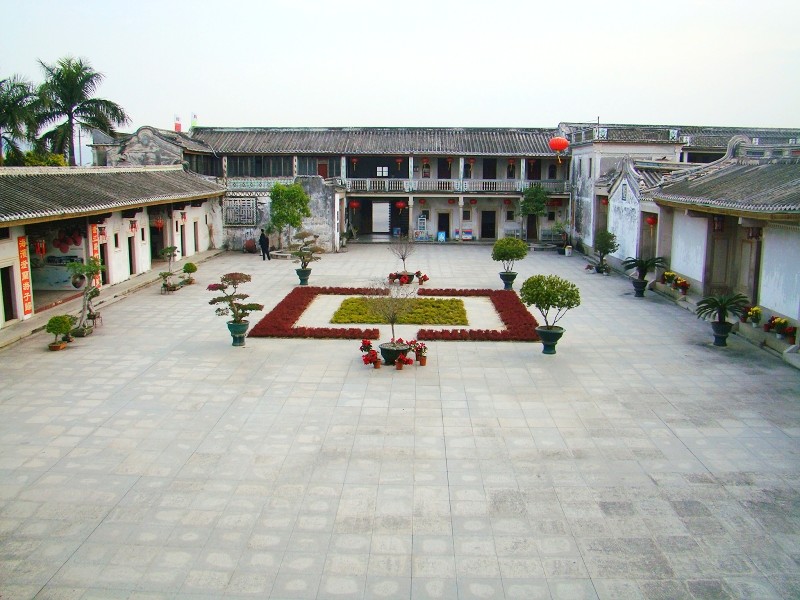
A hall on the central axis with ranges of houses drawn up to either side: the largest of these formations, and the one the Chen Cihong residence at Chenghai belongs to.
Pronunciation sì mǎ tuō chē|Houses and settlement|One entry in the Chaoshan glossary
What it means
An ancestral hall in the centre, with several ranges of houses opening out to either side and further ranges added behind, one at a time. The four horses in the name are the four parallel ranges; the carriage is the central range leading and the others following.
What this name describes is how a whole group of buildings is arranged, not the plan of one house, which is why it does not sit on the same level as four-point gold or the tiger house.
How to tell one
Look at the middle range: it is invariably the ancestral hall, and the highest in rank; the ranges to either side are allotted by branch, and the further out, the later built. The Chen Cihong residence at Chenghai is of this kind — the frame local, the ornament entirely from Nanyang: tile, glass, marble and ironwork.
Words easily confused
Four horses is a combination, four-point gold and the tiger house are units. Inside one such formation, each range of houses may itself be four-point gold.
Read next: The Chen Cihong residence: local frame, Nanyang skin.
Same group: four-point gold, tiger coming down the hill, ancestral hall.
Home › Glossary › Houses and settlement › Four horses
Text on this site is CC BY-SA 4.0; copyright in images is reserved and commercial use requires a separate licence.
Last revised: 3 November 2026