San shan guo wang, the Three Mountain Kings
One of the oldest local cults here: the three mountains are Jinshan, Mingshan and Dushan, and the mother temple stands below Yufeng mountain at Hepo, Jiexi.
Pronunciation sān shān guó wáng|Belief and processions|One entry in the Chaoshan glossary
What it means
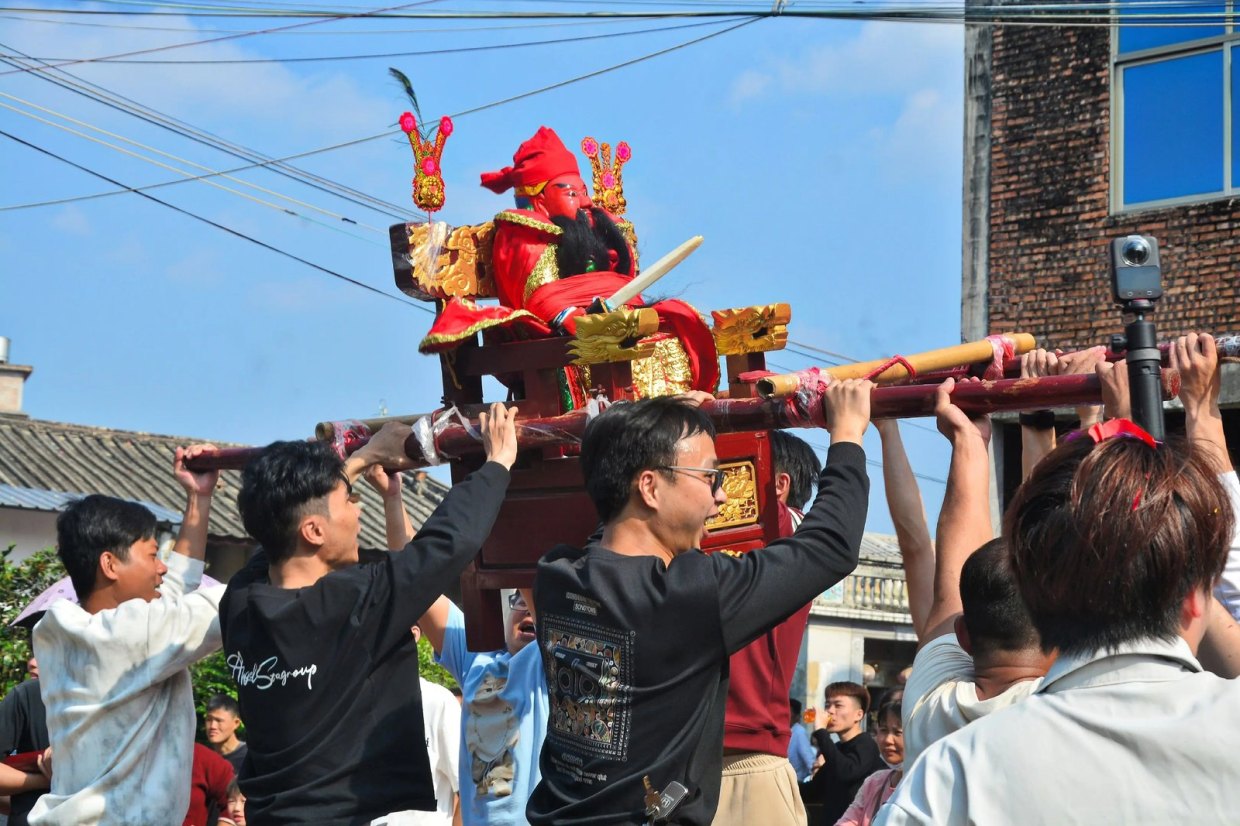
Neither Buddhist nor Daoist, with no scriptures and no clergy, the cult nevertheless has a great many branch temples across eastern Guangdong and overseas. The main hall of the mother temple holds three seated images, each with its own title: Mingshan, Jinshan and Dushan, respectively the kings who repay virtue, who aid government and who bestow abundance. The rear hall holds the three consorts.
Worshippers are not only Chaoshan people: Hakka households keep them too, which follows directly from the origin at Hepo in Jiexi, on the Chaoshan–Hakka border, and is why this cult has travelled further than most local gods.
When you see it
The mother temple holds spring and autumn sacrifices, and separately the highest-grade “pig and sheep sacrifice”, which follows the lesser-offering rite Han Yu once performed here and takes about three hours. In 2014 the Three Mountain Kings rite entered the Guangdong provincial list of representative intangible heritage.
Words easily confused
The Three Mountain Kings is a divine title, not a place name; a temple called “Three Mountain Kings temple” is not necessarily the mother temple. The one below Yufeng mountain at Hepo in Jiexi is the mother temple, the rest are branches, and overseas and Hong Kong and Taiwan houses branch from those in turn.
Custom in Chaoshan villages; this page describes only, and neither endorses superstition nor prescribes behaviour.
Read next: The Three Mountain Kings: mother temple, branches and rites.
Same group: lao ye, ying lao ye, Mazu.
Home › Glossary › Belief and processions › The Three Mountain Kings
Text on this site is CC BY-SA 4.0; copyright in images is reserved and commercial use requires a separate licence.
Last revised: 3 November 2026