Qiang gu, scrambling for the offerings
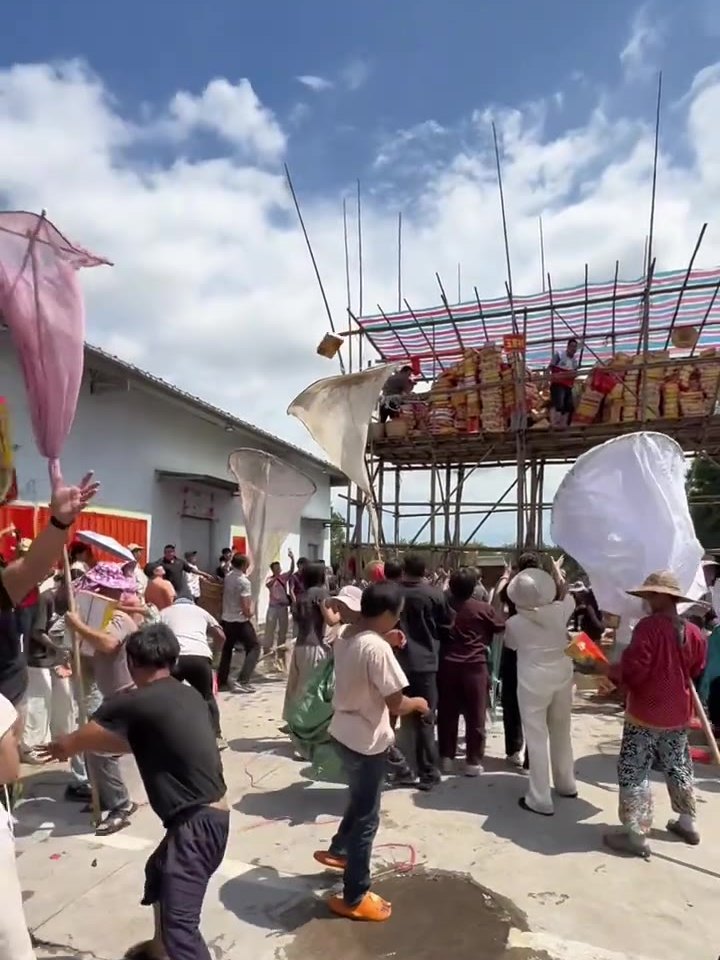
The offerings are thrown down from the platform and the crowd below scramble for them; what you catch is yours.
Pronunciation qiǎng gū|Belief and processions|One entry in the Chaoshan glossary
What it means
Once the sacrifice is over, what is on the platform is thrown down and the crowd below scrambles for it. Some come prepared with a “catcher” — a net bag bound to the end of a bamboo pole, held open to receive; others use a coat or a cardboard box; those with bare hands fare worst, grabbing one thing and dropping another, which is what the old line “drop the peach bun to grab a cake” is about.
What was given out in the old days was not only food: farm tools were among it, and these cannot be thrown, so they were written on tokens and dropped instead, a token being exchanged for the thing itself. For poor households the token mattered more than the opera, hence “those with money go to the play, those without come to scramble”.
When you see it
At the moment the service ends on the main day and the offerings are taken down. Old accounts say the scramble was strongest in Chaoyang, and not weak in Shantou port either, where a painted stage was once put up on a chosen day at the head of Shengping Road and monks of standing hired to chant for the universal deliverance.
Words easily confused
Scrambling is only one way of dispersing the offerings; some places do not scramble at all but divide the food among the poor. Either way it is the close of a feeding.
Custom around Zhongyuan in Chaoshan, part of village mutual aid and sacrifice; this page describes only, and neither endorses superstition nor prescribes behaviour.
Read next: Feeding the dead and the Yulan assembly: how the seventh month is kept.
See also: The ritual year: the festivals of the year.
Same group: feeding the dead, orphan platform.
Home › Glossary › Belief and processions › Scrambling for the offerings
Text on this site is CC BY-SA 4.0; copyright in images is reserved and commercial use requires a separate licence.
Last revised: 3 November 2026