Fang yan kou, the flame-mouth rite
The passage in which the master scatters peach buns and rice to the four directions, asking the buddhas to open the throats of the hungry dead.
Pronunciation fàng yàn kǒu|Belief and processions|One entry in the Chaoshan glossary
What it means
The altar is opened by the vajra master: he strikes the hand-bell and leads the monks on either side in sutra and spell, inviting the buddhas and bodhisattvas down to the incense altar. Chanting all the while, he changes the hand gestures and scatters tray after tray of peach-shaped buns and rice to the four directions, food thrown out for the dead, several times over. This passage is the flame-mouth rite.
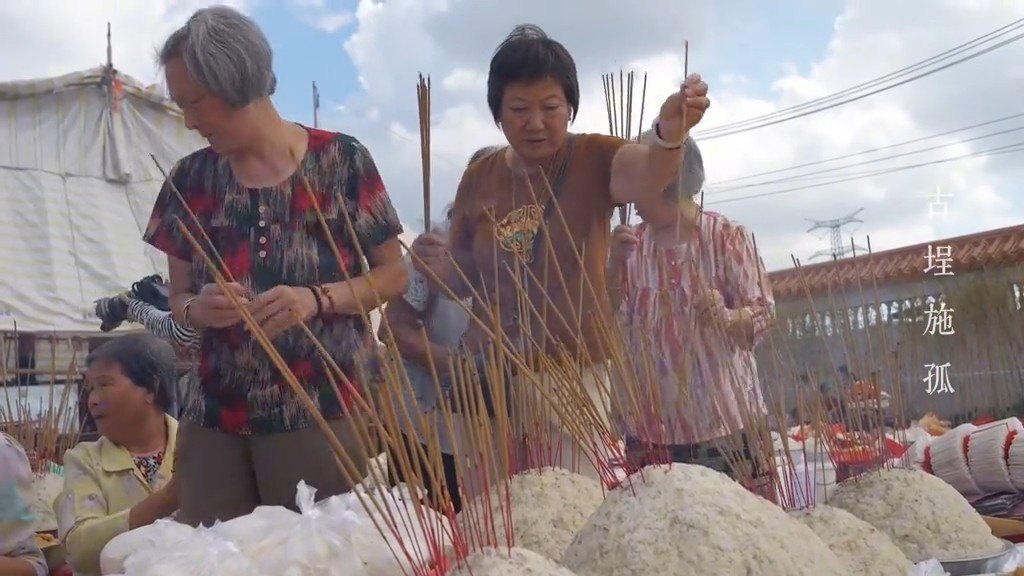
The explanation is that hungry ghosts have throats as narrow as a needle’s eye and fire in the mouth, so food comes to the lips and will not go down; the rite asks the buddhas and bodhisattvas to open their throats so that this one meal can be swallowed.
When you see it
At the service on the main day of feeding, and in the second half of a household’s merit-making. Both call in monks and both scatter food, and the manner is broadly the same.
Words easily confused
The flame-mouth rite is one passage within the service; the feeding is the whole occasion. The rite is the food scattered from the platform, the scramble is the offerings caught below: one throws, the other catches, and one follows the other.
Custom around Zhongyuan in Chaoshan, part of village mutual aid and sacrifice; this page describes only, and neither endorses superstition nor prescribes behaviour.
Read next: Feeding the dead and the Yulan assembly: how the seventh month is kept.
See also: Funeral custom: from merit-making to the coffin leaving.
Same group: feeding the dead, orphan platform.
Home › Glossary › Belief and processions › Flame-mouth rite
Text on this site is CC BY-SA 4.0; copyright in images is reserved and commercial use requires a separate licence.
Last revised: 3 November 2026