The Central Red Route sites
A secret line that ran from Shanghai to the Jiangxi Soviet in the 1930s had its middle station at Shantou. This stretch is the only part of it that was never broken.
In one line Look at the street pattern, not the houses: the escape routes were made by the lanes.
Look for How shop and house connect at the back, the lanes around, two stations compared.
What to see文化看點
The line was opened at the end of 1930, running from Shanghai through Hong Kong and Shantou into the Jiangxi Soviet, close to three thousand kilometres, with Shantou the middle station. This section is the only one on the whole line that was never broken. Look at the street pattern rather than the buildings: what covered the movement was the lanes.
History歷史
At the end of 1930 the transport bureau of the Party centre opened a secret line from Shanghai through Hong Kong and Shantou into the Jiangxi Soviet, close to three thousand kilometres: Shanghai, Hong Kong, Shantou, Dabu, Qingxi, Yongding, Ruijin. Rao Weiping set up the main station in Hong Kong at the end of that year, and Shantou took the middle station.
There were two Shantou stations: 97 Haiping Road, formerly number 98, and 7 Zhenbang Street. In 1931 Chen Pengnian, under the name Hu Guangfu, Gu Yuliang and Luo Guikun opened the Huafu Electrical Supply shop on Haiping Road, with the electrical trade as cover, people living upstairs and the shop trading downstairs. From the end of 1930 to April 1931, number 7 Zhenbang Street covered the transit under the name of a branch of the Sino-French Pharmacy.
In April 1931 Gu Shunzhang turned in Wuhan, the Party centre in Shanghai was broken up, and the pharmacy branch was dropped at once. The line itself kept running until 1934.
Local accounts have it that the line passed two hundred and sixty-three people into the Soviet area, Zhou Enlai, Liu Shaoqi, Ye Jianying and Chen Yun among them — another count says simply more than two hundred — and moved about three hundred tons of material, and that it was the only line never broken and never closed.
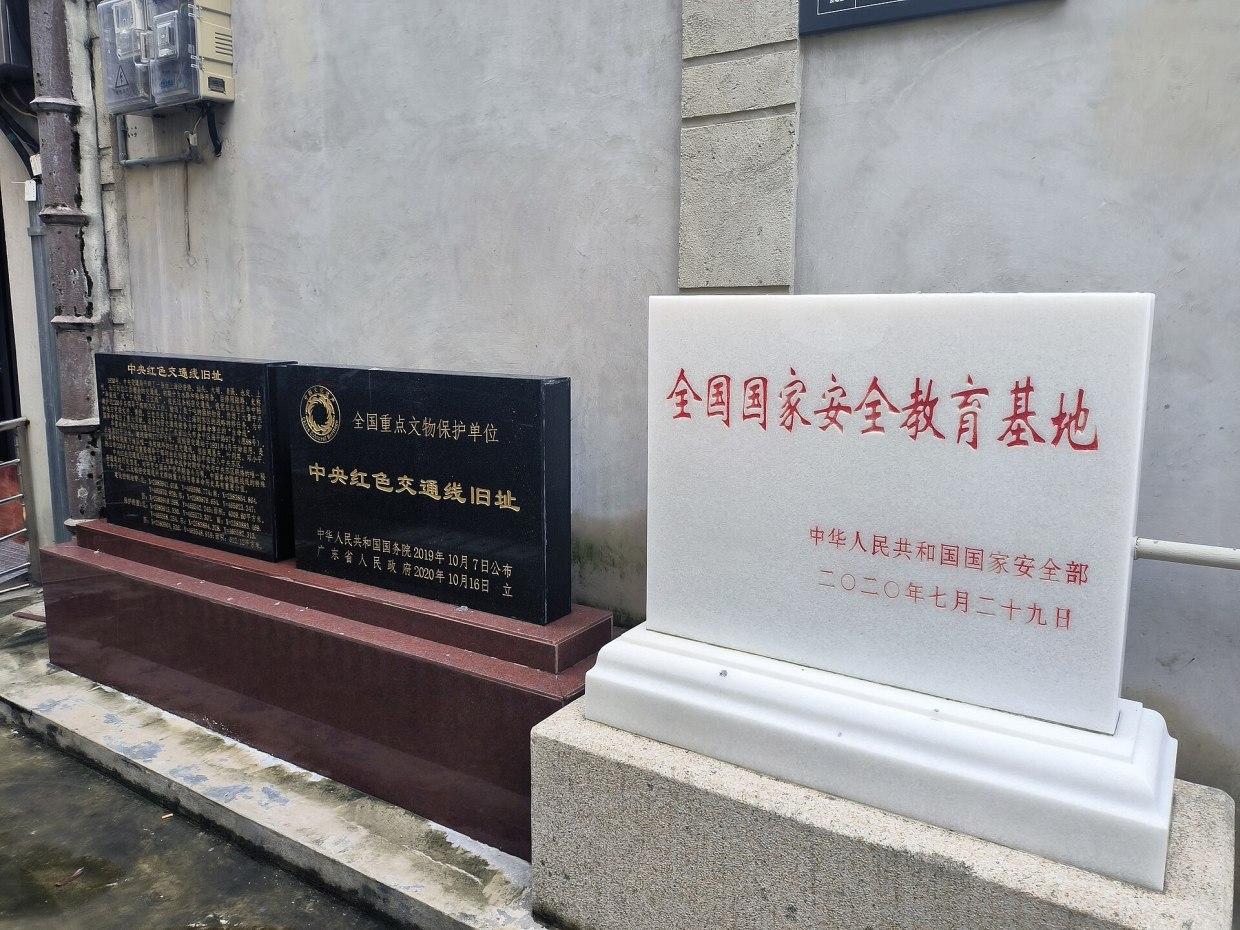
It was listed in December 2015 in the eighth batch of Guangdong provincial protected sites, and in October 2019 in the eighth batch of national protected sites. In 2019 it was designated a Guangdong national-security education base, and in October 2020 a national one.
Building and form工藝與形制
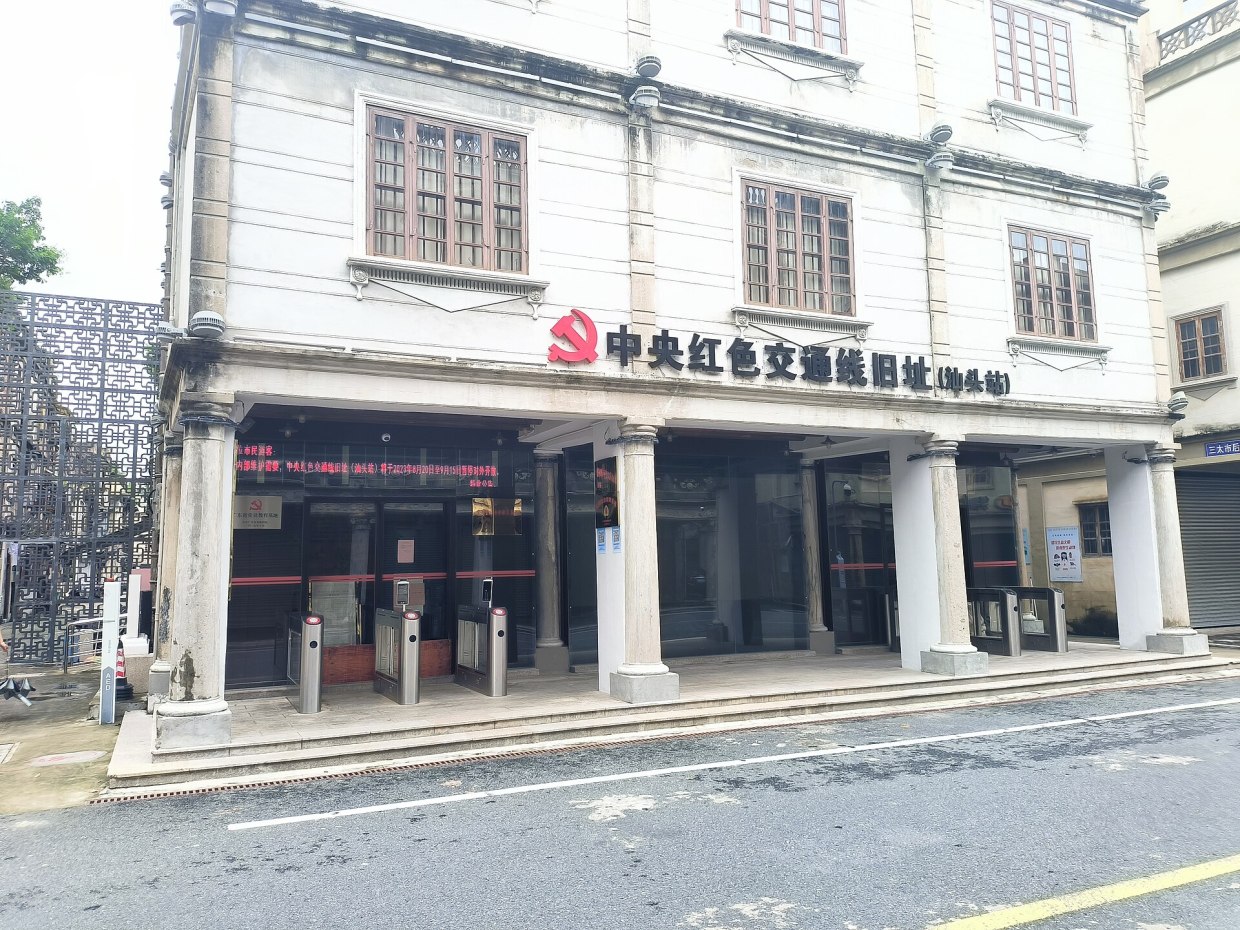
The site is an arcaded shophouse of three storeys, concrete with brick and timber, on a plot of about 623 square metres with about 1,832 square metres of floor. Shop in front, dwelling behind: the street front traded, the rear range and the upper floors housed people.
What a secret station needed was not to look like one. The front had to be an ordinary business, the ways in and out had to double back, and the upper floor had to hold a few people for a few days without their going out. None of that depends on fine building; it depends on position. Put the house back into the street network and the choice makes sense: on the street, several ways out, the wharf and the station both within walking distance.
What to look at看什麼
- How the shopfront connects to the rear range: you can see at once how shop-in-front, house-behind becomes shop-in-front, route-behind.
- The lanes around it: the escape routes were made by the street pattern, not by one building. Which way you turn on leaving matters more than the door.
- How the two stations relate: 97 Haiping Road and 7 Zhenbang Street are not far apart, the first a long-term station, the second used for half a year.
- The route map in the display: Shanghai, Hong Kong, Shantou, Dabu, Ruijin — one line, and the whole thing reads.
Visiting參觀提示
In the old city, and easily strung together with Xiaogongyuan and the customs buildings. The interior is narrow; groups should book.
Tickets and opening No ticket: this is a route through streets and lanes. Walkable at any hour, each site keeping its own opening times. No booking needed.
Related entries對應詞條
History and geography, people and events, qiaopi letters.
On the same trip同城順路
- The Xiaogongyuan port-opening district — also in the old city.
- The old Chaoshan Customs buildings — walkable.
- The Eastern Expedition headquarters — a short drive.
Order them by map and by your own hours; this only says what is on the way to what.
Sources來源
The dates and the course of the line, the figure of nearly three thousand kilometres, Rao Weiping’s Hong Kong station, Chen Pengnian’s alias Hu Guangfu and the Huafu Electrical Supply shop, and the Sino-French Pharmacy branch at 7 Zhenbang Street with its closure: Guangdong provincial gazetteer material, and public introductions by the Jinping district and the Shantou culture, radio, television, tourism and sports bureau.
The 263 people and the other count of more than two hundred, the three hundred tons of material, and the line never being broken: Nanfang Plus, ‘Three more added: which of Shantou’s six national protected sites is the fairest’. The plot and floor areas and the three-storey concrete, brick and timber structure: the Shantou city government portal. The 2015 provincial listing, the 2019 national listing and the two education-base designations: the same, and the Guangdong provincial government notices.
Home › Travel › Shantou › The Central Red Route sites
Last revised: 5 November 2026
 粤公网安备44522102000407号