Home › Intangible heritage › Yingge dance › Glossary
Yingge · Glossary
Fifty groups of terms, fifty words: which are official wording, which go no further than pending verification. The terms from the three branch pages are gathered here.
Header texture: photo by Auongkinghe, CC BY-SA 4.0
Yingge jargon has three layers: what the official project pages write down, what one branch calls things itself, and what a team calls them internally. Each entry below is marked with the layer it belongs to; those marked “pending” record the name only, without explaining the movement.
“Official project material” means the three project pages on the China Intangible Cultural Heritage Network / China Intangible Cultural Heritage Digital Museum — Puning Yingge, Chaoyang Yingge, Jiazi Yingge; the links are at the end of the page. The text is copied as written, without changing a character.
The label says which layer the statement comes from, and the suffix “· Puning”, “· Chaoyang”, “· Jiazi” marks it as belonging to one branch only. The absence of a suffix does not mean all three branches share it — the scope is set by that entry’s “Source” and “Scope” lines; only where neither line limits it does it read as a general rule.
Implements and roles
Yingge maceOfficial project material
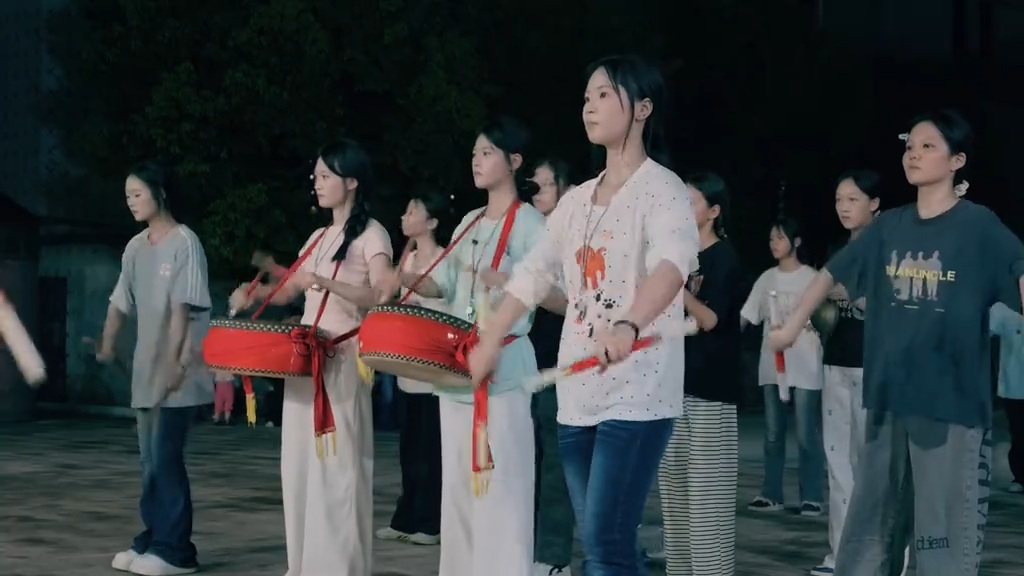
The pair of short wooden sticks each dancer holds. The official text: “each person holds two round short wooden sticks (10 cm in diameter, 20 cm long)”, struck up, down and to either side to the drum and gong beat. On the Chaoyang branch it varies with the rhythmic pattern: the slow branch uses longer sticks, while the fast branch “uses shorter Yingge maces, swung with ease”; the Chaoyang district local standard DB 4405/T 315—2025 also records that “the length differs by type of Yingge, generally 40 cm to 61 cm”, and one pair at the Mianbei Houxi team measured 58 cm.
Source: the text of the Puning and Chaoyang project pages; Chaoyang district local standard Intangible Cultural Heritage: Chaoyang Yingge (DB 4405/T 315—2025), Table 2.scope: 20 cm belongs to the short branch, 40–61 cm is the range across types, and the two figures are not merged into one. Team-made maces vary in length and weight.
lead stickOfficial archive wording
The leading dancer at the front of the team. This is a title the official text uses explicitly — Chen Laifa’s archive records that he “became head mace of the Yingge team the following year”; later he “served as team coach from 1990”. A person can move from head mace to coach, which shows it is a post within the team, not a lifelong title.
Source: Chen Laifa’s inheritor archive.scope: it cannot be written up as “the commander of every team”. What the head mace actually directs differs by team; in some teams the head mace plays Song Jiang and is called “black char” inside the team (the team’s own account, see Teams).
second stickpending
The title of the position after the head mace, see How it is danced The reported Puning wording, “the appearance is led by the ‘head mace’ and the ‘second mace’”. None of the three official project pages defines the second mace, nor states its position relative to the head mace or how the two work together.
scope: the name and the sentence it appears in only; duty, position and the way it answers the head mace are not written down. That entry waits for a team’s own account or an oral account from a team leader.
The two halves of one performance
The two halves of a performance: front section and rear section (diagram drawn for this site)
front sectionOfficial project material
Official text: “the performance is divided into two sections, ‘front section’ (前棚) and ‘rear section’ (后棚); the front section is drum and gong music and the Yingge dance”. Drums, gongs and the Yingge body itself come first and form the trunk of the performance.
Source: the text of the Puning and Chaoyang project pages.scope: on both pages the passage on the two sections is only that one sentence of division plus what each contains; no length, proportion or point of transition is given.
rear sectionOfficial project material
Official text: “the rear section is small operas of their own kind and signature turns”. The turns differ by team; the Jiazi branch has left titles — the small operas Damo Crossing Guanyin, Father and Daughter Meet, Two Bamboo Maces, Two Oars, and the comic turns Stealing the Piglet, The Fool Visits the Hall, Husband Carrying Wife.
Source: the text of the Puning, Chaoyang and Jiazi project pages.scope: the rear section is not “the entertainment after the Yingge is over” — it is the other section of the whole programme, and without it a performance is only half a set.
The four columnsOfficial project material · Jiazi
The Jiazi branch’s procession has four sections: “there are the righteous banner, the Yingge dance, the small opera and the great banner carried on the shoulder”. The Yingge dancers are in the middle, dancing as they walk.
Source: the text of the Jiazi Yingge project page.scope: Jiazi only; the column divisions elsewhere are not extrapolated from it.
Rhythmic patterns
slow tempoOfficial project material · Chaoyang
Official text: “the rhythm is slower, the maces used are longer than in other branches, and the basic method builds a set from three or four beats — slowness with momentum, momentum with spirit”. It is current in Wenguang, Mianbei and Chengnan. There is also a “drunken mace”, in which the dancer looks like a drunkard.
Source: the text of the Chaoyang Yingge project page.scope: the slow branch is defined by beat count and stick length together; to say only that the movement is slow loses the technical marker.
medium tempoOfficial project material · Chaoyang
Official text: “the basic method has sets built of five beats or seven beats (Yingge dance), and sets built of eight, ten, eleven or thirteen beats”. The drumbeat differs from the slow branch: the slow branch’s drumbeat pauses and stretches in the middle, while the middle branch beats continuously.
Source: the text of the Chaoyang Yingge project page.scope: five to thirteen beats all belong to the middle branch; a different beat count does not mean a different rhythmic pattern.
fast tempoOfficial project material · Chaoyang
Official text: “the rhythm is fast, the drumbeat tight, and it changes often as the team’s formation opens and closes; the Yingge maces used are shorter and swung with ease”. It divides further into three: “paired-combat sets, the Nanshan civil school and the Nanshan martial school”.
Source: the text of the Chaoyang Yingge project page.scope: the fast branch is not one set of movements. The civil and martial schools strike differently, and one team’s fast branch cannot stand for all.
Sets and movements
The names below all come from the official project page text, but the text only lists names and does not describe the movement. So the name, the branch it belongs to and the sentence it appears in are what stands.
Washing the StreetOfficial project material
The official text lists them among set names: “there are ‘Washing the Street’, ‘New Year Greeting’, ‘Spreading the Year’, ‘Mace on the Back’, ‘Through the Hip’, ‘Mace Hug with Hooked Foot’ and others”; the Puning passage separately lists “‘Planting the Field’, ‘Washing the Street’, ‘Spinning the Mace’, ‘Mace Flower’ and other dance postures of varied form”. Appearing in both places, these are plainly common names on the Puning branch.
Source: the text of the Puning project page.scope: how the movement goes is not written officially, and the characters of the name do not settle it.
New Year GreetingOfficial project material
Listed alongside Washing the Street in the sentence “as many as 20 sets”.
Source: the text of the Puning project page.scope: the name sounds like an everyday custom, but that does not establish that it means greeting each household — there is no movement record.
Spreading the Year · Planting the FieldOfficial project material · two forms on one page
Two spellings appear in the same Puning project page: the earlier passage writes “Spreading the Year”, the later one “Planting the Field”. The official text does not say whether they are the same set; they stand side by side as written, neither merged nor changed by a character.
Source: two places in the text of the Puning project page.scope: this is the entry most easily flattened into one word by later retelling. A quotation that uses “Planting the Field” most likely comes from the later passage.
Mace on the Back · Through the Hip · Mace Hug with Hooked FootOfficial project material
Three names listed together in one set inventory, belonging to the Puning branch.
Source: the text of the Puning project page.scope: the names describe where the body and the maces sit relative to each other, but the actual extent, tempo and which beat follows depend on the team.
Spinning the Mace · Mace FlowerOfficial project material
The Puning passage calls them “movement sets” and lists them with Planting the Field and Washing the Street. Spinning the Mace is also named on the Chaoyang branch.
Source: the text of the Puning project page.scope: whether the two places’ spinning mace is the same movement differs by account, with no material to settle it, so the two are not merged.
Slicing Mace · Lowering Mace · Mixing Mace · Threading the DragonOfficial project material · Jiazi
Four movement names on the Jiazi branch: “the dance movements include the slicing mace, the lowering mace, the mixing mace, threading the dragon and others”.
Source: the text of the Jiazi Yingge project page.scope: these four names do not appear on the Puning and Chaoyang pages; they belong to the Jiazi branch’s wording.
formations
Two Dragons Out to Sea · Tiger Descending the Mountain · Wheat Ear · Snail SpiralOfficial project material · Puning
Text: “in performance the formation figures change richly — ‘Two Dragons Out to Sea’, ‘Tiger Descending the Mountain’, ‘Wheat Ear’, ‘Snail Spiral’ and other patterns”. The four are examples only; the text says “and other”, so there are more than four.
Source: the text of the Puning project page.scope: a formation name is not a fixed floor plan. Under the same name, a village lane and an open square are walked differently.
Two figures at Jiazi
Flower-drum man · Flower-drum womanOfficial project material · Jiazi
Text: “two flower-drum women climb on the flower-drum men’s shoulders, twirl short sticks in both hands, and move around performing with the Yingge team”. A man and a woman in a pair, the woman on the man’s shoulders: a fixed arrangement on the Jiazi branch.
Source: the text of the Jiazi Yingge project page.scope: this is Jiazi’s costuming; teams elsewhere do not necessarily have it.
Branches and how they divide
The difference between the branches is not which looks better but which ruler each place divides its teams by. This group records only listing facts and the way of dividing, and every figure of scale carries its date.
Ⅲ-8Official project material
One item number covers three entries: Yingge (Puning Yingge), Yingge (Chaoyang Yingge), Yingge (Jiazi Yingge). The list divides by nominating place, not by where the dance is current.
Source: the three project pages on the China Intangible Cultural Heritage Network.scope: it cannot be reversed into “Yingge is current only in three places”, nor into “Chaoshan has only three branches” — Huilai and Raoping have no national sub-item in the list, yet on this site Teams they have teams in the table; and Lufeng’s Jiazi, outside the three Chaoshan cities, is an item.
Chaoyang YinggeOfficial project material · Chaoyang
Nominating place Shantou City, first batch 2006, protecting body the Shantou Chaoyang District Cultural Centre. Divided by rhythm: three rhythmic patterns, slow, middle and fast, with the fast branch further divided into paired-combat sets, the Nanshan civil school and the Nanshan martial school. Over 130 teams in the district (district government reply, 2025-05).
Source: the Chaoyang project page; the Chaoyang district government reply.scope: the rhythmic pattern is a division by rhythm, not what teams call themselves. See the branch page Chaoyang Yingge.
Puning YinggeOfficial project material · Puning
Nominating place Jieyang City, first batch 2006, protecting body the Puning City Cultural Centre. Divided by speed: three major branches, fast, middle and slow (Provincial Foreign Affairs Office visit-site briefing, 2026-07). Establishment 24, 36, 72 up to 108; 107 actually fielded; the accompaniment includes conch horns. 103 teams (same source).
Source: the Puning project page; the Provincial Foreign Affairs Office visit-site briefing.scope: this “three major branches” and Chaoyang’s “three rhythmic patterns” are not the same ruler and cannot be swapped. See the branch page Puning Yingge.
Jiazi YinggeOfficial project material · Jiazi
Nominating place Lufeng City, Guangdong Province; third batch 2011 (expanded item); protecting body the Jiazi Town Cultural Station, Lufeng. Divided by column: the four sections — righteous banner, Yingge dance, small opera, great banner carried on the shoulder. It belongs to Jiazi town, Lufeng, Shanwei, and is not part of today’s three Chaoshan cities.
Source: the Jiazi project page.scope: the Jiazi page has no three-part rhythmic division, and Chaoyang’s three patterns cannot be laid over it. See the branch page Jiazi Yingge.
The nine mace forms (Chaoyang standard)
Two classes and nine forms: the first two cells are the inward and outward spin of the spinning mace, the nine after them the nine striking forms (diagram drawn for this site from the geometric relations stated in the Chaoyang district standard; it shows neither speed nor force)
This group comes from the Chaoyang district local standard DB 4405/T 315—2025; these are terms written into a code, not spoken jargon. The standard gives only the geometric relation, not tempo or force, and does not imply the name is used elsewhere. Other branches have their own names, and the same name need not be the same form — see the “Mace on the Back” entry below.
Spinning the mace (inward · outward)Chaoyang local standard
Inward: grip the mace at its middle with the butt forward, turn the wrist from the butt so that the butt traces a vertical circle against the inner side of the forearm. Outward: the reverse, head forward, circling against the outer side of the forearm.
Source: DB 4405/T 315—2025.scope: the name “spinning the mace” also appears on the Puning branch (listed among movement sets on the project page); whether the two places mean the same movement has no material to settle it, and the two are not merged.
vertical strikeChaoyang local standard
As the standard records: the two maces meet above and below in front of the chest, the rising mace head striking the descending mace head.
Diagonal strikeChaoyang local standard
As the standard records: a diagonal from the right hip past the front left of the head down to the left hip; at the start the right mace strikes the left, then the path is retraced symmetrically.
Double tossChaoyang local standard
As the standard records: swing out forward from beside the hip, strike before the chest, carry the motion into a mace flower and raise it, then return along the same path and strike again.
Slicing strikeChaoyang local standard
As the standard records: the two forearms parallel and facing each other, the upper mace slicing down at the lower and pushing it away with the motion.
Cross slideChaoyang local standard
As the standard records: the two maces crossed at the waist and struck together, one hand sliding forward while the other stays at the waist.
Dart strikeChaoyang local standard
As the standard records: the two mace heads crossed and held at the waist, one hand thrusting level forward while the other draws back.
Downward thrustChaoyang local standard
As the standard records: the mace head thrust down to strike the ground.
Under-hip strikeChaoyang local standard
As the standard records: the two maces struck together below the hip, one before the other.
Mace on the back (Chaoyang standard)Chaoyang local standard
As the standard records: both hands behind the back, the two maces struck up and down.
Source: DB 4405/T 315—2025.scope: the set inventory on the Puning project page also uses the words “mace on the back”; the name is shared, but the material does not settle whether the movement is the same, so two entries stand, not merged.
Footwork, implements and banners
Horse-riding squat stanceOfficial project material · Puning
Text: “the feet form a horse-riding squat stance, the leg is lifted and springs sideways”. This is the one line on the Puning project page that sets the footwork down.
Source: the Puning project page.scope: the Chaoyang and Jiazi pages do not have this line; whether others stand the same way the material does not say.
centipede stepOfficial project material · Jiazi
The Jiazi branch walks the centipede step. The material gives only the name and the fact of walking, not stride, tempo or how it fits the formation.
Source: the Jiazi project page.scope: it cannot be drawn literally as many people strung in a line like a centipede; there is no movement record.
the threading-dragon formationOfficial project material · Jiazi
A formation name on the Jiazi branch: the procession includes the threading-dragon formation.
Source: the Jiazi project page.scope: this is not the same name as Puning’s “Two Dragons Out to Sea” and the two cannot gloss each other; there is no floor plan.
conch hornOfficial project material · Puning
One of the accompanying instruments on the Puning branch. The text says that when the dance reaches its fastest, “the shouts and the conch sound rise together”.
Source: the Puning project page.scope: the accompaniment entries on the Chaoyang and Jiazi pages have no conch horn, and it is not written as common to all three.
Drum and gong players (13 at Jiazi)Reporting · Jiazi
Of the 54 in Jiazi’s Yingge dancing column, 13 play drums and gongs (Shanwei Daily, 2017-10-15).
Source: as above.scope: these 13 count within the dancing column and do not form a column of their own; they cannot be swapped for the drum-and-gong establishment at Chaoyang or Puning.
Obstacle-warding flag · Five-phase flagsThe team’s own account · site record
Dancers of Luxi Shangcuo carry the obstacle-warding flag on the shoulder with five-phase flags stuck in their backs, playing the vanguard (2026-03-16).
Source: on-site record on this site, see Who dances. scope: that team on that occasion only; not generalised.
Team bannerThe team’s own account · site record
Banners lead the team to clear the way, the cloth lettered with the team name or a phrase such as “nation at peace, people secure”; the banner bearers are usually a separate post in the team, not dancers doubling up.
Source: on-site records on this site and the teams’ own accounts, see Who dances the banners section.scope: the lettering differs by team, and on the same day differs between teams; one team’s banner code is no general rule.
Jiazi’s dates: first drum, da xiong, return to the temple
This group belongs to Jiazi alone; it is ordered by the temple’s calendar, not the solar one.
Shi Qian opens the teamOfficial project material · Jiazi
The team is opened by Shi Qian: golden flowers in his hair, a red silk warrior’s crown, a silver snake dancing in his hand; he turns a sideways somersault, sits cross-legged, rises into a war-horse fist posture, and then Li Kui leads the thirty-six in after him.
Source: the Jiazi project page.scope: this is Jiazi’s opening routine; the listing pages for the other two branches have no such passage.
opening drumSite record · Jiazi
The first drum is beaten before the Yuandi Ancestral Temple; the date is set by the management committee and written on the notice in both solar and lunar form (for instance 1 July 2026, the seventeenth of the fifth lunar month), at half past seven in the evening.
Source: on-site record on this site, see Jiazi Yingge and When it is danced.scope: the date differs each year and is cited with year and day together.
da xiongSite record · Jiazi
The stretch before the team sets off for the performance ground is called “da xiong” in the local notices.
Source: as above.scope: these two characters are the notices’ own spelling; whether others call it so the material does not say.
fan miao (return to the temple)Site record · Jiazi
The return to the temple after the performance is called “fan miao”. First drum, da xiong and the return all start and end at the temple.
Source: as above.scope: this ordering belongs to the Jiazi branch alone; elsewhere the team need not finish at a temple.
small bell-drumOfficial project material · Jiazi
The last 12 of Jiazi’s dancing column wear martial-role masks and carry small bell-drums; the first 24 paint the flower face and hold paired wooden sticks.
Source: the Jiazi project page and the Shanwei Daily report.scope: these are the implements of this column, not of the whole team.
Women’s teams and formation names
Five-beatGovernment website · Chaoyang
The Ximen Women’s Yingge Team builds on the “five-beat” foundation.
Source: the Chaoyang district introduction.scope: five beats is this team’s basic combination, not a sign that the whole of Chaoyang uses five; the middle branch has its own groups of five, seven, eight … up to thirteen beats.
Hundred Phoenixes in Flight · Returning TaijiGovernment website · Chaoyang
Two pieces the Ximen women’s team has composed in recent years: the ten-beat paired set “Hundred Phoenixes in Flight” and the solo “Returning Taiji”.
Source: as above.scope: these are the team’s own compositions, not traditional sets; whether other teams have them the material does not say.
Double Coins · Four Columns · Plum BlossomGovernment website · Chaoyang
Three formations the Ximen women’s team uses often.
Source: as above.scope: names only, with no floor plan; these are not the same naming set as Puning’s “Snail Spiral” and “Wheat Ear”.
Masks and appearance
face paintingSite record
Before the performance the face painter draws directly on the face, starting from the centre of the forehead, laying a base first and then the lines. A sheet is eighty per cent done while the man still sits without moving.
Source: on-site records on this site (Jin’ou township, Jinpu and elsewhere).scope: methods and pigments differ by team; there is no single recipe.
Mask sheetThe team’s own account · site record
The drawn design for a mask, one sheet to one face. The sheet also carries written marks — a “軍” (army) character at the centre of the forehead, for instance, marks how the finished face looks.
Source: on-site record on this site.scope: the sheet is not the finished face; the same role is drawn differently by different teams.
Pheasant tailsSite record
The two long pheasant tails stuck in the back of the costume, swinging with the movement.
Source: on-site record on this site, see Who dances the costume section.scope: not every role wears them; who does and who does not is arranged differently by each team.
Chart of the 108 heroesChaoyang local standard
Appendix A of the Chaoyang district standard is a chart of the costume and masks of the 108 heroes of Water Margin, the drawings supplied by the Mianbei Houxi team; Appendix B covers dress.
Source: DB 4405/T 315—2025.scope: this is one written chart from Chaoyang and others need not draw by it; this site does not reproduce the chart online.
No entry matched. Try another word, or click “All”.
Not yet written
Three things are missing: the movement process behind each set name, the duty of the second mace, and each team's own vocabulary. They are missing for one reason: the official pages list names without writing down the method. They can only be filled from teams' own accounts, oral accounts from team leaders, or continuous footage, recorded team by team.
No conjecture is carried. Explaining a name as a movement on the assumption that it means that is where error comes easiest — the coexistence of “Spreading the Year” and “Planting the Field” is one instance.
← Previous: Questions and gapsBack to the featureNext: The inheritors →
Sources
The three official pages:Yingge (Puning Yingge) Yingge (Chaoyang Yingge) Yingge (Jiazi Yingge). All three were opened and checked page by page on 23 October 2026.
One item does not come from these three pages: the “head mace” entry quotes the post held in Chen Laifa's inheritor archive, and this is noted within the entry.
Last revised: 24 October 2026