Weng Wanda
Weng Wanda was a leading minister of the middle Ming, ending his career as Minister of War and Governor of Xuan-Da. The wall and the beacon towers he built on the northern frontier are part of the Great Wall that stands today; the Jiajing emperor called him ‘the first minister south of the ranges’.
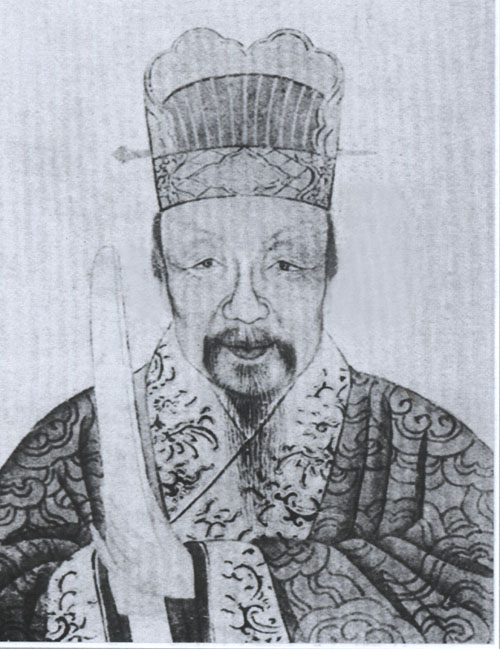
Life生平
Weng Wanda (1498–1552), courtesy name Renfu, style Dongya, was a Jieyang man whose native place falls in what is now the Tuopu area of Jinping district, Shantou. He came from a poor household and passed the examination in 1526, the fifth year of the Jiajing reign. He served as prefect of Wuzhou in Guangxi, as provincial administration commissioner and then governor in Shaanxi, as Governor of Xuan-Da, and as Minister of War.
Two things he did兩件事
In the south he had a hand in the handling of the disturbances in Annam. In the north he commanded the frontier against the raids of the Mongol leader Altan Khan. In five or six years of frontier command he built more than eight hundred li of wall and over three hundred beacon towers between Datong and Xuanfu, and the border settled. These two are the substance of his record, and the ground on which the Ming History gives him a biography.
Reputation評價
The Jiajing emperor called him ‘the first minister south of the ranges’. Zhang Juzheng, summing up the frontier ministers of that reign, wrote that one bends a finger to none but him. The Ming History says: among the frontier ministers of the Jiajing period, the one whose conduct fitted the occasion and whose proposals hit the mark was Wanda, first of all.
His posthumous name is given as either Xiangmin or Xiangyi; gazetteers and biographies do not agree.
Writings著作
What survives is the Dongya Collection, the Ji Qian Collection and the Ji Qian Poems, with the Memorials of the Governor-General and the Memorial on the Defence of the Three Garrisons known from catalogue entries. A modern edition, the Collected Works of Weng Wanda, has been compiled.
He is named with Lin Daqin and Chen Beike as the three outstanding men of Chaoshan, and since the three styled themselves Dongpu, Dongya and Dongshi, also as the three Dongs. The grouping is a later joint honour and appears in no document of the time; when it is cited, that has to be said.
Sources來源
The biography of Weng Wanda in the Ming History; local historical material; dictionary entries under the three outstanding men of Chaoshan.
Last revised: 5 November 2026
 粤公网安备44522102000407号