Lin Daqin
Lin Daqin is the only civil examination top graduate that Chaoshan itself trained. He came first in the palace examination of 1532, was appointed compiler of the Hanlin Academy, and died at thirty-four. The stories told about him have travelled far further than the office he held.
Life生平
Lin Daqin (1511–1545), courtesy name Jingfu, style Dongpu, was from Shandou village in Dongpu du, Haiyang — today Xiandu village in Jinshi town, Chao’an district, Chaozhou. The family was poor and he was a quick, hungry student. In 1532, the eleventh year of the Jiajing reign, he took first place in the palace examination and by rule was appointed compiler of the Hanlin Academy at the sixth rank, the one post a fresh graduate could hold at that grade; the office drafted edicts and compiled history, which is why he is also called the Dongpu historian.
That sitting is now nearly five hundred years back. He was not yet twenty-one when he came first, which in the long record of the Chinese examinations is a rare age for the top place.
The palace examination essay廷試策
The policy answer he wrote in the palace hall runs to more than four thousand five hundred characters. It names the abuses of the day, works out how they arose, sets out eight measures for clearing them, and asks the emperor to keep himself ‘empty and of few desires’ so that ‘the people may have enough to eat and wear’. The essay drew the Jiajing emperor’s notice for its pace and held readers by striking at the problems of the moment. It is the hardest piece of prose Lin left behind, and the key text for judging what he thought.
Writings and what stands著作與遺蹟
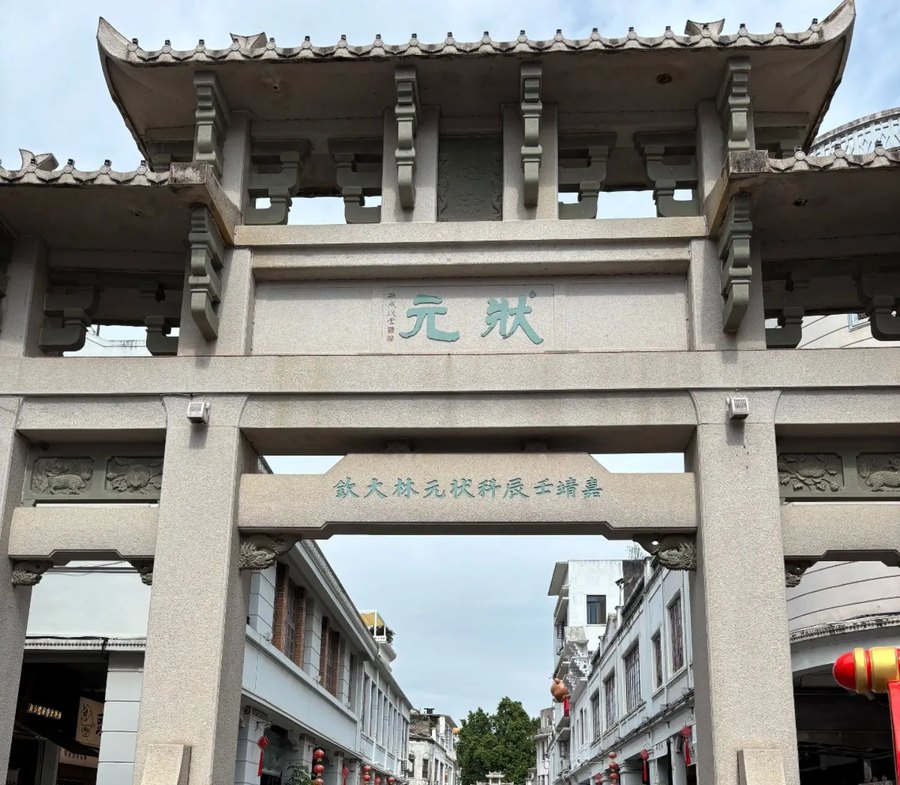
Later hands gathered his prose into the Collected Works of Mr Dongpu. The Zhuangyuan arch on Paifang Street in Chaozhou was put up in the Jiajing period, the same two characters carved on both faces. The beam that carries the upper storey of this arch is one whole block of stone, unlike every other arch on the street, and is read as ‘the timber of the state’ — the phrase for a man fit to bear the country’s weight.
Legend and record, kept apart傳說與史實要分開
The stories about Lin are many: his first teacher Ye Zhen testing him with couplets — ‘a bamboo frame fills the garden, how is it to become a great forest’ answered by ‘the plum leads the flowers, when did it ever come from Mr Ye’; ‘this wood is firewood, hill on hill out’; ‘white water is a spring, evening on evening more’; outwitting Weng Wanda; reciting a poem to beg a night’s lodging; a trick that saved Guangdong. Everyone in the region knows them.
They are legend. They may be written down, but they have to be labelled. The test is simple: examination year, office and year of death can be checked in the Ming History and the prefectural gazetteer; the couplet contests and the clever tricks first appear in later notebooks and in speech, with nothing written at the time. Keep the two in separate columns, and do not use legend to fill a hole in the record.
The tomb at Zhuangyuanpu墓:桑浦山狀元埔
The grave lies at Zhuangyuanpu on Sangpu hill, in the third village of Xiandu, Jinshi town, Chao’an district, set on a north-east to south-west axis. It was built after 1545 and is a standard Ming official’s tomb. In 1987 it was listed by Chaozhou city as a protected site; in October 2012 it entered the seventh batch of Guangdong provincial protected sites.
The precinct is sixty metres across and 133.4 metres long, 8,004 square metres in all. A granite stele pavilion about three metres high stands over the grave, double-eaved with a hip-and-gable roof; the ceiling inside is carved with the eight trigrams and the taiji, and the board across the front reads ‘A fine resting place at Dongpu’. The face of the stele reads ‘Lin of Dongpu, top graduate by imperial grant and compiler of the Hanlin Academy, tomb of the Ming’, with small characters at the lower right: ‘his son Tianji set this stone, weeping blood’.
In 2016 the flanking stones, the pavilion, the offering platform and the steps of the tomb path were restored to the conservation plan, and a caretaker’s building put up. The Lin descendants of Xiandu still hold a public offering at Qingming and on the anniversary of his death.
Sources來源
Notes on the arches of Paifang Street, Chaozhou, for the Zhuangyuan arch; Xuexi Qiangguo, ‘Guangdong: Chaozhou’s old paifang street’; local historical compilations.
Last revised: 5 November 2026
 粤公网安备44522102000407号