Home › Intangible heritage › Yingge dance › When it is danced
Yingge · When it is danced
The dates in a year, a team’s own year, and who organises a performance.
Header texture: photo by H2v5o68z, CC0
When it is danced
Traditional Yingge appears mostly at festivals and in god parades: at the Spring Festival, at the Lantern Festival rites for the local gods, at temple processions, Mazu cultural festivals and folk showcases, a team goes along. At bottom it is a ritual troupe rather than a stage company. The last twenty years have added something else: stage shows, exchanges abroad and commercial events use Yingge more and more, with different arrangements and different purposes; those occasions are recorded separately in Origins and disputes and are not mixed in with the village scenes. The god-parade calendar and the Lantern Festival rites linked above are in Chinese.
The dates in a year
Traditional occasions fall into three kinds — festivals, god parades and performances — and the actual dates follow each township’s and temple’s calendar. The 117 records below are indexed by report date — the day each video was posted, not necessarily the day of the performance; performance dates are marked separately where the source gives them. The appearances cluster at a few points.
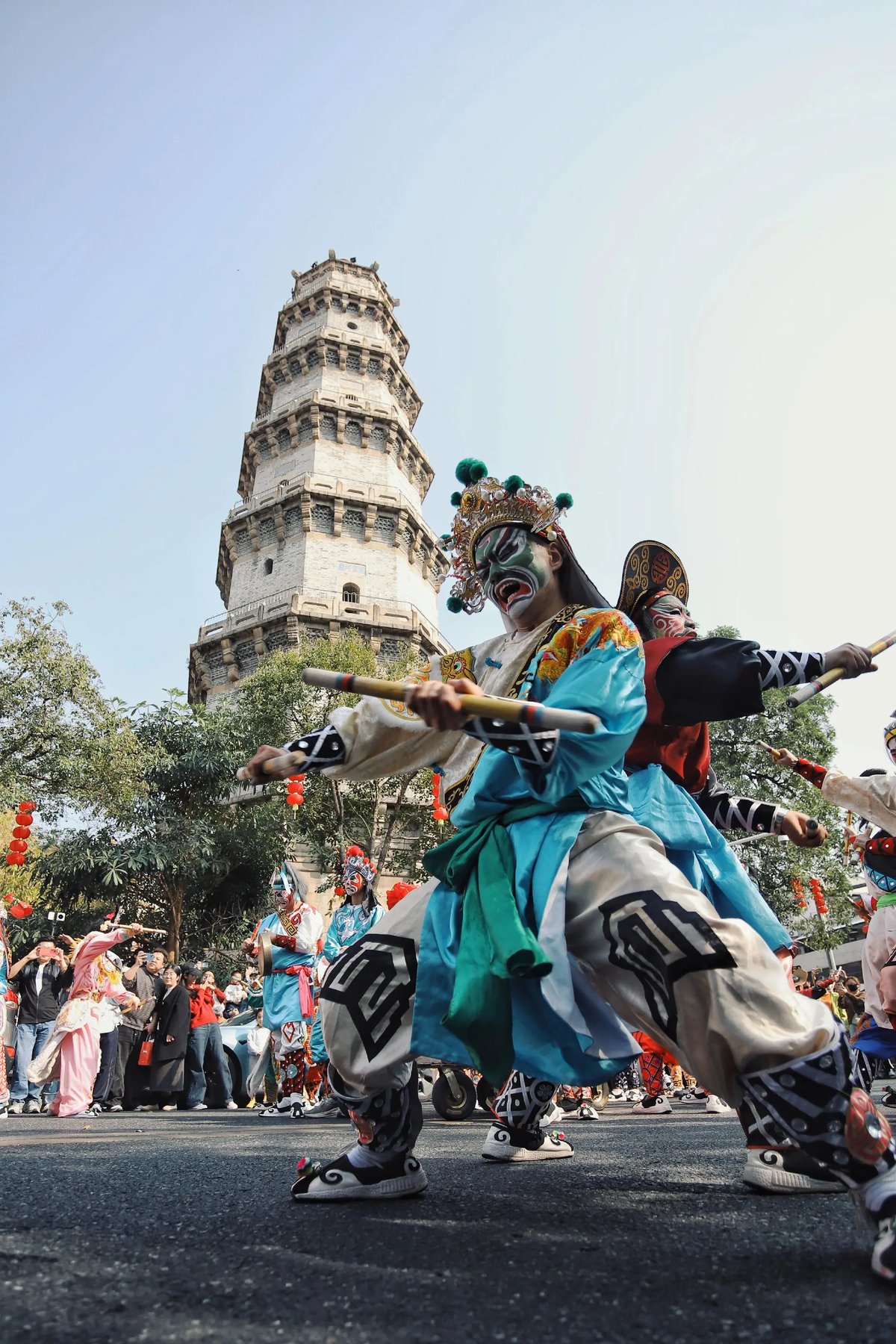
First day of the first lunar month, the Jin’ou township team’s New Year parade (2026-02-17).Second day of the first lunar month, the Puning Yingge culture festival, where the Fumei youth women’s group and the Nanshan women’s group appeared the same day (2026-02-18).During the first month, the Chaoyang Yingge carnival (2026-02-21).
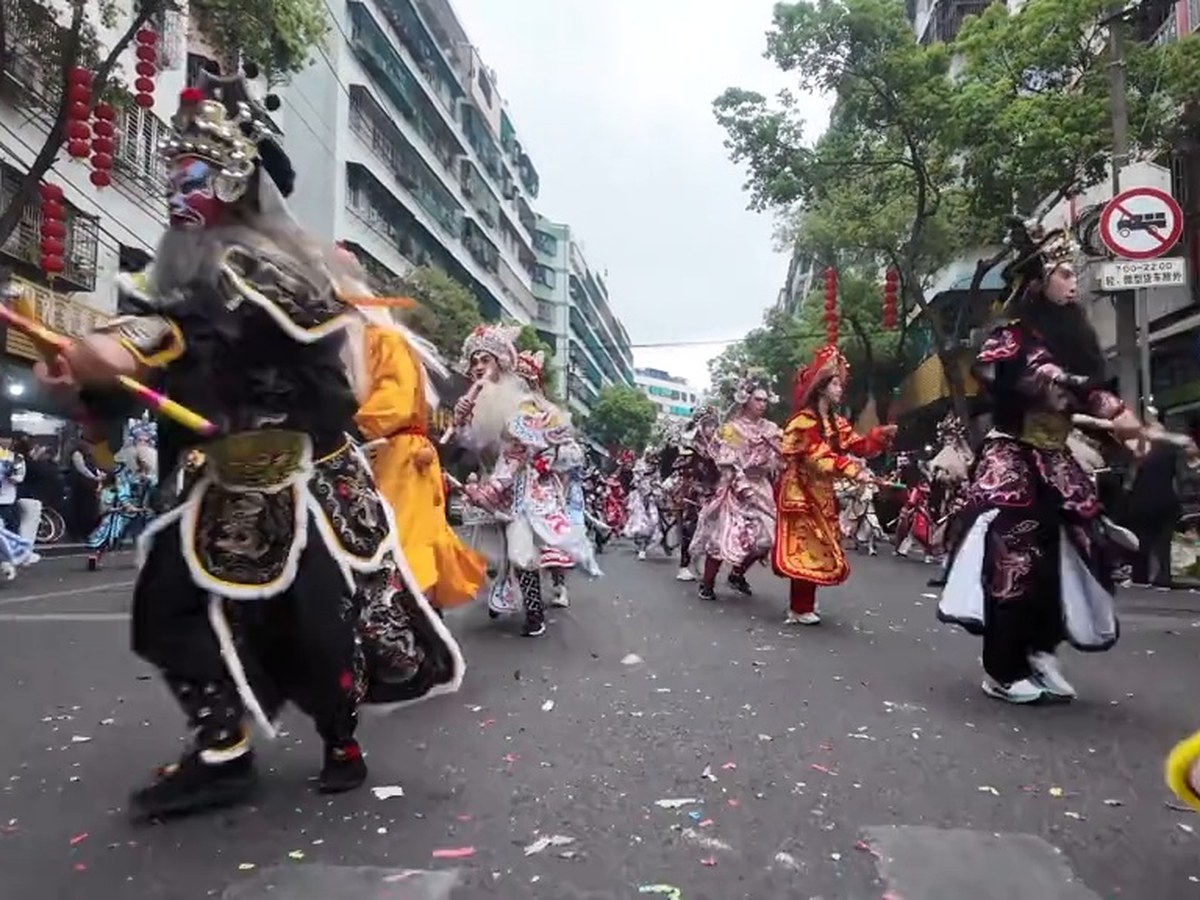
The second month belongs to the Shuangzhong Cultural Festival. The Guiyu Huamei women’s team played three days running, the 26th, 27th and 28th of the second lunar month (March 2025). The 13th edition, in 2026, fell on 28 March, the tenth of the second lunar month, when the Fenggang team made its stick offering.
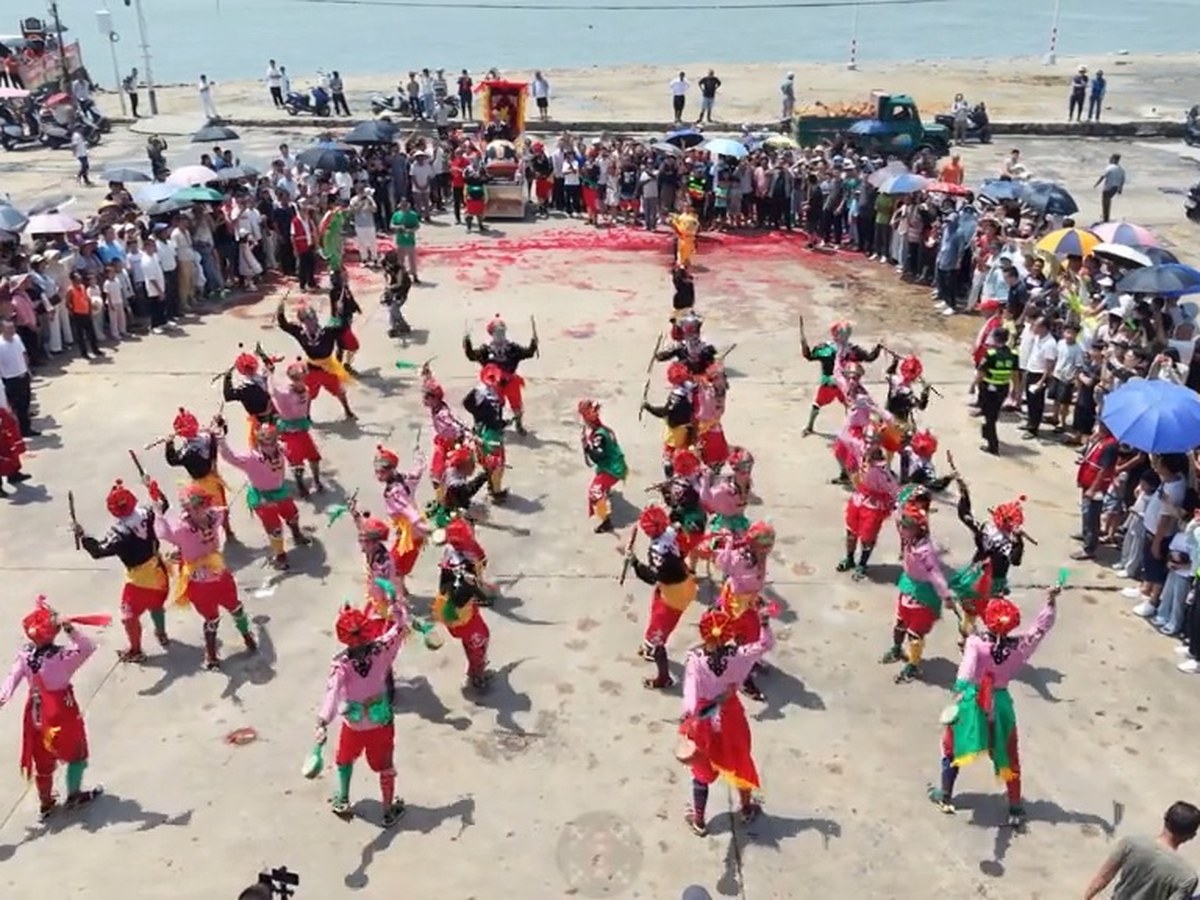
Mazu’s occasions are a separate account. The Huamei women’s team took the boat “Tianfei No. 3” to Meizhou Island on 2 May 2025; the Gurao team went to Meizhou Island in November 2025; and when Mazu went out at Liantan, Puning, the Pudou and Xinshunxing teams met on the road (2026-05-09).
Great rites, community sacrifices, thanks to the gods each have their own. At the 15th Baosheng Emperor rite at Jin’ou the team opened its drum in December 2025, the title reading “the three-year rite: call and we come” (2025-12-11). The Chen lineage sacrifice at Gurao Toupu (2025-11-28). The year-end thanks at Jiamie, Chengtian (2025-11-14). The consecration of “heaven and earth, father and mother” at Xiajia, Chengtian (2026-01-17).
These dates are the posting dates of the videos, not necessarily the day of the performance; a day or two out is common. To pin down one occasion you still have to ask someone in the team.
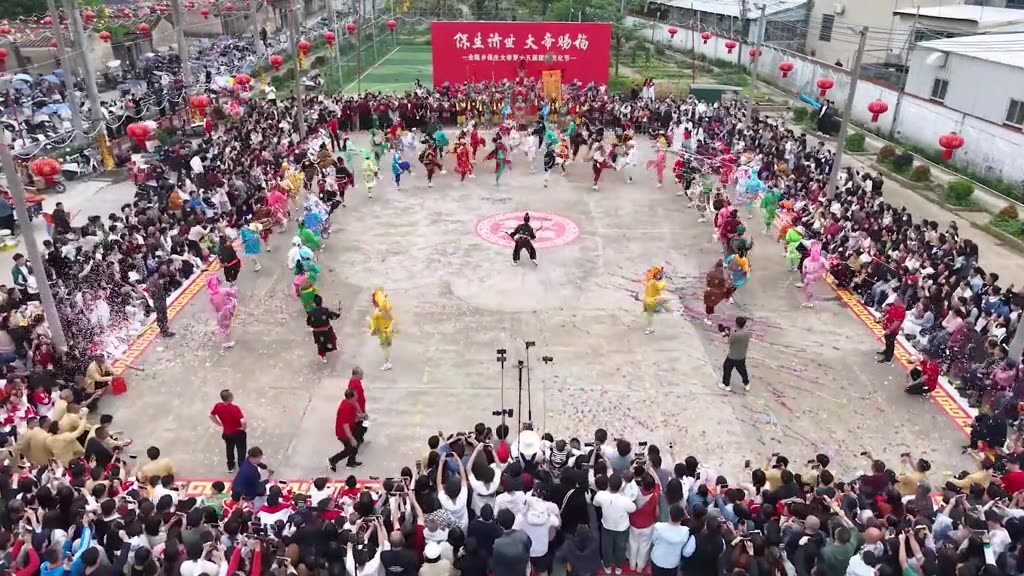
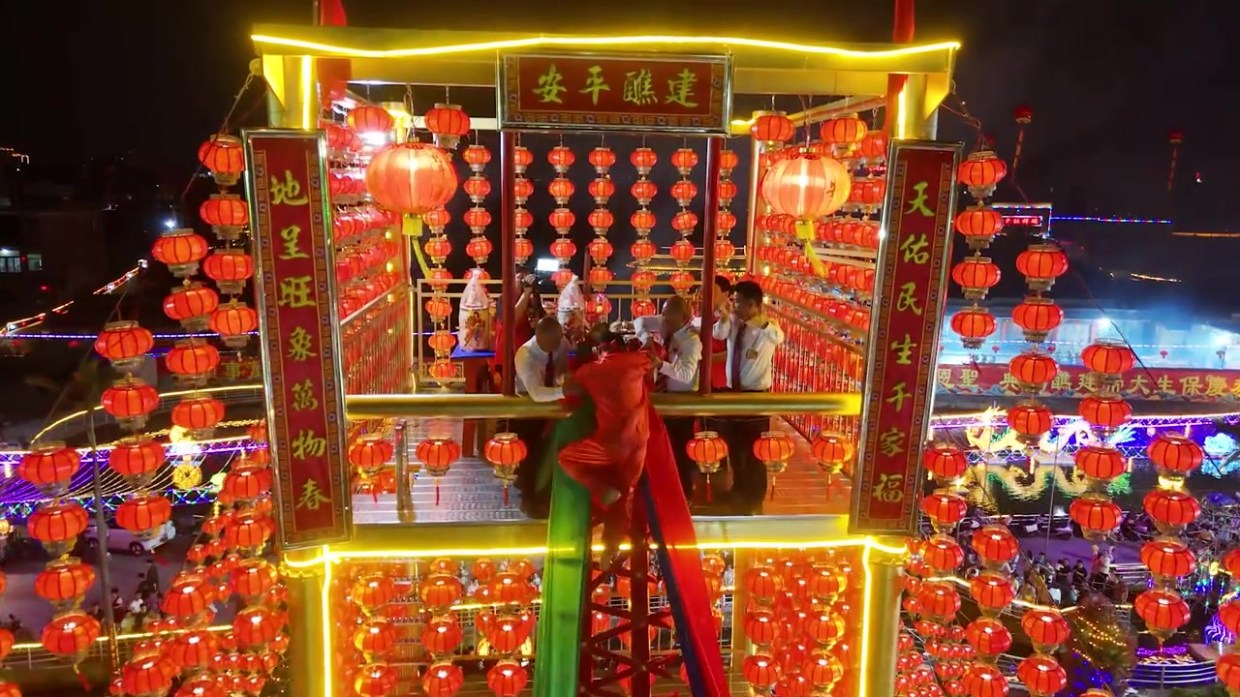
The ground of the rite is busier at night than by day. At Jin’ou a lantern tower stands in the middle: a wooden frame in tiers, red lanterns on every tier, a plaque at the front reading “peace to the rite” and a couplet on either side. Men stand at the railing of the platform in white shirts and red ties, a microphone in front of them. A green silk ribbon hangs from the top of the tower to the ground.
A team’s year: opening drum, street practice, full dress
Teams The table above records one day’s state. How a team moves through a year, these records can put in order.
- opening drum— the Jin’ou township team “formally opened the drum” on 18 December 2025 under the name “the 2026 cohort”; a week before, a title already read “the three-year rite: call and we come” (2025-12-11). The Gurao Beilin women’s team raised its drum on 7 October 2026 under the title “the bingwu year”.
- street practice— the Jin’ou township team’s “first street practice” on 26 January 2026; the Puning Longmen team practised on the street on 5 August 2025 and the title says “four hours”.
- Dress rehearsal— the Jin’ou township team’s “rehearsal of the dance and the rear section” on the night of 25 March 2026; the street practice two nights later carried a live-stream number in its title (2026-03-27).
- Full dress— the Jin’ou township team appeared “in full dress” on the 14th of the second lunar month (announced in a title on 2026-03-25); on 2 April a title read “setting out” and “full strength, 107”, and the next day “the full set at Beihe She” (2026-04-03).
Other teams do not necessarily take all these steps. The Puning Qiaozhu Jiudi women’s team formed on 14 August 2025, announced “the first street rehearsal on the 21st”, and by 5 October was performing before the Zhenzhu Niangniang temple; the Puning Qingyangshan team was founded on 13 August and announced the same day “full dress and out on the morning of the 22nd”.
Street practice happens on village lanes, with no line between crowd and team. For the Jin’ou practice on 27 March the title said “tonight at seven” and left a live-stream number; the rehearsal on the 25th was titled “remember to come and see the rear section tonight”. Such occasions are public, and they are also when the team drills its formations.
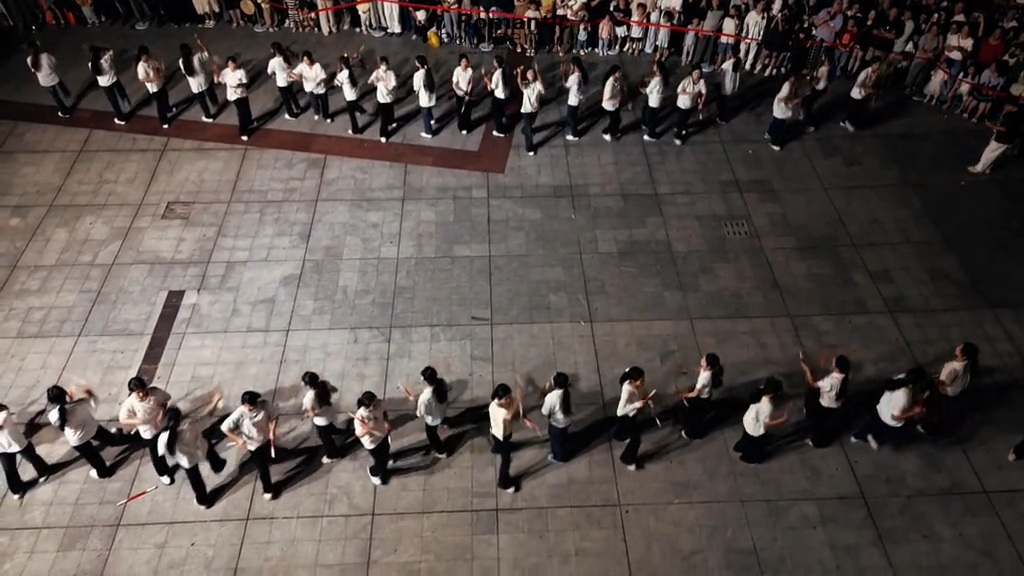
The order is only by the dates in the records. How long from the opening drum to full dress varies by team, and no record states a rule.
Who organises a performance: village and lineage, temple, engagement
Behind a performance three kinds of people come forward.
- The village and the lineage— forming the team and raising the drum are started by the village or the lineage. The Puning Qingyangshan team was “formally founded” on 13 August 2025; the Puning Qiaozhu Jiudi women’s team reappeared “after many years” the same August (2025-08-14); the Gurao Toupu team is named for the Chen lineage sacrifice (2025-11-28).
- The temple council— the Jin’ou township team was received by the council of the Ciji Hall of the god temple on 23 January 2026, the title recording a council member speaking to the team (2026-01-23).
- The party that hires— when the Zhenzhu Niangniang image went out at Fanggang, Tongyu, the Caowei team was hired to “guard the way”, the full set running about twenty minutes (2026-03-21); a Heping Xiagong team title calls itself “the vanguard that guards Mazu’s way” (2025-04-17).
The teaching is someone else again. The Chaoyang Taguan Ximen women’s team has a “head coach” (2025-08-10); a Caowei title @s the “chief coach” directly (2026-03-21); the Jin’ou township team’s director Chen Zhihong is called “red beard” in the team (2026-03-23).
On money, start with what is not there: for the price of a single performance there is no checkable figure in the public material.
Three kinds of support. Teams that mostly play in their own village are funded by the village council, local worthies and villagers; Laoxixi and the Guiyu Huamei women’s team are of this kind. The Jinpu Meihua team takes commercial bookings and neighbouring villages’ celebrations as well as village sponsorship. The Nanshan team, coached by a national-level inheritor, goes out as a full unit on invitation and uses the fees as development money, and for that reason takes part less in village god parades.
All three come to the same thing: the money covers training and performing at most, and most of the time the dancers are unpaid (Farmers’ Daily, 2023-06-06). A 2024 Xinhua report puts it more plainly: village councils, local worthies and villagers pay for costume, gear, food and travel, all of it to keep training and performing going; the dancers draw no wage and give their time for nothing. Chen Laifa says it himself: “Yingge dance is an amateur pursuit; there is no professional troupe, no fee for performing, and everyone does it out of love.” (Global Times, 2026-02-14)
The government side. Inheritors at national, provincial, municipal and district level each receive an annual subsidy. Zhuang Qingsheng, head of the Shantou ICH office, gave a figure in 2023: 5,000 yuan a year for a municipal-level inheritor. He added a further layer: at festivals the government invites teams to perform and does pay, but not much; if the costs of an invited team are high, the balance is its own problem.
When gear is short. When the Fengyixing team at Aotou, Dongfeng, Chao’an was forming it had no large gongs or cymbals and borrowed them; later members’ parents put in money, the Chen family temple council rallied local worthies and well-wishers, and people even helped water the practice ground and buy drinking water. The team’s coach, Chen Ziqi, says they changed the traditional seven strikes into a “twelve-road stick” to look better on stage (Chao’an district government website).
Do not mix three figures: the price of a single performance has no source; 5,000 yuan is Shantou’s 2023 subsidy to a municipal-level inheritor, not a dancer’s income; and funding structures differ by type of team and cannot be converted into one another.
← Previous page: Who dancesBack to the featureNext page: Teams →
| Sources | Type |
|---|---|
| Behind Yingge dance’s breakoutFarmers’ Daily (reprinted by China Economic Net)2023-06-06 | report |
| “Chinese New Year, a taste of the world”Global Times2026-02-14 | report |
| Lion dance and Yingge go viral: how folk sport became the new fashionXinhua (reprinted by People’s Daily Online)2024-02-16 | report |
| The Fengyixing team at Aotou, Dongfeng: transmission and innovation togetherChao’an District People’s Government, ChaozhouPage undated | Government website |
| Yingge (Puning Yingge)China Intangible Cultural Heritage Network / Digital Museum of China ICHNo publication date on the item page; announced in the first batch, 2006 | National list entry |
| Yingge (Chaoyang Yingge)Ibid.No publication date on the item page; announced in the first batch, 2006 | National list entry |
| Yingge (Jiazi Yingge)Ibid.No publication date on the item page; third batch, 2011 (extension item) | National list entry |
| Publication of the revised protection units for national ICH representative itemsDepartment of Intangible Cultural Heritage, Ministry of Culture and Tourism2019-12-05 | Ministry release |
| Puning Yingge DanceOffice of the Foreign Affairs Commission of the CPC Guangdong Provincial Committee (Foreign Affairs Office of the Guangdong Provincial People’s Government)2026-07-24(https certificate error; this link runs on http) | Government website introduction |
| Reply to Proposal No. 20250334 of the Fourth Session of the 14th Shantou CPPCCOffice of the Chaoyang District People’s Government, Shantou2025-05-14(https certificate error; this link runs on http) | Government information disclosure |
| Ximen Women’s Yingge Team, ChaoyangShantou Polytechnic, “Yingge dance” feature2025-03-06 | College feature |
| “Once in a lifetime, you must see Yingge dance in Chaoshan!”China News Service2024-02-28 | report |
Access date: all eight items above were opened one by one on 23 October 2026 and were reachable that day. Two further team counts sit outside the table for want of a stable direct link: the Chaoyang team count in Southern.com, November 2024, and the Puning team count on the Puning municipal government site, January 2024; both are named in the text. The figures they record can be checked against two government documents already in the table (the Chaoyang district government reply of May 2025 and the provincial foreign affairs office’s July 2026 note on a visit), so the two notes stand side by side, without arguing from the unlinked items alone.
Two further pieces were read but not cited and so are not listed: the National Ethnic Affairs Commission’s “Dance drama Yingge: where the sticks rise, one family” (2026-08) and the Guangdong Department of Housing and Urban-Rural Development’s “Light and shadow on the hometown of emigrants”.
Last revised: 25 October 2026